Bovine AI: Alberta cattle rancher says technology helps save time and money
Advertisement
Read this article for free:
or
Already have an account? Log in here »
To continue reading, please subscribe:

Digital Subscription
One year of digital access for only $205*
- Enjoy unlimited reading on winnipegfreepress.com
- Read the E-Edition, our digital replica newspaper
- Access News Break, our award-winning app
- Play interactive puzzles
*First annual payment billed as $205.00 + GST for one year. This annual subscription will automatically renew at $233.00 + GST every 52 weeks (10% off the regular annual price of $259.35). Offer available to new and qualified returning subscribers only. Cancel any time.
To continue reading, please subscribe:
Add Free Press access to your Brandon Sun subscription for only an additional
$1 for the first 4 weeks*
- Enjoy unlimited reading on winnipegfreepress.com
- Read the E-Edition, our digital replica newspaper
- Access News Break, our award-winning app
- Play interactive puzzles
*Your next Brandon Sun subscription payment will increase by $1.00 and you will be charged $17.95 plus GST for four weeks. After four weeks, your payment will increase to $24.95 plus GST every four weeks.
Read unlimited articles for free today:
or
Already have an account? Log in here »
Hey there, time traveller!
This article was published 26/12/2023 (995 days ago), so information in it may no longer be current.
EDMONTON – Ashley Perepelkin says she was born and raised a city girl, never thinking she’d sell fresh beef from cattle she raised on her own Alberta farm with the help of artificial intelligence.
“I met a boy, and this boy happened to be a farmer,” she says.
Perepelkin, who spent most of her life in Red Deer, Alta., says she and her now-husband Andrew met in 2010, got married and began farming grain together.
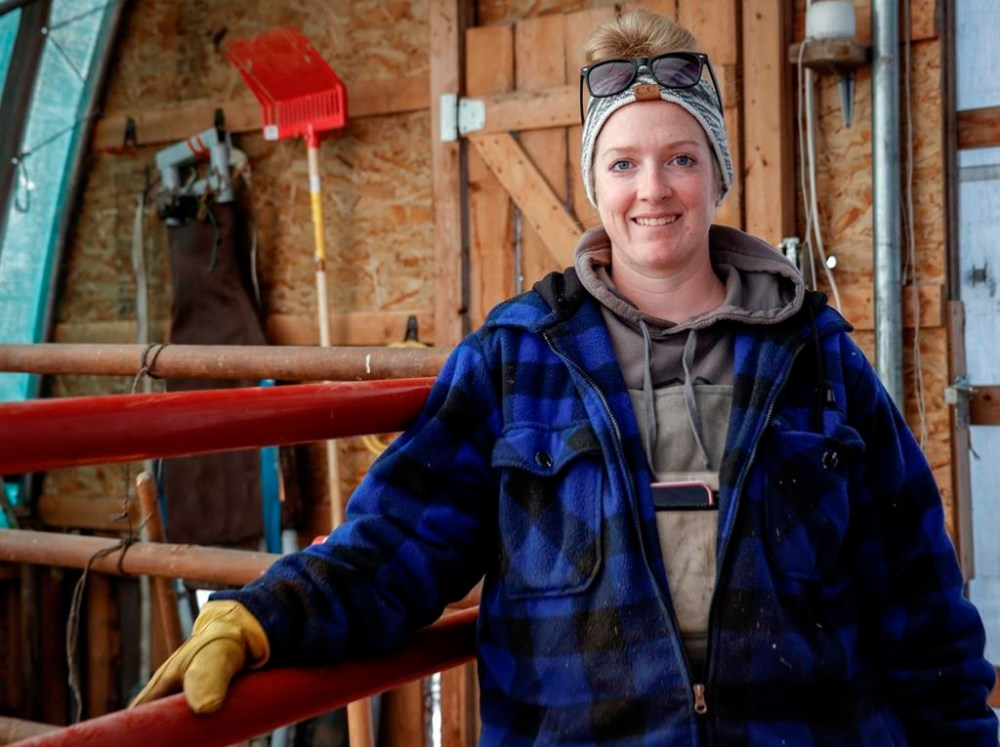
When she decided to get cattle, it was a steep learning curve.
“A lot of things were learned, unfortunately, through trial and error,” she says.
Perepelkin says she enrolled in a continuing education course through Olds College of Agriculture and Technology in Olds, Alta. That’s when she saw a video about what AI could do for farmers, and became excited.
“Employees are expensive, especially … when you don’t exactly know what you’re looking for at the beginning,” she says.
“It’s hard to train somebody.”
The Perepelkins can monitor their cattle’s health, activity, nutrition and growth though cameras, thanks to facial recognition technology for animals called 360 Live ID, a platform developed by a startup called OneCup AI.
OneCup AI is the creator of Bovine Expert Tracking and Surveillance, or BETSY. CEO Mokah Shmigelsky says the technology has been on the market since 2022, and there are now 140 setups across Canada.
“So far our producers have been very excited about our system, and offering consistent feedback so that we can improve their user experience,” she says.
Shmigelsky, who grew up near Calgary, says her extended family has been involved in ranching and farming for a long time.
She says the idea for BETSY came about when she and her husband were sitting around a campfire at a family reunion in Saskatchewan, discussing the “pain points” in the cattle industry.
She says a cousin talked about wanting to identify cows without having to use tags and asked if it could be done using computers and cameras.
Shmigelsky’s husband, Geoff, who she says is the brains behind OneCup AI, responded that identifying cattle using AI would be no problem. That’s when they developed the system and tested it on their relatives’ cattle.
“When BETSY sees an animal that’s calving, she’ll send a text message to the producer,” she says.
Perepelkin says her herd of 100 don’t start calving until January or February. She brings the animals into a closer pen around the end of December.
“At that point, (the cameras) will visually see their bedding packs, where I put straw out for the cows to sleep.”
Perepelkin says a maternity pen is equipped with another BETSY camera that oversees its entire area.
She says instead of getting up every three or four hours in the evening to check if her cows are calving, she receives text messages, and can view the cameras through her phone or computer. The cameras watch for signs such as contractions to determine if a cow is about to give birth.
Perepelkin says BETSY can distinguish between two cows having babies side-by-side.
“If the cows did switch babies, we can switch them back and rectify the problem.”
In November, BETSY won OneCup AI the business of the year honour at the Animal AgTech Awards at the Canadian Western Agribition in Regina.
Perepelkin says a lot of what farmers and ranchers do comes down to experience and time.
“As everybody knows, time costs money, right?”
Perepelkin says she knew her farm could be better if she only had an extra set of hands when calving out cows and detecting if one is injured or sick.
“It’s a little hard to explain if you’re not familiar yourself with cows and how they show some signs and symptoms of things.”
Perepelkin says cows make a certain shape to their tail when they are contracting, but it’s similar to when they’re urinating or defecating.
“That has probably been the hardest jump for (OneCup AI) to get past, is to identify the difference from to the other,” she says.
Shmigelsky says dairy farmers are not only interested in calving alerts, but alerts when cows are in heat and are ready to breed.
“You want to get those animals bred in an optimal window, essentially.”
She says there should be enough camera coverage for where the animals are located, and that most places have four to six cameras depending on how many animals and pens they own.
Perepelkin says she also started selling meat right from the “farm to table” about five years ago.

“It absolutely blew the grocery store out of the park,” she says.
She says she began providing meat to her urban friends and relatives.
“Growing up in the city, they never got to experience the farm-fresh beef.”
The business has expanded into pepperoni, ground beef, smokies, sausages, steaks and roasts, and the Perepelkins hope to make a storefront on their property someday soon.
This report by The Canadian Press was first published Dec. 26, 2023.