Study maps mammoth’s 1,000-km trek, suggests species coexisted with humans in Alaska
Advertisement
Read this article for free:
or
Already have an account? Log in here »
To continue reading, please subscribe:

Digital Subscription
One year of digital access for only $205*
- Enjoy unlimited reading on winnipegfreepress.com
- Read the E-Edition, our digital replica newspaper
- Access News Break, our award-winning app
- Play interactive puzzles
*First annual payment billed as $205.00 + GST for one year. This annual subscription will automatically renew at $233.00 + GST every 52 weeks (10% off the regular annual price of $259.35). Offer available to new and qualified returning subscribers only. Cancel any time.
To continue reading, please subscribe:
Add Free Press access to your Brandon Sun subscription for only an additional
$1 for the first 4 weeks*
- Enjoy unlimited reading on winnipegfreepress.com
- Read the E-Edition, our digital replica newspaper
- Access News Break, our award-winning app
- Play interactive puzzles
*Your next Brandon Sun subscription payment will increase by $1.00 and you will be charged $17.95 plus GST for four weeks. After four weeks, your payment will increase to $24.95 plus GST every four weeks.
Read unlimited articles for free today:
or
Already have an account? Log in here »
Hey there, time traveller!
This article was published 17/01/2024 (977 days ago), so information in it may no longer be current.
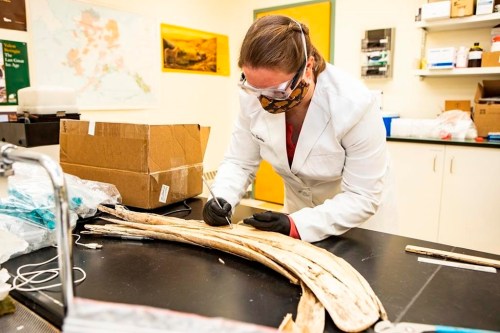
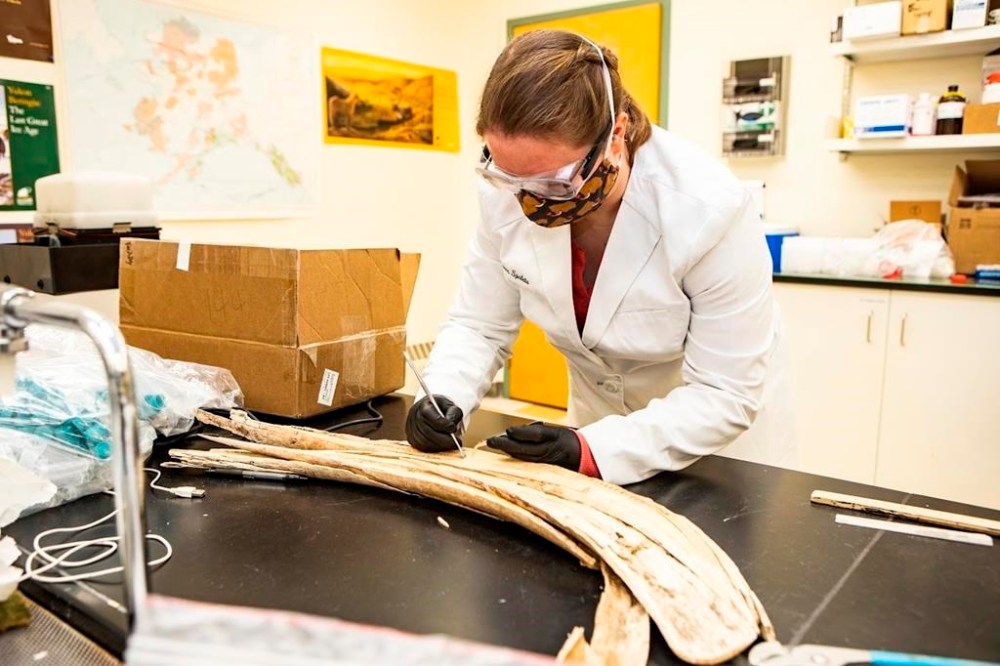
A new study traces the 1,000-kilometre journey of a woolly mammoth from western Yukon to the interior of Alaska, where she died about 14,000 years ago, seemingly in the prime of her life, near a hunting camp for some of the region’s earliest humans.
Analysis of the mammoth’s tusk has unlocked insights into the iconic Ice Age species, with the research suggesting they “coexisted” for at least 1,000 years with some of the first people to cross the Bering land bridge into North America.
The tusk belonged to a female mammoth that was about 20 years old when she died, in the “prime of early adulthood,” says the research published Wednesday in the peer-reviewed journal Science Advances.
The study stops short of concluding the mammoth was killed by hunters near Alaska’s earliest-known archeological site dating back about 14,000 years.
But that was the likely scenario, says an Ontario-based researcher who led the team that performed genomic sequencing of eight woolly mammoths found at the Swan Point site.
Hendrik Poinar says evidence of mammoth hunting in Alaska is more “subtle” than in Siberia, where spear points have been found “still stuck into bones.”
There is “no direct evidence” to verify that people were actively hunting mammoths in Alaska, such as embedded weaponry or a clear “kill site,” the study says.
Yet why did an apparently healthy mammoth, whose tusk showed no signs of nutritional stress, die near a seasonal hunting camp for the area’s early residents?
“I think the most parsimonious answer is she was hunted,” says Poinar, director of the Ancient DNA Centre at McMaster University.
The mammoth has been named Élmayuujey’eh by the village council for Healy Lake, or Mendas Cha-ag in the Tanacross language.
Poinar calls her “Elma.” The mammoth would have stood at least three metres tall, with shaggy brown fur, a sloped back, a heavy pair of tusks and large feet adapted to withstand temperatures as low as -40 C, he says.
“I personally don’t like to think of her being hunted,” Poinar adds.
“But then again, I wasn’t trying to supply food for the survival of my family 14,000 years ago in a very open and barren landscape.”
The new study says the site where Elma’s tusk was found contained a “stone tool kit” with weapon technology that is “essentially identical” to the “microblades” and projectile points from Siberia, where mammoth hunting has been documented.
The presence of rib fragments from a newborn mammoth also suggests residents of Swan Point probably hunted the animals, at least when they were young, it says.
Poinar says the existence of good datawas key to tracing Elma’s likely route from what is now Yukon to Alaska, a journey that took her more than two years.
Researchers at the University of Alaska Fairbanks examined isotopes contained in her tusk and compared them with levels across the landscape at the time, he says.
“The maps are getting increasingly good, and when you have very clear delineation of those (isotope) ratios … you can get a remarkably well-resolved route,” says Poinar, adding he “didn’t even know this was feasible five years ago.”
“I was blown away by Matt’s work,” he says ofMatthew Wooller, director of the Alaska Stable Isotope Facility at the university.
The research found humans and mammoths coexisted for at least a millennium in the region, based on overlap between the earliest archeological sites and latest mammoth specimens.
That’s longer than previously thought, Poinar says, noting theaccuracy of technology used for radiocarbon dating has improved in recent years.
“Before, it looked like the mammoths were there in that locality and then humans arrived,” he says of the Alaska site. “Now, with this high-resolution data and additional archeological data … it’s quite clear that these are synchronous in time.”
Poinar says the study represents “the most important direct association of humans hunting mammoths” at the earliest archeological site north of the ice sheets that stretched across almost all of Canada and into parts of the United States.
After Elma died, the study says her tusk likely served multiple functions for humans, including as an anvil and a source of ivory fragments for further modification.

There are several other camps in close proximity to the Swan Point site, it notes.
The study concludes it’s likely that people intentionally followed the “mobile, but highly visible” mammoth populations as a source of food and materials for tools.
“I think it’s important to point out that these animals provided a huge amount of (protein) for people that were living in those landscapes,” Poinar says.
“You don’t kill a 20-year-old megatonne mammoth and just let it go to waste,” he adds. “You have all sorts of clever ways of maintaining that food source for as long as you possibly can.”
This report by The Canadian Press was first published Jan. 17, 2024.