How To Tech: Why it’s important to turn on Apple’s new Stolen Device Protection

Advertisement

Advertise with us

LONDON (AP) — You’re in a crowded bar when a thief watches you unlock your iPhone with your passcode, then swipes it. That sinking feeling hits when you realize it's gone, along with priceless photos, important files, passwords on banking apps and other vital parts of your digital life.

Read this article for free:


or

Already have an account? Log in here »

To continue reading, please subscribe:

Subscribe and receive a limited-edition Free Press branded hat or tote.

Digital Subscription

One year of digital access for only $205*

  • Enjoy unlimited reading on winnipegfreepress.com
  • Read the E-Edition, our digital replica newspaper
  • Access News Break, our award-winning app
  • Play interactive puzzles

*First annual payment billed as $205.00 + GST for one year. This annual subscription will automatically renew at $233.00 + GST every 52 weeks (10% off the regular annual price of $259.35). Offer available to new and qualified returning subscribers only. Cancel any time.

To continue reading, please subscribe:

Add Free Press access to your Brandon Sun subscription for only an additional

$1 for the first 4 weeks*

  • Enjoy unlimited reading on winnipegfreepress.com
  • Read the E-Edition, our digital replica newspaper
  • Access News Break, our award-winning app
  • Play interactive puzzles
Start now

*Your next Brandon Sun subscription payment will increase by $1.00 and you will be charged $17.95 plus GST for four weeks. After four weeks, your payment will increase to $24.95 plus GST every four weeks.

Hey there, time traveller!
This article was published 25/01/2024 (939 days ago), so information in it may no longer be current.

LONDON (AP) — You’re in a crowded bar when a thief watches you unlock your iPhone with your passcode, then swipes it. That sinking feeling hits when you realize it’s gone, along with priceless photos, important files, passwords on banking apps and other vital parts of your digital life.

Apple rolled out an update to its iOS operating system this week with a feature called Stolen Device Protection that makes it a lot harder for phone thieves to access key functions and settings. Users are being urged to turn it on immediately.

Here’s how to activate the new security option and why it’s so important:
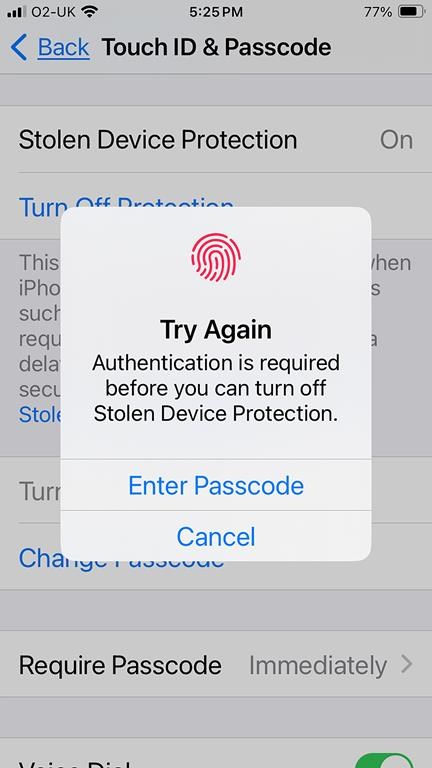
This screenshot shows the prompt requiring a fingerprint to turn off the Stolen Device Protection feature on iPhones. Apple rolled out an update to its iOS operating system this week that makes it a lot harder for phone thieves to access key functions and settings. (AP Photo)

SHOULD I TURN ON STOLEN DEVICE PROTECTION?

The software update for iPhones and iPads includes the essential new feature designed to foil thieves from wiping phones for resale or accessing Apple ID or other important accounts. Stolen Device Protection is a new setting that’s included with the latest iOS release, version 17.3.

Apple says the feature, buried in your iPhone’s settings, adds an extra layer of security for users. It addresses a vulnerability that thieves have discovered and exploited: allowing them to lock victims out of their Apple accounts, delete their photos and other files from their iCloud accounts and empty their bank accounts by accessing passwords kept in the Keychain password manager.

Apple is introducing the feature as anecdotal evidence suggests phone thefts are surging. Stories of stolen phones abound on Reddit groups and in news articles in places from Los Angeles to London, where police say pickpocketing, “table surfing” and moped snatching are common tactics.

The Wall Street Journal reported last year how criminals watched people use their passcodes to gain access to their personal information after stealing their phones.

HOW DOES STOLEN DEVICE PROTECTION WORK?

Stolen Device Protection keeps track of a user’s “familiar locations,” such as their home or workplace, and adds extra biometric security hoops to jump through if someone tries to use the device to do certain things when it’s away from those places.

It also reduces the importance of passcodes, which thieves can steal by peering over someone’s shoulder or threatening and forcing victims to hand them over, in favor of “biometric” features such as faces or fingerprints that are a lot harder to duplicate.

Let’s say the bar thief that snatched your iPhone tries to erase its contents and settings to sell it. With Stolen Device Protection turned on, the phone will now require a Face ID or Touch ID scan to verify that person is the rightful owner.

And that’s the only way — the new feature doesn’t let someone use the passcode or any other backup method.

Other actions that will trigger this feature if it’s not at a familiar place include using passwords saved in Keychain or payment methods saved in Safari, turning off Lost Mode, applying for a new Apple Card or using the iPhone to set up a new device.

There’s also a second layer designed to slow down thieves trying to access critical security settings. If someone tries to, say, sign out of an Apple ID account, change the passcode or reset the phone while it’s in an unfamiliar location, they’ll have to authenticate using Face ID or Touch ID, wait an hour, then do a second facial or fingerprint scan.
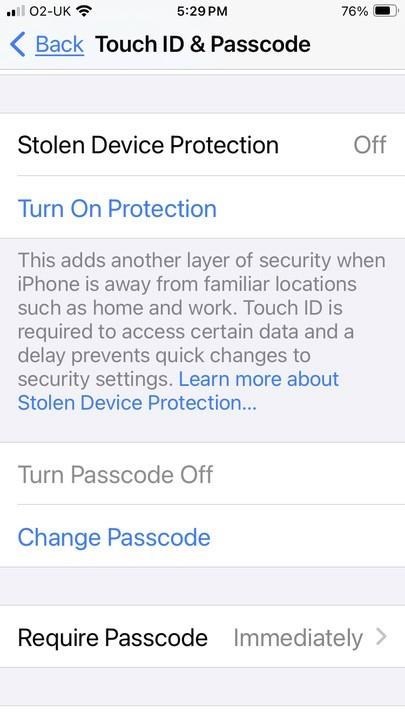
This undated screenshot shows the location of the new iPhone Stolen Device Protection setting on iPhones. Apple rolled out an update to its iOS operating system this week that makes it a lot harder for phone thieves to access key functions and settings. (AP Photo)

Changing an Apple ID password, updating Apple ID security settings, adding or removing Face or Touch ID, and turning off the Find My device feature or Stolen Device Protection also will trigger this feature.

“The security delay is designed to prevent a thief from performing critical operations so that you can mark your device as lost and make sure your Apple account is secure,” the company said. “When your iPhone is in a familiar location, these additional steps will not be required and you can use your device passcode like normal.”

HOW DO I ACTIVATE STOLEN DEVICE PROTECTION?

It’s simple — if you know where to look.

First, download and update your iPhone or iPad with the latest iOS update. Then go to your settings, scroll down to “Face ID & Passcode” or “Touch ID & Passcode” and enter your passcode. Scroll down and you’ll see Stolen Device Protection.

Depending on your iPhone model, you’ll need to tap or toggle to turn it on or off. Make sure you’ve first activated two-factor authentication and Find My device for your Apple ID account, or it won’t show up.

WHAT DEVICES DOES IT APPLY TO?

IPhone XS and newer models, including second- and third-generation SE models.

Report Error Submit a Tip

More Stories

Man pleads guilty to shotgun slaying

Erik Pindera 5 minute read Preview

Man pleads guilty to shotgun slaying

Erik Pindera 5 minute read Yesterday at 2:01 AM CDT

A Winnipeg drug dealer has pleaded guilty to second-degree murder in a March 2025 killing that saw the body of a 30-year-old man dumped in a garbage bin and dragged to a West End alleyway.

Frederick Francis Mathias Baker, who was 28 upon his arrest early last year, shot Bronson Emery Dale Kequahtooway once in the thigh with a sawed-off shotgun and left him with a fatal wound, Crown prosecutor Matt Armstrong told Court of King’s Bench Justice Brian Bowman on Wednesday.

A split second after Baker shot Kequahtooway in the thigh, the victim was shot in the head with a sawed-off .22 rifle. The man accused of being armed with the rifle, Eric Matthew Morrissette, remains before the court on a second-degree murder charge.

“Either wound would have been fatal on its own,” said Armstrong.

Read
Yesterday at 2:01 AM CDT

Chronic blame game festers

Tom Brodbeck 5 minute read Preview

Chronic blame game festers

Tom Brodbeck 5 minute read 6:00 AM CDT

Health Minister Uzoma Asagwara doesn’t mince words when describing how bad things are in the province’s emergency departments and urgent-care centres.

“The wait times that we are seeing in Manitoba are unacceptable,” said Asagwara in an interview with the Free Press. “I hear from families, I hear from providers, I hear from Manitobans who are concerned about the wait times that they’re seeing, that they’re experiencing, and those concerns are valid — I share those concerns.”

So what is the NDP, who promised voters nearly three years ago it had the answers to bring down wait times, doing about it?

A lot, according to Asagwara, who has been the province’s health minister since the NDP was sworn into office in October 2023.

Read
6:00 AM CDT

Low-income residents of 114-year-old downtown block staggered by proposed rent hikes

Malak Abas 9 minute read Preview

Low-income residents of 114-year-old downtown block staggered by proposed rent hikes

Malak Abas 9 minute read Updated: Yesterday at 11:27 AM CDT

Marcel Blanchette’s life has not travelled down a smooth road.

In 2014, he was violently assaulted in his home, an unprovoked attack that left him with severe injuries, including permanent brain damage. He underwent months of hospitalization and rehabilitation. During that time, he learned his possessions had been sold off when the Office of The Public Guardian and Trustee took over his affairs.

Twelve years later, he finds himself in another fight. This time, it comes in the form of a proposal from the new owners of the Conway Court apartment block that would nearly double his monthly rent. While he’s been able to live in the Kennedy Street unit with the support of disability income assistance for nearly five years, the sudden spike, he said, could leave him homeless.

“To go through that, and now I’m going through this, it’s another obstacle,” Blanchette told the Free Press. “I fought the Public Guardian and Trustee, and I’ll fight this too, with whatever I have.”

Read
Updated: Yesterday at 11:27 AM CDT

Manitoba premier open to lifting U.S. booze ban but hopes Canadians won’t buy it

Ian Bickis, The Canadian Press 4 minute read Preview

Manitoba premier open to lifting U.S. booze ban but hopes Canadians won’t buy it

Ian Bickis, The Canadian Press 4 minute read Updated: Yesterday at 5:13 PM CDT

WINNIPEG - Manitoba's premier says he is reluctantly open to returning U.S. booze to provincial shelves as part of a trade deal, but hopes Canadians won't buy it.

Wab Kinew said Thursday he's still waiting for key details, including what the final tariff rates will be, before making any commitments. 

He said Prime Minister Mark Carney has all but begged the provinces to agree to allow U.S. alcohol sales, as Canada and the United States work to finalize a new trade deal to ward off further punishing tariffs on Canadian goods.

While he hasn't agreed to it yet, Kinew said if the province does agree, he hopes Canadians still buy locally.

Read
Updated: Yesterday at 5:13 PM CDT

Time for a stronger all-Canadian grid

Editorial 4 minute read Preview

Time for a stronger all-Canadian grid

Editorial 4 minute read 2:00 AM CDT

The New York Times published a quite terrifying story on the U.S. electrical grid this week, one that points out that, with a few simple directed attacks on nine of 10 major U.S. substations, the entire U.S. power grid could be disabled.

Read
2:00 AM CDT

How To Tech: Why it’s important to turn on Apple’s new Stolen Device Protection

Kelvin Chan, The Associated Press 5 minute read Preview

How To Tech: Why it’s important to turn on Apple’s new Stolen Device Protection

Kelvin Chan, The Associated Press 5 minute read Thursday, Jan. 25, 2024

LONDON (AP) — You’re in a crowded bar when a thief watches you unlock your iPhone with your passcode, then swipes it. That sinking feeling hits when you realize it's gone, along with priceless photos, important files, passwords on banking apps and other vital parts of your digital life.

Apple rolled out an update to its iOS operating system this week with a feature called Stolen Device Protection that makes it a lot harder for phone thieves to access key functions and settings. Users are being urged to turn it on immediately.

Here's how to activate the new security option and why it's so important:

SHOULD I TURN ON STOLEN DEVICE PROTECTION?

Read
Thursday, Jan. 25, 2024