Study suggests oilsands pollutant release vastly higher than official estimates

Advertisement

Advertise with us

Alberta's oilsands are releasing potentially hazardous compounds into the atmosphere at rates dozens of times higher than official estimates, newly published research suggests.

Read this article for free:


or

Already have an account? Log in here »

To continue reading, please subscribe:

Subscribe and receive a limited-edition Free Press branded hat or tote.

Digital Subscription

One year of digital access for only $205*

  • Enjoy unlimited reading on winnipegfreepress.com
  • Read the E-Edition, our digital replica newspaper
  • Access News Break, our award-winning app
  • Play interactive puzzles

*First annual payment billed as $205.00 + GST for one year. This annual subscription will automatically renew at $233.00 + GST every 52 weeks (10% off the regular annual price of $259.35). Offer available to new and qualified returning subscribers only. Cancel any time.

To continue reading, please subscribe:

Add Free Press access to your Brandon Sun subscription for only an additional

$1 for the first 4 weeks*

  • Enjoy unlimited reading on winnipegfreepress.com
  • Read the E-Edition, our digital replica newspaper
  • Access News Break, our award-winning app
  • Play interactive puzzles
Start now

*Your next Brandon Sun subscription payment will increase by $1.00 and you will be charged $17.95 plus GST for four weeks. After four weeks, your payment will increase to $24.95 plus GST every four weeks.

Hey there, time traveller!
This article was published 25/01/2024 (979 days ago), so information in it may no longer be current.

Alberta’s oilsands are releasing potentially hazardous compounds into the atmosphere at rates dozens of times higher than official estimates, newly published research suggests.

The authors say the massive releases of volatile organic compounds, separate from the industry’s climate-change-causing emissions, raise concerns about what those hundreds of complex, highly reactive chemicals are doing in the environment.

“It’s difficult to know,” said John Liggio, an atmospheric scientist with Environment Canada who worked with a group from Yale University on the paper, which was published in the journal Science. “Some of these compounds could be toxic.”
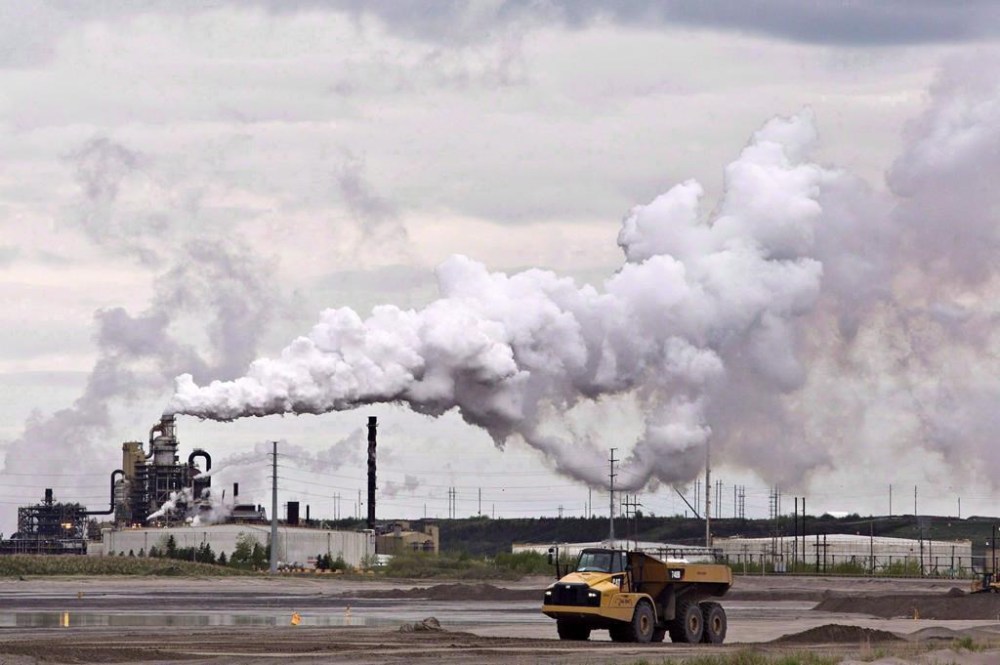
New research suggests Alberta's oilsands are releasing potentially hazardous compounds into the atmosphere at rates dozens of times higher than official estimates. A dump truck works near the Syncrude oilsands extraction facility near the city of Fort McMurray, Alta., on June 1, 2014. THE CANADIAN PRESS/Jason Franson

Industry figures suggest the oilsands release about 68 million tonnes of carbon dioxide a year, over 10 per cent of all Canadian emissions. Liggio’s lab has suggested that figure could be closer to 100 million tonnes.

But more is released than carbon dioxide, which is a greenhouse gas.

The current paper is the first to make field-based measurements of the release of what are called volatile organic compounds — “every molecule that has carbon as a backbone,” Liggio said.

Previously, the release of those chemicals has been tracked using modelled estimates, exhaust stack measurements and a few measurements in the field.

“It’s really a mix of a bunch of different ways (industry) comes up with the number that they’ve reported to the national inventory,” Liggio said.

Liggio’s team used 30 airplane overflights in the spring and summer of 2018 to sample and analyze what was in the air over a series of oilsands operations, open-pit and in situ. Those measurements found actual emissions to dwarf what has been reported.

Liggio’s study suggests volatile organic compounds are being released from the oilsands at rates that are anywhere from 20 to 63 times higher than the figures in the national pollutant inventory. The paper suggests those emissions from the oilsands are roughly equal to the entire output of such chemicals from everywhere else in Canada.

The three largest sources — Syncrude’s Mildred Lake, Suncor and Canadian Natural Resources — emit anywhere between 200,000 and 500,000 tonnes of carbon in those chemicals annually.

As well, Liggio and his team used lab experiments to measure how much volatile organic carbon was released during the drying of mature fine tailings, one of the processes used to reclaim tailings ponds.

“We found that the (chemicals) were in fact being emitted when you dry (tailings),” he said. “In fact, more was emitted when you dry it.”

Mark Cameron, vice president of the Pathways Alliance group of oilsands producers, said his group will examine the study.

“(It) has identified a difference between ground measurements and those collected in an aircraft that warrant further review,” he said in an emailed statement.

“The oilsands industry measures emissions using standards set by Environment and Climate Change Canada and we look forward to working together to explore opportunities to further enhance our measurement practices.”

Liggio adds that air quality downwind of the oilsands remains within Canadian and Alberta guidelines. There are thousands of different kinds of carbon-based molecules released from energy production and all are highly reactive.

“All of these different hydrocarbons in the atmosphere react,” Liggio said. “They form things that are of concern.”

Such chemicals form contaminants such as fine particulates, which can lead to heart and lung problems and are one of the leading causes of air pollution health impacts. They also create ozone, which can also cause respiratory issues.

Liggio’s paper is similar in some ways to recent research that has used airborne measurements to find that official estimates of greenhouse gases such as carbon dioxide and methane are also being routinely and significantly underestimated by industry and government. Those airborne methods are gradually gaining favour.

Not enough is known about what happens when those chemicals mix and react, said Liggio. Nor is it known whether they accumulate in the environment.

“It’s difficult to know what the impact is right now,” he said. “There are thousands of chemicals.

“Some of them are (cumulative). I don’t know which ones that would be.

“What this (study) really means is that probably some additional work is required.”

This report by The Canadian Press was first published Jan. 25, 2024

Report Error Submit a Tip

More Stories

Winnipeg Rifles can still secure post-season berth despite starting season 0-4

Joshua Frey-Sam 5 minute read Preview

Winnipeg Rifles can still secure post-season berth despite starting season 0-4

Joshua Frey-Sam 5 minute read 12:47 PM CDT

The Winnipeg Rifles have a seat at the table, something they would’ve certainly taken a few weeks ago.

A solid three-phase performance in a 25-13 win over the Edmonton Huskies on Sunday kept the junior football club’s playoff hopes alive as the team heads into the final week of the regular season in the Prairie Football Conference.

The path to punching their ticket isn’t easy, however. The Rifles must travel to a perennially difficult environment in Saskatoon to face the Hilltops (4-3) on Sunday (1 p.m.), a contest that only matters if the Huskies beat the Edmonton Wildcats on Saturday.

But after starting the season 0-4, it’s a deal that the Rifles will happily take.

Read
12:47 PM CDT

Obsessed stalker who shot, killed young woman at bus stop in 1993 dies behind bars at age 74

Erik Pindera 3 minute read Preview

Obsessed stalker who shot, killed young woman at bus stop in 1993 dies behind bars at age 74

Erik Pindera 3 minute read Yesterday at 5:53 PM CDT

A Winnipeg man who stalked a woman for several years before shooting her dead in the street in 1993 has died in Stony Mountain prison.

On Monday, 74-year-old Ronald Edd Bell died of apparent natural causes at the federal prison just north of Winnipeg, the Correctional Service of Canada said.

Bell had been in prison since May 30, 1994, when he was given a life sentence with no chance of parole for 18 years for killing Terry-Lyn Babb, 25, on Jan. 21, 1993.

Bell walked up behind an unsuspecting Babb, who was waiting at a bus stop at Sherbrook Street and Wolseley Avenue, and shot her in the head with a pistol in front of horrified witnesses, says the Free Press report of his sentencing hearing.

Read
Yesterday at 5:53 PM CDT

Acquisition of former residential school grounds will help educate future generations: premier

Connor McDowell and Morgan Modjeski 6 minute read Preview

Acquisition of former residential school grounds will help educate future generations: premier

Connor McDowell and Morgan Modjeski 6 minute read Yesterday at 8:31 PM CDT

Premier Wab Kinew says a former Brandon-area campground acquired by the province will help educate future generations about the horrors of residential schools.

“We live in an era where people are trying to deny what happened in residential schools,” Kinew said during a Tuesday afternoon visit to Turtle Crossing Campground, near the former Brandon Indian Residential School. “It’s an important part of our national history, and keeping that truth alive.”

Kinew officially announced the province’s plan Tuesday, in partnership with the City of Brandon, to acquire and protect the site where the bodies of more than 50 Indigenous children are located.

The premier said the property has “huge national significance” for education about residential school history because it is one of the “most documented” in the country. He carried photographs, and some 20th century newspaper clippings from the Brandon Sun around the site Tuesday.

Read
Yesterday at 8:31 PM CDT

Manitoba PCs choose Narth as interim leader; ‘deeply hurt’ Khan blasts former caucus colleagues

Carol Sanders 7 minute read Preview

Manitoba PCs choose Narth as interim leader; ‘deeply hurt’ Khan blasts former caucus colleagues

Carol Sanders 7 minute read Updated: Yesterday at 9:46 PM CDT

Manitoba’s Progressive Conservative caucus chose MLA Konrad Narth as interim party leader Tuesday to replace Obby Khan, who quit a day earlier after he said he was stabbed in the back by a small group of caucus members plotting in secret to oust him.

Read
Updated: Yesterday at 9:46 PM CDT

Bombers coach happy to be back at work after backbreaking loss to Argos

Taylor Allen 6 minute read Preview

Bombers coach happy to be back at work after backbreaking loss to Argos

Taylor Allen 6 minute read Yesterday at 8:16 PM CDT

It’s the first practice day after a backbreaking loss.

The Winnipeg Blue Bombers are in a challenging predicament with four games remaining — starting Saturday on the road against the Montreal Alouettes (11-3) — that leaves their playoff aspirations far from solidified.

And yet, head coach Mike O’Shea makes his way behind the podium, looks out at a room of reporters and is grinning ear to ear.

Why so happy?

Read
Yesterday at 8:16 PM CDT

Port of Churchill signs agreement with Dutch port

Aaron Epp 2 minute read Preview

Port of Churchill signs agreement with Dutch port

Aaron Epp 2 minute read Yesterday at 4:40 PM CDT

Arctic Gateway Group, operator of the Port of Churchill, has signed an agreement with the Port of Rotterdam in the Netherlands to attract business and strengthen supply chains linking Western Canada and Europe.

The agreement enables the two ports to work together to develop new trade in critical minerals and energy products, connect Canadian producers with European buyers, and identify opportunities to improve the supply chain from Western Canadian resource projects through Churchill and into European markets.

The Port of Rotterdam is Europe’s largest port and home to more than 3,000 businesses across its industrial complex, serving as a major gateway for critical raw materials and energy.

Meanwhile, the Port of Churchill has been identified as a transformative national strategy for Canada and is emerging as a northern trade corridor connecting Western Canada’s resources to global markets.

Read
Yesterday at 4:40 PM CDT