A grainy sonar image reignites excitement and skepticism over Earhart’s final flight
Advertisement
Read this article for free:
or
Already have an account? Log in here »
To continue reading, please subscribe:

Digital Subscription
One year of digital access for only $205*
- Enjoy unlimited reading on winnipegfreepress.com
- Read the E-Edition, our digital replica newspaper
- Access News Break, our award-winning app
- Play interactive puzzles
*First annual payment billed as $205.00 + GST for one year. This annual subscription will automatically renew at $233.00 + GST every 52 weeks (10% off the regular annual price of $259.35). Offer available to new and qualified returning subscribers only. Cancel any time.
To continue reading, please subscribe:
Add Free Press access to your Brandon Sun subscription for only an additional
$1 for the first 4 weeks*
- Enjoy unlimited reading on winnipegfreepress.com
- Read the E-Edition, our digital replica newspaper
- Access News Break, our award-winning app
- Play interactive puzzles
*Your next Brandon Sun subscription payment will increase by $1.00 and you will be charged $17.95 plus GST for four weeks. After four weeks, your payment will increase to $24.95 plus GST every four weeks.
Read unlimited articles for free today:
or
Already have an account? Log in here »
Hey there, time traveller!
This article was published 30/01/2024 (962 days ago), so information in it may no longer be current.
COLUMBIA, S.C. (AP) — A grainy sonar image recorded by a private pilot has reinvigorated interest in one of the past century’s most alluring mysteries: What happened to Amelia Earhart when her plane vanished during her flight around the world in 1937?
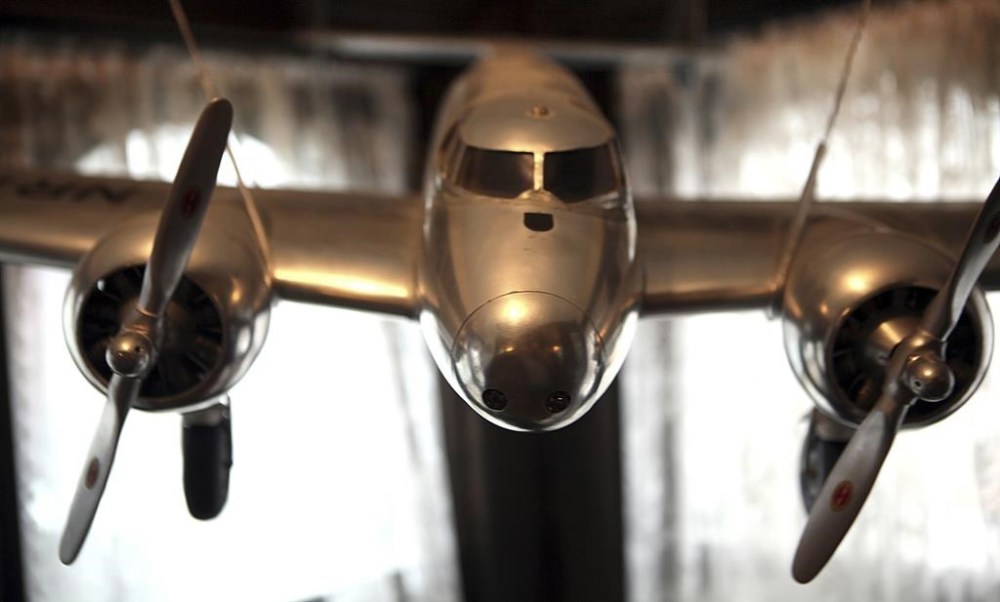
Numerous expeditions have turned up nothing, only confirming that swaths of ocean floor held no trace of her twin-tailed monoplane. Tony Romeo now believes his new South Carolina-based sea exploration company captured an outline of the iconic American’s Lockheed 10-E Electra.
Archaeologists and explorers are hopeful. But whether the tousled-haired pilot’s plane lies at the roughly 16,000-foot (4,800-meter) depth remains to be seen. And debates abound about the proper handling of whatever object is discovered.
Archivists are hopeful that Romeo’s Deep Sea Vision is close to solving the puzzle — if for no other reason than to return attention to Earhart’s accomplishments.
Regardless, the search is on for the first woman to fly across the Atlantic Ocean.
HOW DID DEEP SEA VISION DETECT THE OBJECT THAT COULD BE EARHART’S PLANE?
Romeo wanted more of an adventure than his commercial real estate career. His father flew for Pan American Airlines, his brother is an Air Force pilot and he has a private pilot’s license himself. Hailing from an “aviation family,” he’d long held interest in the Earhart mystery.
Romeo said he sold his real estate interests to fund last year’s search and buy a $9 million underwater drone from a Norwegian company. The state-of-the-art technology is called the Hugin 6000 — a reference to its ability to break into the deepest layer of the ocean at 6,000 meters (19,700 feet).
A 16-person crew began a roughly 100-day search in September 2023, scanning over 5,200 square miles (13,468 square kilometers) of seafloor. They narrowed their probe to the area around Howland Island, a mid-Pacific atoll between Papua New Guinea and Hawaii.
But it wasn’t until the team reviewed sonar data in December that they saw the fuzzy yellow outline of what resembles a plane.
“In the end, we came out with an image of a target that we believe very strongly is Amelia’s aircraft,” Romeo told The Associated Press.
The next step is taking a camera underwater to better examine the unidentified object. If the visuals confirm the explorers’ greatest hopes, Romeo said the goal would be to raise the long-lost Electra.
Ultimately, Romeo said his team undertook the costly adventure to “solve aviation’s greatest unsolved mystery.” An open hatch could indicate that Earhart and her flight companion escaped after the initial impact, Romeo said, and a cockpit dial could lend insight into what, exactly, went wrong.
FROM ALIEN ABDUCTION TO JAPANESE EXECUTION, THEORIES ABOUND
Earhart and her navigator, Fred Noonan, disappeared while flying from New Guinea to Howland Island as part of her attempt to become the first female pilot to circumnavigate the globe. She had radioed that she was running low on fuel.
The Navy searched but found no trace. The U.S. government’s official position has been that Earhart and Noonan went down with their plane.
Since then, theories have veered into the absurd, including abduction by aliens, or Earhart living in New Jersey under an alias. Others speculate she and Noonan were executed by the Japanese or died as castaways on an island.
“Amelia is America’s favorite missing person,” Romeo said.
Deep Sea Vision’s is hardly the first foray. David Jourdan said his exploration company Nauticos searched in vain on three separate expeditions between 2002 and 2017, surveying an area of seafloor about the size of Connecticut. Those efforts were preceded by a $1 million hunt in 1999 from Nevada-based Dana Timmer. As recently as 2014, Timmer had not given up and sought to raise nearly $2 million for another go.
Between 1988 and 2002, the International Group for Historic Aircraft Recovery made six trips to a different island in the western Pacific Ocean under the impression that Earhart crash-landed on a flat reef 1,800 miles (2,900 kilometers) south of Hawaii.
Hillary Clinton, then the U.S. Secretary of State, encouraged the group in 2012 when it launched a new search for the wreckage fueled by analysis of a 1937 photo believed to show the Lockheed Electra’s landing gear jutting out of the island’s shoreline.
‘WE NEED TO SEE MORE’
Maritime archaeologist James Delgado said Romeo’s potential find would change the narrative, but “we need to see more.”
“Let’s drop some cameras down there and take a look,” said Delgado, senior vice president of the archaeological firm SEARCH Inc.
Delgado said Romeo’s expedition employed world-class, cutting-edge technology that was once classified and is “revolutionizing our understanding of the deep ocean.”
But he said Romeo’s team must provide “a forensic level of documentation” to prove it’s Earhart’s Lockheed. That could mean the patterns in the fuselage’s aluminum, the configuration of its tail and details from the cockpit.
Jourdan, of Nauticos, would have expected to see straight wings and not swept wings, like the new sonar suggests, as well as engines. But that could be explained by damage to the aircraft or reflections distorting the image, he acknowledged.
“It could be a plane. It certainly looks like a plane. It could be a geological feature that looks like a plane,” he said.
Dorothy Cochrane, an aeronautics curator at the National Air and Space Museum, said Romeo’s crew searched in the right place near Howland Island. That’s where Earhart desperately sought a runway when she disappeared on the last leg of her flight.
If the object really is the historic aircraft, the question for Cochrane will be whether it is safe to raise. How much of the machinery is still intact would be determined in part by how smoothly Earhart landed, she added.
“That’s where you have to really look at this image and say, ‘What have we got here?’” said Cochrane.
WHAT IF EARHART’S LOCKHEED ELECTRA HAS BEEN FOUND?
If the fuzzy sonar images turn out to be the plane, international standards for underwater archaeology would strongly suggest the aircraft remain where it is, said Ole Varmer, a retired attorney with the National Oceanic and Atmospheric Administration and a senior fellow at The Ocean Foundation.
Nonintrusive research can still be conducted to reveal why the plane possibly crashed, Varmer said.
“You preserve as much of the story as you can,” Varmer said. “It’s not just the wreck. It’s where it is and its context on the seabed. That is part of the story as to how and why it got there. When you salvage it, you’re destroying part of the site, which can provide information.”
Raising the plane and placing it in a museum would likely cost hundreds of millions of dollars, Varmer said. And while Romeo could conceivably make a salvage claim in the courts, the plane’s owner has the right to deny it.
Earhart bought the Lockheed with money raised, at least in part, by the Purdue Research Foundation, according to a blog post by Purdue University in Indiana. And she planned to return the aircraft to the school.
Romeo said the team believes the plane belongs in the Smithsonian. Acknowledging the “uncharted territory” of potential legal issues, he said his exploration company will “deal with those as they come up.”
___
Finley reported from Norfolk, Virginia. Pollard is a corps member for the Associated Press/Report for America Statehouse News Initiative. Report for America is a nonprofit national service program that places journalists in local newsrooms to report on undercovered issues.