Crash tests indicate nation’s guardrail system can’t handle heavy electric vehicles
Advertisement
Read this article for free:
or
Already have an account? Log in here »
To continue reading, please subscribe:

Digital Subscription
One year of digital access for only $205*
- Enjoy unlimited reading on winnipegfreepress.com
- Read the E-Edition, our digital replica newspaper
- Access News Break, our award-winning app
- Play interactive puzzles
*First annual payment billed as $205.00 + GST for one year. This annual subscription will automatically renew at $233.00 + GST every 52 weeks (10% off the regular annual price of $259.35). Offer available to new and qualified returning subscribers only. Cancel any time.
To continue reading, please subscribe:
Add Free Press access to your Brandon Sun subscription for only an additional
$1 for the first 4 weeks*
- Enjoy unlimited reading on winnipegfreepress.com
- Read the E-Edition, our digital replica newspaper
- Access News Break, our award-winning app
- Play interactive puzzles
*Your next Brandon Sun subscription payment will increase by $1.00 and you will be charged $17.95 plus GST for four weeks. After four weeks, your payment will increase to $24.95 plus GST every four weeks.
Read unlimited articles for free today:
or
Already have an account? Log in here »
Hey there, time traveller!
This article was published 31/01/2024 (979 days ago), so information in it may no longer be current.
LINCOLN, Neb. (AP) — Electric vehicles that typically weigh more than gasoline-powered cars can easily crash through steel highway guardrails that are not designed to withstand the extra force, raising concerns about the nation’s roadside safety system, according to crash test data released Wednesday by the University of Nebraska.
Electric vehicles typically weigh 20% to 50% more than gas-powered vehicles thanks to batteries that can weigh almost as much as a small gas-powered car. And they have lower centers of gravity. Because of these differences, guardrails can do little to stop electric vehicles from pushing through barriers typically made of steel.
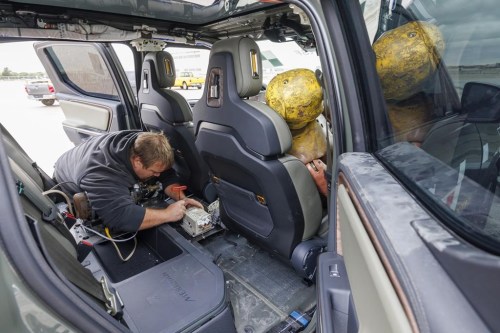
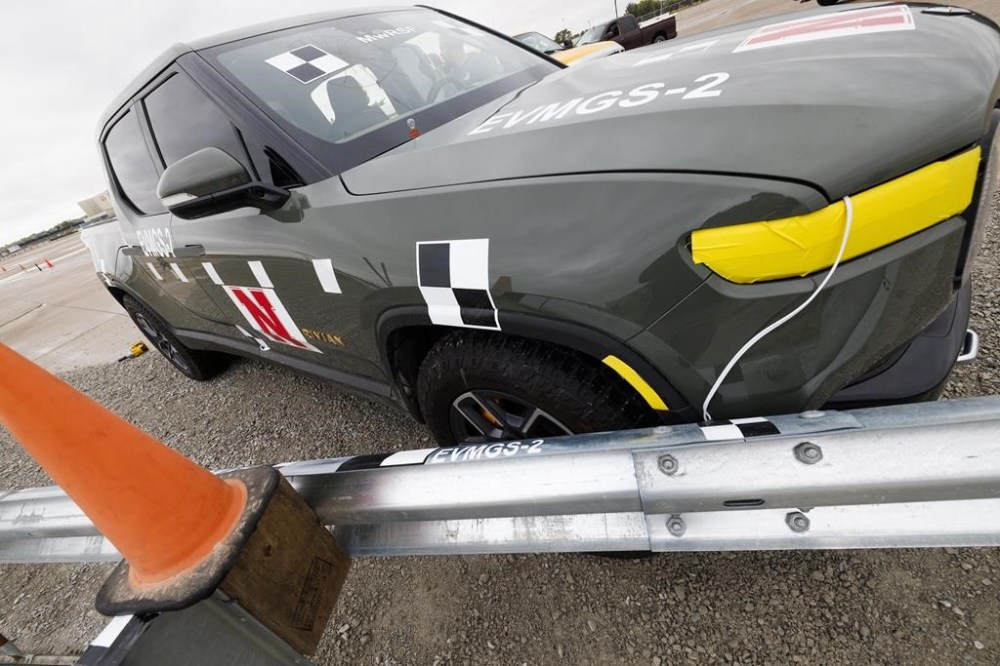
Last fall, engineers at Nebraska’s Midwest Roadside Safety Facility watched as an electric-powered pickup truck hurtled toward a guardrail installed on the facility’s testing ground on the edge of the local municipal airport. The nearly 4-ton (3.6 metric ton) 2022 Rivian R1T tore through the metal guardrail and hardly slowed until hitting a concrete barrier yards away on the other side.

“We knew it was going to be an extremely demanding test of the roadside safety system,” said Cody Stolle with the facility. “The system was not made to handle vehicles greater than 5,000 pounds.”
The university released the results of the crash test at a time when the rising popularity of electric vehicles has led transportation officials to sound the alarm over the weight disparity of the new battery-powered vehicles and lighter gas-powered ones. Last year, the National Transportation Safety Board expressed concern about the safety risks heavy electric vehicles pose if they collide with lighter vehicles.
Road safety officials and organizations say the electric vehicles themselves appear to offer superior protection to their occupants, even if they might prove dangerous to occupants of lighter vehicles. The Rivian truck tested in Nebraska showed almost no damage to the cab’s interior after slamming into the concrete barrier, Stolle said. In response to the release of the test results Wednesday, Rivian Automotive Inc. noted that the truck used in the testing received a 2023 Top Safety Pick+ award, the highest tier award issued by the Insurance Institute for Highway Safety.
But the entire purpose of guardrails, found along tens of thousands of miles of roadway, is to help keep passenger vehicles from leaving the road, said Michael Brooks, executive director of the nonprofit Center for Auto Safety. Guardrails are intended to keep cars from careening off the road at critical areas, such as over bridges and waterways, near the edges of cliffs and ravines and over rocky terrain, where injury and death in an off-the-road crash are much more likely.
“Guardrails are kind of a safety feature of last resort,” Brooks said. “I think what you’re seeing here is the real concern with EVs — their weight. There are a lot of new vehicles in this larger-size range coming out in that 7,000-pound range. And that’s a concern.”
The preliminary crash test sponsored by the U.S. Army Corps of Engineers’ Research and Development Center also involved a Tesla sedan crash, in which the sedan lifted the guardrail and passed under it. The tests showed the barrier system is likely to be overmatched by heavier electric vehicles, officials said.
The extra weight of electric vehicles comes from their outsized batteries needed to achieve a travel range of about 300 miles (480 kilometers) per charge.
“So far, we don’t see good vehicle-to-guardrail compatibility with electric vehicles,” Stolle said.
More testing, involving computer simulations and test crashes of more electric vehicles, is planned, he said, and will be needed to determine how to engineer roadside barriers that minimize the effects of crashes for both lighter gas-powered vehicles and heavier electric vehicles.
“Right now, electric vehicles are at or around 10% of new vehicles sold, so we have some time,” Stolle said. “But as EVs continue to be sold and become more popular, this will become a more prevalent problem. There is some urgency to address this.”
The facility has seen this problem before. In the 1990s, as more people began buying light-weight pickups and sport utility vehicles, the Midwest Roadside Safety Facility found that the then-50-year-old guardrail system was proving inadequate to handle their extra weight. So, it went about redesigning guardrails to adapt.
“At the time, lightweight pickups made up 10-to-15% of the vehicle fleet,” Stolle said. “Now, more than 50% of vehicles on the road are pickups and SUVs.”
“So, here we are trying to do the same thing again: Adapt to the changing makeup of vehicles on the road.”
It’s impossible to know what that change will look like, Stolle said.
“It could be concrete barriers. It could be something else,” he said. “The scope of what we have to change and update still remains to be determined.”
Philip Jones, executive director of the Alliance for Transportation Electrification, which supports the use of electric vehicles in North America, questioned why electric vehicles were singled out in the testing, noting that several large SUV models can weigh around 6,000 pounds.
“The EVs are not necessarily heavier,” Jones said. “I drive a Chevy Bolt, and it’s 3,700 pounds.”

But he acknowledged that, on the whole, the first generation of electric vehicles are heavier than their gas-powered counterparts. Successive generations are likely to be lighter, he said, as manufacturers work to make smaller batteries that carry more power.
The U.S. Federal Highway Administration declined to immediately comment on the Nebraska test results.
The concern over the weight of electric vehicles stretches beyond vehicle-to-vehicle crashes and compatibility with guardrails, Brooks said. The extra weight will affect everything from faster wear on residential streets and driveways to vehicle tires and infrastructure like parking garages.
“A lot of these parking structures were built to hold vehicles that weighed 2,000 to 4,000 pounds — not 10,000 pounds,” he said.
“What really needs to happen is more collaboration between transportation engineers and vehicle manufacturers,” Brooks said. “That’s where you might see some real change.”