Online influencers lead thousands demanding change in Hungary following president’s resignation

Advertisement

Advertise with us

BUDAPEST, Hungary (AP) — Some of Hungary's best-known online personalities led a crowd of at least 10,000 protesters in Budapest on Friday to demand a change in the country's political culture, a response to the conservative president's recent resignation over a pardon she issued in a child sexual abuse case.

Read this article for free:


or

Already have an account? Log in here »

To continue reading, please subscribe:

Subscribe and receive a limited-edition Free Press branded hat or tote.

Digital Subscription

One year of digital access for only $205*

  • Enjoy unlimited reading on winnipegfreepress.com
  • Read the E-Edition, our digital replica newspaper
  • Access News Break, our award-winning app
  • Play interactive puzzles

*First annual payment billed as $205.00 + GST for one year. This annual subscription will automatically renew at $233.00 + GST every 52 weeks (10% off the regular annual price of $259.35). Offer available to new and qualified returning subscribers only. Cancel any time.

To continue reading, please subscribe:

Add Free Press access to your Brandon Sun subscription for only an additional

$1 for the first 4 weeks*

  • Enjoy unlimited reading on winnipegfreepress.com
  • Read the E-Edition, our digital replica newspaper
  • Access News Break, our award-winning app
  • Play interactive puzzles
Start now

*Your next Brandon Sun subscription payment will increase by $1.00 and you will be charged $17.95 plus GST for four weeks. After four weeks, your payment will increase to $24.95 plus GST every four weeks.

Hey there, time traveller!
This article was published 16/02/2024 (963 days ago), so information in it may no longer be current.

BUDAPEST, Hungary (AP) — Some of Hungary’s best-known online personalities led a crowd of at least 10,000 protesters in Budapest on Friday to demand a change in the country’s political culture, a response to the conservative president’s recent resignation over a pardon she issued in a child sexual abuse case.

Demonstrators filled the Hungarian capital’s sprawling Heroes’ Square and called for genuine reforms to Hungary’s child protection system and for a transformation in Prime Minister Viktor Orbán’s system of governance.

“I don’t know exactly what we’re going to achieve at the end of the day,” said Zsolt Osváth, a popular online content creator who helped organize the demonstration. “But it’s certain that we won’t stay silent any longer, and that we had to step out from the comfort zone of our computer screens.”
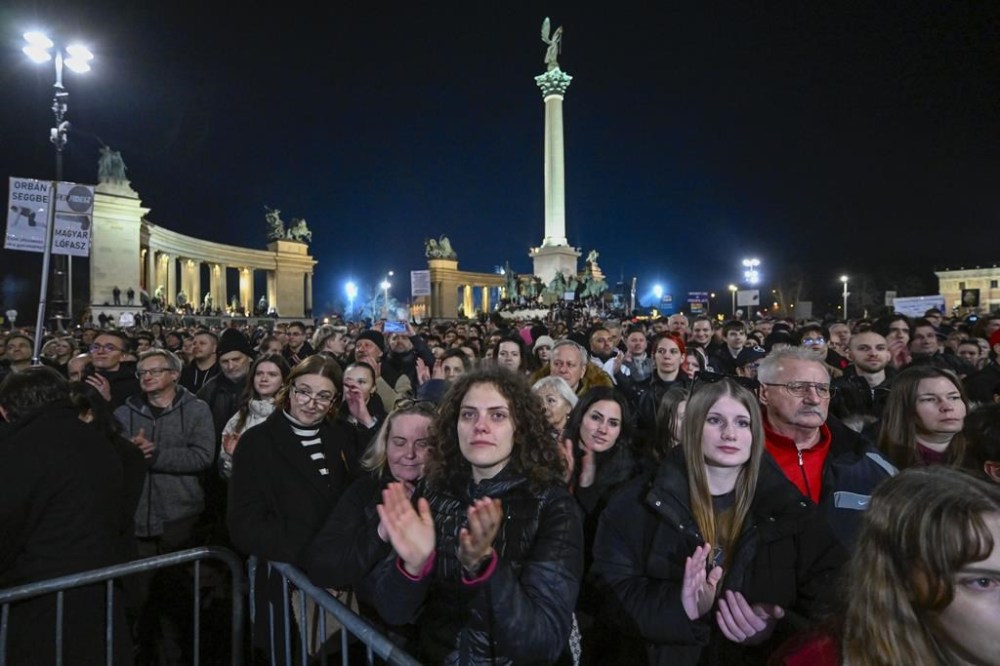
People stage a protest, at Heroes' Square in Budapest, Hungary, Friday, Feb. 16, 2024. Protesters demand a change in the country's political culture after the conservative head of state resigned amid scandal over a presidential pardon. (AP Photo/Denes Erdos)

The protest came amid an unprecedented political scandal that has shaken the government of the prime minister, a staunch nationalist who has dominated Hungary’s public life since 2010.

President Katalin Novák, an Orbán ally, resigned amid controversy last week after it was revealed that she issued a presidential pardon to a man that had been imprisoned for covering up a string of child sexual abuses by the director of a state-run orphanage.

The pardon shocked Hungarian society and opened fissures within Orbán’s Fidesz party, which has governed the country with a constitutional majority for nearly 14 years.

Friday’s expression of popular discontent took root among a segment of society that is often disengaged from politics. The demonstration’s organizers included nearly a dozen popular YouTubers and other content creators, who wrote that they were “distraught” over the revelations and protesting for a “healthy society.”

The organizers, each of whom has hundreds of thousands of subscribers on YouTube, urged their fellow Hungarians to break out of political “apathy” but asked opposition political parties not to display party insignia at the protest.

Bulcsú Hunyadi, an analyst with the Budapest-based think tank Political Capital, said influencers taking the lead gave the event greater resonance than calls to action by Hungary’s fragmented political opposition.

“The people who are organizing this demonstration reach certain groups of society in large proportions. Their voices go far and wide,” Hunyadi said. “This demonstration can reach a different group than those organized by the traditional political parties, and can presumably reach a wider audience.”

Also implicated in the scandal was former Justice Minister Judit Varga, another key Fidesz figure who resigned her parliamentary seat over her role in endorsing the pardon.

Varga was expected to lead the list of candidates from Fidesz when European Parliament elections are held in June. The loss of two of Hungary’s leading female politicians from the male-dominated government came as a blow to Orbán as his party prepares for the European Union balloting.

Gábor Balk, a protester and father of three, said he is not convinced the scandal will mark a turning point in Hungarian politics.

“I don’t expect anything from this government. They aren’t going to change anything,” Balk said. “They threw away two people, they can go, but there will just be two other cadres in their place.”

Even with Novák and Varga’s resignations, the pardon scandal has spread to implicate others in Orbán’s circle and sparked outrage over unanswered questions on why the pardon was issued.

Zoltán Balog, one of Orbán’s former ministers and the head of Hungary’s reformed church, stepped down from his role Friday after he admitted to having advised Novák to issue the pardon.

Varga’s ex-husband, Péter Magyar, made public accusations of corruption and intimidation against Orbán’s government in an interview on popular YouTube channel Partizán, which has garnered more than 2 million views in the country of fewer than 10 million.

Hunyadi, the analyst, said such public outcry among a wide spectrum of Hungarian society could mobilize further opposition to Orbán’s power.

“What works against apathy now is that people simply feel that this is a serious matter that can and has had consequences — the two resignations,” he said. “Now they feel that there’s a reason to do something, that they can achieve something by taking action.”

Report Error Submit a Tip

More Stories

Pimp sentenced to 11 years in prison

Erik Pindera 5 minute read Preview

Pimp sentenced to 11 years in prison

Erik Pindera 5 minute read 2:00 AM CDT

A man who picked up a vulnerable 17-year-old child-welfare ward on the streets of Winnipeg and coerced her into providing sexual services for several months has been sent to prison for more than a decade.

After a trial, Hassan Kargbo, who’s in his early 30s, was found guilty of sexual exploitation, making child sexual abuse and exploitation material, receiving a material benefit from sexual services provided by a person under 18, procuring a person under 18 and advertising sexual services.

Provincial court Judge Julie Frederickson sentenced him to 11 years behind bars late last month.

“Mr. Kargbo picked up a young Indigenous girl walking over the Osborne Street bridge and quickly got her involved in drug use and escorting,” Frederickson said in a written decision.

Read
2:00 AM CDT

Real journalists matter in an AI world

Paul Deegan 4 minute read Preview

Real journalists matter in an AI world

Paul Deegan 4 minute read 2:00 AM CDT

An algorithm can decide what you see, but it doesn’t report the news. Nunatsiaq News, an award-winning newspaper in Nunavut, recently reported that a so-called “news” website was posting AI-generated articles about the north by stealing real news stories produced by real journalists.

The articles were supposedly written by Nunavut correspondent Leah Qammaniq — a fake journalist, with a fake photo and a fake bio.

Governor General Louise Arbour warned us of fake news in her installation speech in June. She said, “We must continue to protect the public space in which our national debates take place: from schools and universities to the media, political parties, unions and civil society organizations …With instant access to vast amounts of information, it is very tempting to pay little attention to the reliability of sources. The lines between knowledge and belief, between truth and falsehood, between facts and assumptions, are increasingly blurred. AI could be threatening not only the way we live and work, but also the control we exercise over our own destiny.”

The Government of Canada has recognized the problem as well. Its recent discussion paper, Enhancing trust in artificial intelligence through increased transparency, stated, “Canadians encounter news reporting, product reviews, and audio-visual content across the internet, often without any indication of whether it was written by a person, generated by an AI system, or produced through some combination of both … A particular concern within this broader landscape is that generative AI greatly enables the creation and dissemination of deceptive or misleading content.”

Read
2:00 AM CDT

The election of our discontent: City at a crumbling crossroads, grumbling residents say in poll

Matthew Frank 7 minute read Preview

The election of our discontent: City at a crumbling crossroads, grumbling residents say in poll

Matthew Frank 7 minute read Updated: Yesterday at 3:16 PM CDT

There’s an undercurrent of unhappiness running through the Winnipeg electorate as the municipal election day approaches.

One-half of Winnipeggers believe the city is heading in the wrong direction, according to a new Abacus Data poll, with nearly one-third unsure if Winnipeg is regressing or progressing.

Only 21 per cent of residents believe the city is on the right track, the Free Press-commissioned poll found.

That discontentment extends to how the city spends its tax dollars, with four in 10 Winnipeggers believing they receive poor value for what they pay in property taxes.

Read
Updated: Yesterday at 3:16 PM CDT

Mayoral candidates Klein, Vogiatzakis continue to snipe over inducement allegations

Chris Kitching and Joyanne Pursaga 6 minute read Preview

Mayoral candidates Klein, Vogiatzakis continue to snipe over inducement allegations

Chris Kitching and Joyanne Pursaga 6 minute read Updated: Yesterday at 5:50 PM CDT

Winnipeg mayoral candidate Mike Vogiatzakis told reporters Monday he will contact the city clerk to report his allegation that rival Kevin Klein offered him a job to drop out of the race.

Vogiatzakis and Klein both doubled down a day after accusing each other of offering the other a position at city hall, if they were victorious in the Oct. 28 election, in exchange for a withdrawal.

“Do I want to get him charged? Not really. I don’t want to destroy anybody’s life,” Vogiatzakis told reporters.

“Kevin’s a good guy. I thought he was a friend of mine, but he’s not. Kevin uses leverage to get ahead, and he tried to use me as leverage.”

Read
Updated: Yesterday at 5:50 PM CDT

‘Amazing honour’: Winnipeg distribution centre continues award-winning ways for McKesson Canada

Aaron Epp 5 minute read Preview

‘Amazing honour’: Winnipeg distribution centre continues award-winning ways for McKesson Canada

Aaron Epp 5 minute read Yesterday at 6:00 AM CDT

After a three-year absence, the trophy is back in Winnipeg.

Last week, McKesson Canada named its 120,000-square-foot pharmaceutical distribution centre in the northwest part of the Manitoba capital its Distribution Centre of the Year. The award recognizes the facility’s role in helping essential medications reach communities across the province and some of Canada’s remote regions.

This is the fourth time the Winnipeg facility has earned the company-wide award since it opened five years ago. McKesson previously honoured the centre in 2021, 2022 and 2023. The recognition comes with a trophy, as well as a banner that was hung from the rafters on Thursday.

More than 100 employees work across the centre’s day-and-night operations, processing between 80,000 and 100,000 medication units daily. Last year, the centre distributed more than 21 million medication units while maintaining more than 99 per cent accuracy.

Read
Yesterday at 6:00 AM CDT

Essential workers ruling raises questions

Editorial 4 minute read Preview

Essential workers ruling raises questions

Editorial 4 minute read 2:00 AM CDT

Ever been to a Dynacare clinic? Most of us have been. It’s an amazing demographic and ethnic slice of the city we’ve become. Old patients. Young patients. New arrivals. Long-time Canadians. People who know the ropes — others who are startled by the crowds and the noise and the lockstep forward motion of professionals doing what they have been trained to do. It seems, all at the same time, both chaotic and diagnostic, as names of patients are steadily called out and thousands of tests are performed.

But Dynacare is at the centre of a new kind of test and this time, we’re all in the test tube together.

It’s the first real test for new labour law put in place by the government of Premier Wab Kinew in 2024 — a law that redefined what essential services are for provincially-regulated workplaces. Under this law, companies and their employee and unions must have an agreement of which employees are essential — which ones must stay on the job during a legal strike for the protection of the health and safety of the public.

Dynacare had that kind of essential employee agreement with its staff and union — the company and the union had agreed the employees were not essential.

Read
2:00 AM CDT