Coral reef that ‘shouldn’t exist’ thrives off B.C.’s Pacific Ocean, biologist says

Advertisement

Advertise with us

VANCOUVER - It started with a tip from the local First Nation of a "bump on the sea floor" where the fish liked to be and led to the discovery of Canada's only known live coral reef.

Read this article for free:


or

Already have an account? Log in here »

To continue reading, please subscribe:

Subscribe and receive a limited-edition Free Press branded hat or tote.

Digital Subscription

One year of digital access for only $205*

  • Enjoy unlimited reading on winnipegfreepress.com
  • Read the E-Edition, our digital replica newspaper
  • Access News Break, our award-winning app
  • Play interactive puzzles

*First annual payment billed as $205.00 + GST for one year. This annual subscription will automatically renew at $233.00 + GST every 52 weeks (10% off the regular annual price of $259.35). Offer available to new and qualified returning subscribers only. Cancel any time.

To continue reading, please subscribe:

Add Free Press access to your Brandon Sun subscription for only an additional

$1 for the first 4 weeks*

  • Enjoy unlimited reading on winnipegfreepress.com
  • Read the E-Edition, our digital replica newspaper
  • Access News Break, our award-winning app
  • Play interactive puzzles
Start now

*Your next Brandon Sun subscription payment will increase by $1.00 and you will be charged $17.95 plus GST for four weeks. After four weeks, your payment will increase to $24.95 plus GST every four weeks.

Hey there, time traveller!
This article was published 12/03/2024 (910 days ago), so information in it may no longer be current.

VANCOUVER – It started with a tip from the local First Nation of a “bump on the sea floor” where the fish liked to be and led to the discovery of Canada’s only known live coral reef.

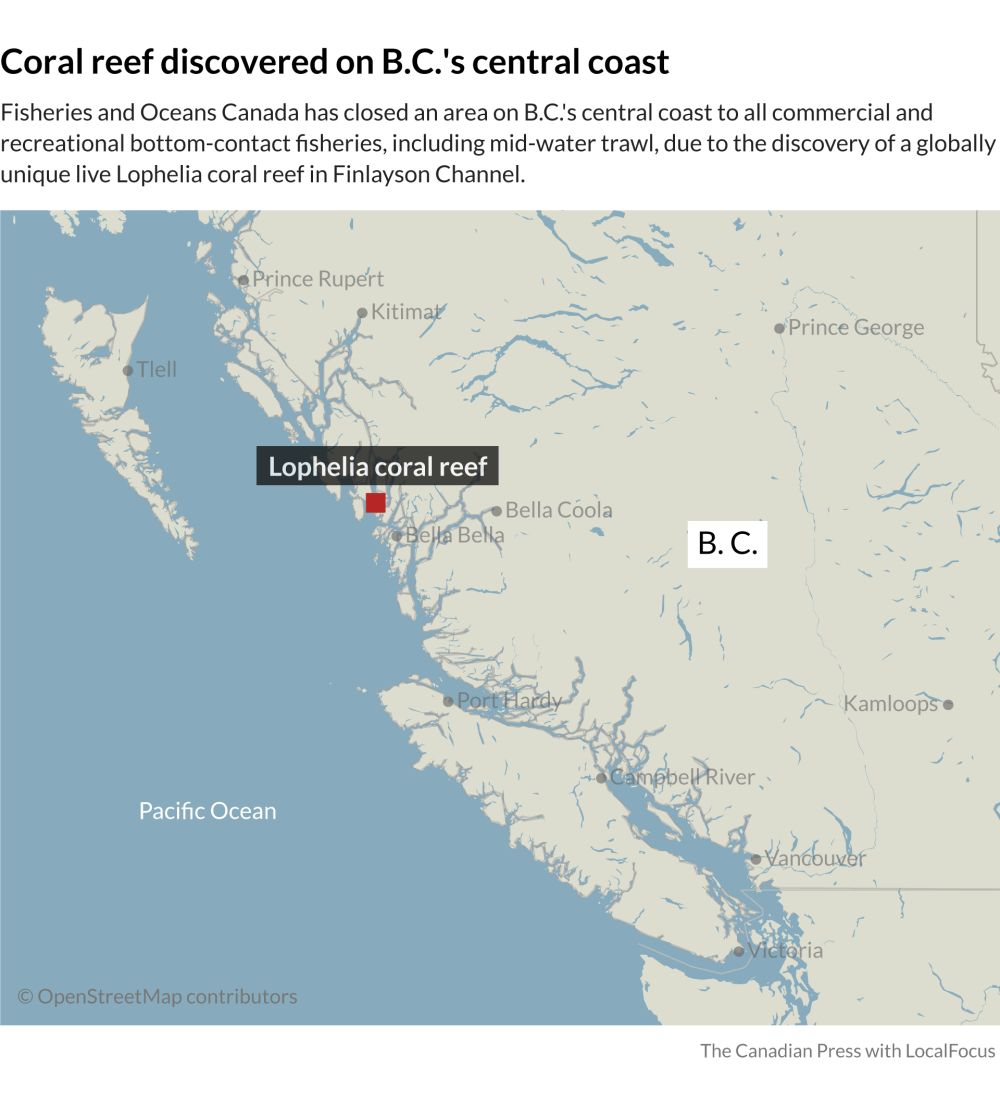
Deep sea ecologist Cherisse Du Preez worked with the Kitasoo Xai’xais and Heiltsuk First Nations and began searching for the Lophelia coral reef in 2021, taking a remote controlled submersible deep into the ocean in Finlayson Channel, about 500 kilometres northwest of Vancouver.

On what was to be their team’s last dive for the expedition they found it, a “thriving, beautiful,” ecosystem about 200 metres down.
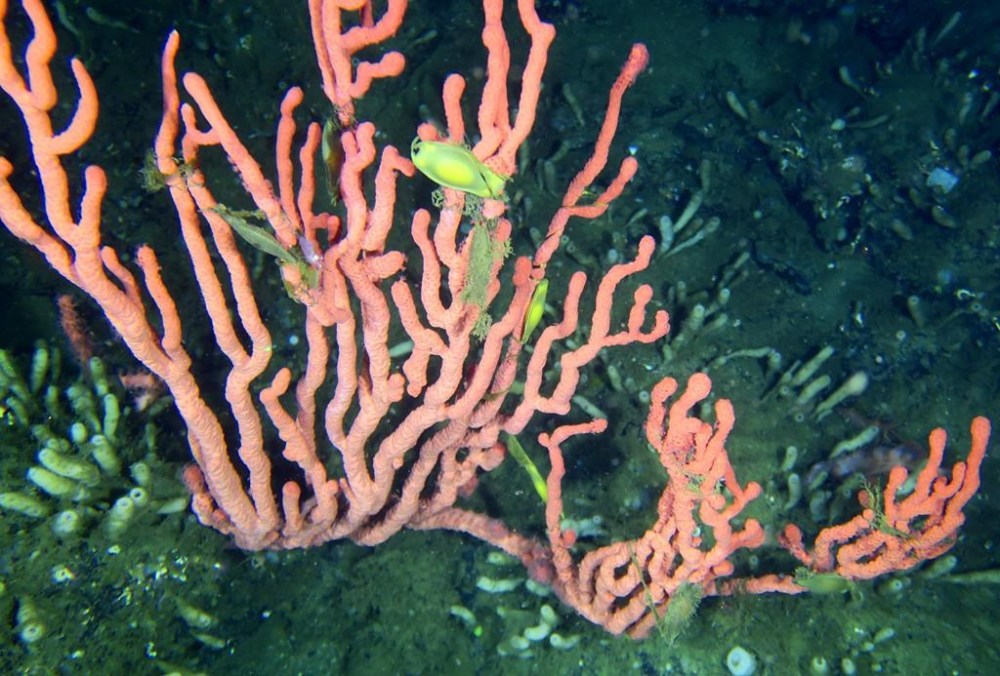
Fish swim amidst pink coral in the Lophelia Reef, located in the Finlayson Channel of the British Columbia coast, about 500 kilometres northwest of Vancouver, in an undated handout photo. It started with a tip from the local First Nation of a
Fish swim amidst pink coral in the Lophelia Reef, located in the Finlayson Channel of the British Columbia coast, about 500 kilometres northwest of Vancouver, in an undated handout photo. It started with a tip from the local First Nation of a "bump on the sea floor" where the fish liked to be and led to the discovery of Canada's only known coral live coral reef. THE CANADIAN PRESS/HO-Fisheries and Oceans Canada, *MANDATORY CREDIT*

“You light it up and you realize you’re the first person to ever see this, beautiful pinks and purples and yellows, crevasses, mounts. And once you see past the corals, you realize that there are other animals on them,” said Du Preez, who’s the head of the deepsea ecology program with Fisheries and Oceans Canada.

“Then the movement starts and you start to see the eels and the octopus or the rock fish swimming in and out. And even when we tilt the camera up you can see the schools of fish on top. Everywhere you look is life.”

All the science and rationale in the world says the coral reef shouldn’t exist here, but the First Nations knew something was there, said Du Preez.

The Fisheries Department announced last week it had closed the area on B.C.’s central coast over the coral reef to all commercial and recreational bottom-contact fisheries, including mid-water trawl.

The department said the indefinite closure is “based on a significant scientific discovery as this site, while small, is a globally unique reef that is highly susceptible to damage, most notably from fishing gear.

The reef is the most northern known coral reef in the entire Pacific Ocean, it said.

Du Preez said she clearly recalls the excitement when they first discovered the reef.

“It’s quite remarkable to visit these places to get the visuals and to feel that paradox of it’s far away, it’s another world, but it’s our world,” said Du Preez.

Mike Reid, fisheries manager for Heiltsuk Nation’s integrated resource management department, said his nation always knew that something was supporting the fish in the area, but they didn’t know what it was.

“Lophelia reef is very important to the ecosystem, to the biodiversity of that specific area, it adds to the overall health of that area,” said Reid.

The reef provides habitat and refuge for animals, allowing for the creation of colonies of fish and other creatures, Du Preez said.

“This coral reef has valleys and mounds … the mounds provide nursery grounds. So, you have all the schools of tiny fish living and hiding from the animals hunting them.

”Then you have large fish, we have species that are of special concern and endangered using this coral reef as food and shelter, as habitat,” said Du Preez.
Du Preez said they found dead coral around the reef, which could be the fault of climate change.

“It’s a very big concern, and that’s one of the reasons why it’s so important to stop fishing in this area is because we have to take away all the stresses we can to give this reef an opportunity to survive the changes that we can’t control.”

A one-degree change in temperature could be devastating for the reef, she said.

Leri Davies, spokeswoman for Fisheries and Oceans Canada’s Pacific Region, said fishery officers from their Conservation and Protection Branch routinely patrol marine refuges, marine protected areas and closed areas.

“We use a variety of intelligence-led enforcement methods including air, ocean, river, and ground surveillance, as well as night and covert patrols, to actively monitor fishing activities in all sectors and ensure compliance with the laws,” said a Fisheries Department statement.

Du Preez said the Canada’s Pacific coast is “globally unique,” with nature and wildlife not found anywhere else.

It gives us the ability to have so much life in our deep sea and we are so fortunate, she said.

“We are so spoiled on our coast with our deep sea and I hope that through media like this Canadians start to feel that the deep sea is as Canadian as the Rocky Mountains.”

This report by The Canadian Press was first published March 12, 2024.

Report Error Submit a Tip

More Stories

US tourism groups want to win Canadian visitors back. A testy trade war isn’t helping

Rio Yamat, The Associated Press 7 minute read Preview

US tourism groups want to win Canadian visitors back. A testy trade war isn’t helping

Rio Yamat, The Associated Press 7 minute read Sunday, Sep. 6, 2026

LAS VEGAS (AP) — Appeals from American tourism organizations seemed to be everywhere Josh Loewen looked over the last year. Billboards and banners proclaimed a state or city's love for Canada. Online and social media ads offered special deals for travelers from north of the border.

As a Vancouver resident and marketing executive himself, Loewen said he understands the conciliatory overtures. The number of Canadians traveling to the United States plunged after President Donald Trump returned to office with remarks about making Canada the 51st state. An acrimonious trade war between the two countries now is threatening to reinforce the informal boycott just as it appeared to be easing slightly.

"It’s such a big ask right now,” Loewen, 45, said of the U.S. tourism industry's attempts to woo Canadians like him back before a new president occupies the White House. “It’s just a wasted effort.”

Relations between the U.S. and Canadian governments have deteriorated sharply since their trade negotiations collapsed last month. Trump imposed import taxes of up to 50% on a range of Canadian products. Canada’s government responded in kind. Trump ordered the U.S. government to change the name of border-spanning Lake Ontario to “Lake America.” Canadian Prime Minister Mark Carney dismissed insults from members of Trump's Cabinet as childish and undignified.

Read
Sunday, Sep. 6, 2026

Thousands affected by storm-related power outages

1 minute read Updated: Yesterday at 8:45 PM CDT

Thousands are still without power in Winnipeg after high winds and thunderstorms knocked out power lines Sunday.

About 4,000 Manitoba Hydro customers were still dealing with outages this morning after crews worked to restore power in the Westwood and River Heights areas, Hydro spokesman Peter Chura said. On Sunday, Hydro reported outages affecting approximately 6, 700 customers.

The high winds and heavy rain brought down trees and broke power poles, causing "very severe damage," in River Heights, one of the hardest-hit neighbourhoods, while some of the damage in the Westwood area appeared to be caused by lightning strikes, Chura said.

Thunderstorms rolled in at about 6 p.m. Sunday and brought heavy rain and high winds to some areas of the province. Winnipeg received about 35 mm of rain, while some areas got almost double that. More than 62 mm was recorded at The Forks and 68.8 mm was recorded at Portage Southport, according to Environment Canada.

Dauphin ER reopening ‘monumental team effort’

Abiola Odutola 5 minute read Preview

Dauphin ER reopening ‘monumental team effort’

Abiola Odutola 5 minute read Yesterday at 9:55 PM CDT

DAUPHIN — The emergency department at Dauphin Regional Health Centre reopened Monday morning after a closure of just over two months, restoring 24-7 emergency services to Dauphin and surrounding communities.

Health Minister Uzoma Asagwara hailed the reopening as a major milestone.

“It’s been a monumental team effort to get to this point,” Asagwara told the Brandon Sun on Monday afternoon before embarking on a tour of the facility.

“We asked everyone to approach this as one team and that’s exactly what we’re seeing the results of now.”

Read
Yesterday at 9:55 PM CDT

Coral reef that ‘shouldn’t exist’ thrives off B.C.’s Pacific Ocean, biologist says

Nono Shen, The Canadian Press 5 minute read Preview

Coral reef that ‘shouldn’t exist’ thrives off B.C.’s Pacific Ocean, biologist says

Nono Shen, The Canadian Press 5 minute read Tuesday, Mar. 12, 2024

VANCOUVER - It started with a tip from the local First Nation of a "bump on the sea floor" where the fish liked to be and led to the discovery of Canada's only known live coral reef.

Deep sea ecologist Cherisse Du Preez worked with the Kitasoo Xai'xais and Heiltsuk First Nations and began searching for the Lophelia coral reef in 2021, taking a remote controlled submersible deep into the ocean in Finlayson Channel, about 500 kilometres northwest of Vancouver.

On what was to be their team's last dive for the expedition they found it, a "thriving, beautiful," ecosystem about 200 metres down.

“You light it up and you realize you’re the first person to ever see this, beautiful pinks and purples and yellows, crevasses, mounts. And once you see past the corals, you realize that there are other animals on them," said Du Preez, who's the head of the deepsea ecology program with Fisheries and Oceans Canada.

Read
Tuesday, Mar. 12, 2024

Time to ditch role as ex’s emotional crutch

Maureen Scurfield 5 minute read 2:00 AM CDT

DEAR MISS LONELYHEARTS: I mourn the end of summer every fall, but this year it’s far worse. My partner (a man, like me) broke up with me and my menagerie of animals.

The hardest part is that he still calls me before he goes to sleep at night — to see if I’m OK, and to tell me essentially, to buck up! Nothing like losing somebody and being told to be happy about it by the exact person you’ve lost.

He goes on about his new life and the people he’s meeting, and sometimes I just have to hang up on him.

Why does he bother calling? It seems like he maybe doesn’t know if he’s completely through with me yet, so he’s using me as a crutch. (Do I sound bitter?) What can I do?

Fund full-day kindergarten for all

Catherine-Laura Dunnington and Molly McCracken 4 minute read 2:00 AM CDT

Children entering kindergarten are starting school this fall. While the 2.5-hour kindergarten day commonly found in Manitoba schools sounds like a pleasant transition to the school system, in truth it remains one of the biggest missing pieces of the child-care puzzle.

Province-wide, families face a stressful dilemma — if they are lucky enough to have child care, they have to leave work at lunch and shuttle a child from school to child care; if they don’t, they must reduce hours, or forgo working or education, because they don’t have child care for their kindergartener.

The Government of Manitoba has made progress on making child care more affordable and accessible. But we have largely left one enormous piece untouched — part-day kindergarten. Why is publicly funded education for kindergarten still only 2.5 hours a day? To date, British Columbia, Ontario, Quebec, New Brunswick, Newfoundland and Labrador, Nova Scotia, and Prince Edward Island have all implemented full-day, publicly funded kindergarten. The Manitoba School Boards Association passed a resolution in 2025 to implement full-day kindergarten programming, but the province has not provided sufficient funding to implement it province-wide.

There are currently 13,600 children in kindergarten in Manitoba. With a coverage rate for licensed child care of 32.3 per cent, roughly 5,000 families with kindergarteners lack access to licensed child care during the part of the day when their child is not in school. That is a precarious position to put any family in.