What to know about next week’s total solar eclipse in the US, Mexico and Canada

Advertisement

Advertise with us

North America is on the verge of another masking of the sun.

Read this article for free:

or

Already have an account? Log in here »

To continue reading, please subscribe:

Subscribe and receive a limited-edition Free Press branded hat or tote.

Digital Subscription

One year of digital access for only $205*

  • Enjoy unlimited reading on winnipegfreepress.com
  • Read the E-Edition, our digital replica newspaper
  • Access News Break, our award-winning app
  • Play interactive puzzles

*First annual payment billed as $205.00 + GST for one year. This annual subscription will automatically renew at $233.00 + GST every 52 weeks (10% off the regular annual price of $259.35). Offer available to new and qualified returning subscribers only. Cancel any time.

To continue reading, please subscribe:

Add Free Press access to your Brandon Sun subscription for only an additional

$1 for the first 4 weeks*

  • Enjoy unlimited reading on winnipegfreepress.com
  • Read the E-Edition, our digital replica newspaper
  • Access News Break, our award-winning app
  • Play interactive puzzles
Start now

*Your next Brandon Sun subscription payment will increase by $1.00 and you will be charged $17.95 plus GST for four weeks. After four weeks, your payment will increase to $24.95 plus GST every four weeks.

Hey there, time traveller!
This article was published 01/04/2024 (853 days ago), so information in it may no longer be current.

North America is on the verge of another masking of the sun.

Monday’s total solar eclipse will make landfall along Mexico’s Pacific coast and cross into Texas and 14 other U.S. states, before exiting over Canada.

It will last almost twice as long, with an even wider audience, than the total solar eclipse that stretched coast-to-coast in the U.S. in 2017.
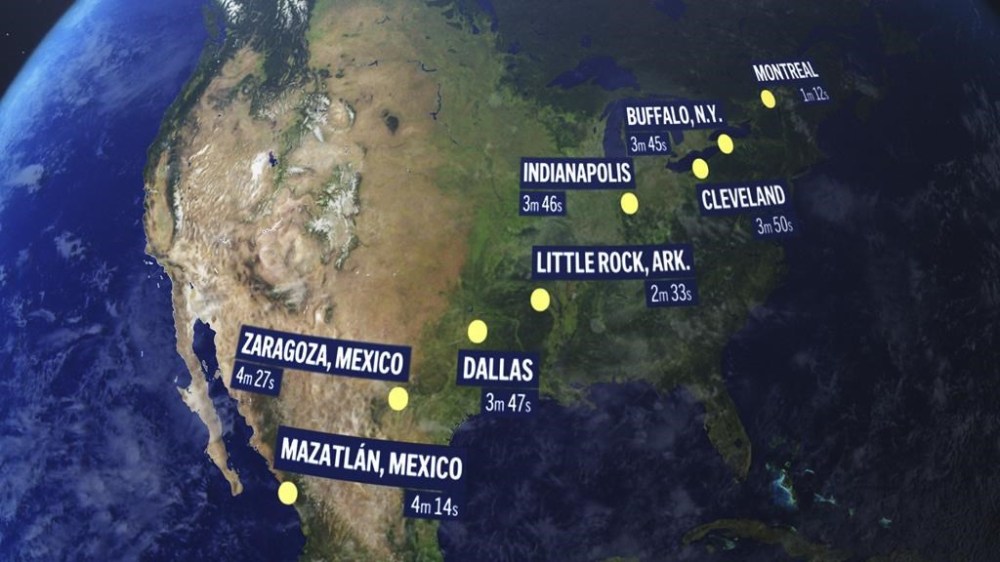
FILE - A total solar eclipse April 8 will enter over Mexico's Pacific coast, dash up through Texas and Oklahoma, crisscross the Midwest, Mid-Atlantic and New England, before exiting over eastern Canada into the Atlantic. (AP Photo, File)

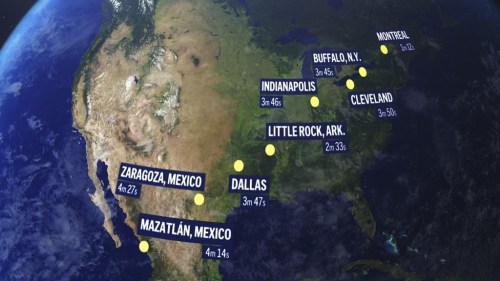
The moon will shroud the sun for up to 4 minutes, 28 seconds, a spectacle normally unfolding in remote corners of the globe but this time passing over major cities like Dallas, Indianapolis and Cleveland. An estimated 44 million people live within the path of totality, with another couple hundred million within 200 miles (320 kilometers), guaranteeing the continent’s biggest eclipse crowd ever.

Practically everyone on the continent will get to see a partial eclipse. You can watch the whole thing unfold online, too. NASA is offering several hours of streaming online from several cities along the totality path. The Associated Press will bring live coverage of watch parties and festivities.

And don’t forget your special glasses to safely watch the eclipse.

It all depends on the weather, of course. The National Weather Service is providing daily updates of its cloud cover forecasts along the path.

Here’s more to know about Monday’s celestial showstopper:

What’s a total solar eclipse?

The moon will line up perfectly between the Earth and the sun at midday, blotting out the sunlight. The full eclipse will last longer than usual because the moon will be just 223,000 miles (360,000 kilometers) from Earth, one of the year’s closest approaches. The closer the moon is to Earth, the bigger it is in the sky from our perspective, resulting in an especially long and intense period of sun-blocked darkness. Totality will last the longest over Mexico at 4 minutes, 28 seconds. Elsewhere along the track, like in Syracuse, New York, totality will last just 1 1/2 minutes.

What’s the eclipse path?

The moon’s shadow will slice a diagonal line from the southwest to the northeast across North America, briefly plunging communities along the track into darkness. Totality will enter the continent at Mazatlan, Mexico, and exit at Newfoundland in Canada. In between, 15 U.S. states from Texas to Maine will experience totality, including snippets of Tennessee and Michigan. It will be a repeat for Cape Girardeau, Missouri, and Carbondale, Illinois, which were also in prime position for 2017’s total solar eclipse.

A comet during the eclipse?

During totality, you may be able to spot a comet along with four planets, if you’re lucky. Jupiter will be to the left of the sun and Venus to the right. Saturn and Mars will be to the right of Venus, but fainter. The solar system’s three other planets will be in the vicinity, but virtually impossible to see with the naked eye. Comet 12P/Pons-Brooks is swinging past Earth, as it does every 71 years. Still faint, it will be positioned near Jupiter during the eclipse. But it will take a sudden outburst of dust and gas to see this so-called devil comet without a telescope, according to Anita Cochran of the University of Texas at Austin. But don’t waste time looking for it. “There is lots to see and not that long a time,” she said via email.

Last total solar eclipse in the U.S.?

The U.S. hasn’t experienced a total solar eclipse since Aug. 21, 2017, although a “ring of fire” solar eclipse crossed a part of the country last October. The moon was too far away then to completely blot out the sun, leaving a brilliant, burning ring around our star. The dramatic “ring of fire” stretched from Oregon to Texas, and crossed over Central America and Colombia, before exiting over Brazil. Kerrville, Texas, just west of San Antonio, is back in the bull’s-eye and expecting another packed house.

When’s the next one?

After Monday, the next total solar eclipse won’t occur until 2026. But it will graze the top of the world, dipping into Greenland, Iceland and Spain. The next one in 2027 will march across Spain and northern Africa, with totality lasting an incredible 6 1/2 minutes. North Americans will have to wait until 2033 for another total solar eclipse, but it will be limited to Alaska. In 2044, Western Canada, Montana and North Dakota will have front-row seats. And in 2045, the U.S. will once again experience a coast-to-coast total solar eclipse.

___

The Associated Press Health and Science Department receives support from the Howard Hughes Medical Institute’s Science and Educational Media Group. The AP is solely responsible for all content.

Report Error Submit a Tip

More Stories

As wildfire season rages, new book explores the frontlines of battling Canadian blazes

Reviewed by GC Cabana-Coldwell 4 minute read Preview

As wildfire season rages, new book explores the frontlines of battling Canadian blazes

Reviewed by GC Cabana-Coldwell 4 minute read Yesterday at 2:02 AM CDT

Mother Nature’s talking but we haven’t been listening, according to Jesse Winter, author of Wild Fire: Dispatches from a Country Ablaze, a book, released earlier this summer detailing Canada’s wildfire woes.

Currently, almost 1,000 wildfires across Northwestern Ontario, British Columbia, the Prairies, Northwest Territories and eastern provinces are burning in Canada. Forest fires also continue to wreak havoc in France, Spain and other European countries, and in the U.S. states of Oregon, California, Florida and Texas. While 2023 still rates as the world’s worst wildfire season, 2026 is hot on its heels.

Winter, a Vancouver-based, award-winning climate disaster photojournalist, spent more than two years on Wild Fire, his first book. In-depth research included working with firefighting crews and environmentalists as well as talking to researchers, politicians and evacuees. He says we need to rethink our views on wildfires or be prepared to watch more land go up in flames.

Canada, Winter writes, is “a country almost perfectly designed to burn.” At least 70 per cent of boreal forests, which cover one-third of the country, are stuffed with highly flammable spruce, fir, pine and tamarack trees as well as aspen, poplar and birch. With a wealth of available fuel, it’s no surprise, he writes, that an area twice the size of Vancouver Island burns every summer in Canada.

Read
Yesterday at 2:02 AM CDT

On the night table: Colson Whitehead

1 minute read Preview

On the night table: Colson Whitehead

1 minute read Yesterday at 2:02 AM CDT

Colson Whitehead

Author, Cool Machine

I’ve been reading Caroline Fraser. She has a book called Murderland about serial killers that came out last year. Her previous book, Prairie Fires, was a biography of Laura Ingalls Wilder. She’s a new author for me, and I’m going through that biography now. I never read Wilder’s books, but I liked the TV show when I was a kid; it’s one of those books that’s about a person’s life, but also pulls back to get the larger cultural panorama of America, talking about frontier life and and prairie life — it’s really interesting.

Colson Whitehead will launch Cool Machine, the third book in his Harlem trilogy, on Tuesday at 7 p.m. in the Muriel Richardson Auditorium at WAG-Qaumajuq (300 Memorial Blvd.) in an event presented by McNally Robinson Booksellers.

Read
Yesterday at 2:02 AM CDT

Giant Tiger decision creates giant void for desperate population

Niigaan Sinclair 5 minute read Preview

Giant Tiger decision creates giant void for desperate population

Niigaan Sinclair 5 minute read Friday, Jul. 31, 2026

A lot of Winnipeggers may shrug, but the end of Giant Tiger’s downtown store is a giant problem for many of the people living in the centre of the city.

It would have been difficult for anyone going into or passing by the Canadian discount chain’s Donald Street and Ellice Avenue location Thursday to miss the red notices posted on the store’s windows advising it will close on Nov. 7.

According to a 2024 Downtown Winnipeg BIZ report, about 18,000 people live in Winnipeg’s downtown.

More than 60,000 people work there, and some days — when there’s a big concert or the Jets play at Canada Life Centre, for example — the number of people spending time in the area increases significantly.

Read
Friday, Jul. 31, 2026

On eve of Folklorama, Ghana pavilion scrambles to replace stolen outfits

Chris Kitching 4 minute read Preview

On eve of Folklorama, Ghana pavilion scrambles to replace stolen outfits

Chris Kitching 4 minute read Friday, Jul. 31, 2026

Volunteers from Folklorama’s Ghana pavilion scrambled to replace cultural costumes for about 40 young dancers after the outfits were stolen in Winnipeg days before the annual festival begins.

Two plastic storage bins containing the costumes, to be worn by children and teenagers, were taken from the trunk of a parked car on Banning Street, near Notre Dame Avenue in the West End, likely late Wednesday or early Thursday.

“I felt sad that this has happened. I felt completely devastated for the mother who had them in her car,” said pavilion co-ordinator Abigail Larson. “The initial feeling of sadness changed to, ‘OK, how do we make this a positive?’”

The costumes belong to the Ghana Union of Manitoba Dancers, whose members have rehearsed for months for Folklorama, which begins Sunday.

Read
Friday, Jul. 31, 2026

Today’s horoscope

Georgia Nicols 4 minute read Preview

Today’s horoscope

Georgia Nicols 4 minute read 2:00 AM CDT

MOON ALERT: Avoid shopping (except food and gas) and important decisions from 7 a.m. until 4 p.m. today. After that, the moon moves from Pisces into Aries.

ARIES (March 21-April 19)

The day is a mixed bag. There are still fun opportunities to play and enjoy socializing with others. However, you might be sandbagged by someone who is critical or negative. Be careful with whom you choose to associate, because they might irk you. Focus on home repairs.

TAURUS (April 20-May 20)

Read
2:00 AM CDT

Excited Goldeyes fans buzz over Manitoba Mosquitoes’ name change

Grace Penner 4 minute read Preview

Excited Goldeyes fans buzz over Manitoba Mosquitoes’ name change

Grace Penner 4 minute read Friday, Jul. 31, 2026

BITE club has entered the ball park for a single game, filling the stands with mosquitoes — just not in the way you may think.

The Fish are participating an alternate identity takeover, one that many other teams in the minor baseball leagues have been having some fun with. The Winnipeg Goldeyes re-branded to pay homage to the province’s beloved summer creatures, the Manitoba Mosquitoes.

The Fargo-Moorhead RedHawks had some fun with its alternative identity, doing a five-game name change to the Woodchippers, a fun reference to the 1996 film Fargo.

Other honourable mentions are the Chicago Dogs, who switched over to the Chicago Wieners, the Sioux Fall Canaries transformed into the Minnehaha Martians, Milwaukee Milkmen became the Franklin Benjamins, and the Lake Country Dockhounds swapped to the Wisconsin Dive Bars.

Read
Friday, Jul. 31, 2026