Looking to pick up carpentry skills? In Newfoundland, you can learn to build a boat

Advertisement

Advertise with us

ST. JOHN'S, N.L. - There are many reasons a dozen people gathered two evenings a week this year in St. John's to build a traditional Newfoundland boat, bending and clamping long planks of wood and handling high-strength industrial glue.

Read this article for free:


or

Already have an account? Log in here »

To continue reading, please subscribe:

Subscribe and receive a limited-edition Free Press branded hat or tote.

Digital Subscription

One year of digital access for only $205*

  • Enjoy unlimited reading on winnipegfreepress.com
  • Read the E-Edition, our digital replica newspaper
  • Access News Break, our award-winning app
  • Play interactive puzzles

*First annual payment billed as $205.00 + GST for one year. This annual subscription will automatically renew at $233.00 + GST every 52 weeks (10% off the regular annual price of $259.35). Offer available to new and qualified returning subscribers only. Cancel any time.

To continue reading, please subscribe:

Add Free Press access to your Brandon Sun subscription for only an additional

$1 for the first 4 weeks*

  • Enjoy unlimited reading on winnipegfreepress.com
  • Read the E-Edition, our digital replica newspaper
  • Access News Break, our award-winning app
  • Play interactive puzzles
Start now

*Your next Brandon Sun subscription payment will increase by $1.00 and you will be charged $17.95 plus GST for four weeks. After four weeks, your payment will increase to $24.95 plus GST every four weeks.

Hey there, time traveller!
This article was published 07/04/2024 (909 days ago), so information in it may no longer be current.

ST. JOHN’S, N.L. – There are many reasons a dozen people gathered two evenings a week this year in St. John’s to build a traditional Newfoundland boat, bending and clamping long planks of wood and handling high-strength industrial glue.

Some, like John Handrigan of Placentia Junction, N.L., were drawn in by the history and felt a connection to the centuries of fishermen who had built similar boats — though without the help of power saws and Bostik 920FS marine sealant.

Others wanted to learn to build their own boats or had already started. Derrick Cove was constructing a vessel in a garage outside St. John’s, in tandem with the class.
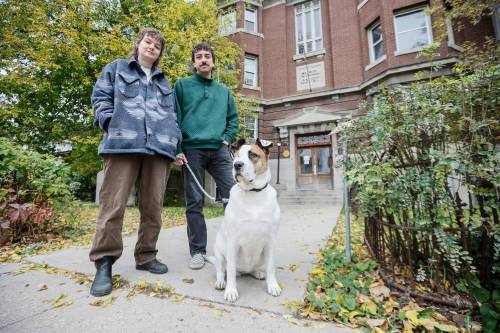
Student Derrick Cove with a traditional Newfoundland punt that he is learning how to build during the Winter semester at Memorial University of Newfoundland, in St. John's, Tuesday, March 26, 2024. THE CANADIAN PRESS/Paul Daly

“I’m retired, I don’t like sitting down and I want to try to retain some of my Newfoundland culture,” he explained during a class late last month.

And some enrolled to learn basic carpentry skills.

“There aren’t a lot of options for amateur, recreational woodworking learning,” said Ellen Davis, who works in public relations.

She laughed about running out of her office to be on time for her “boat course.”

“It’s really fun, and now at the end, we have this really cool project.”

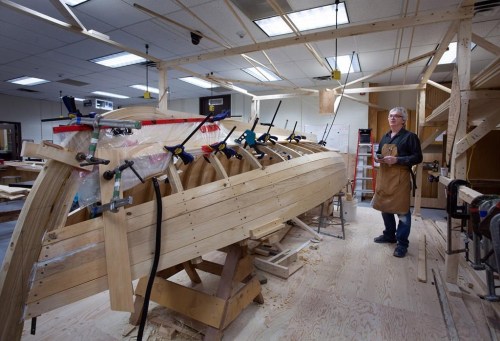
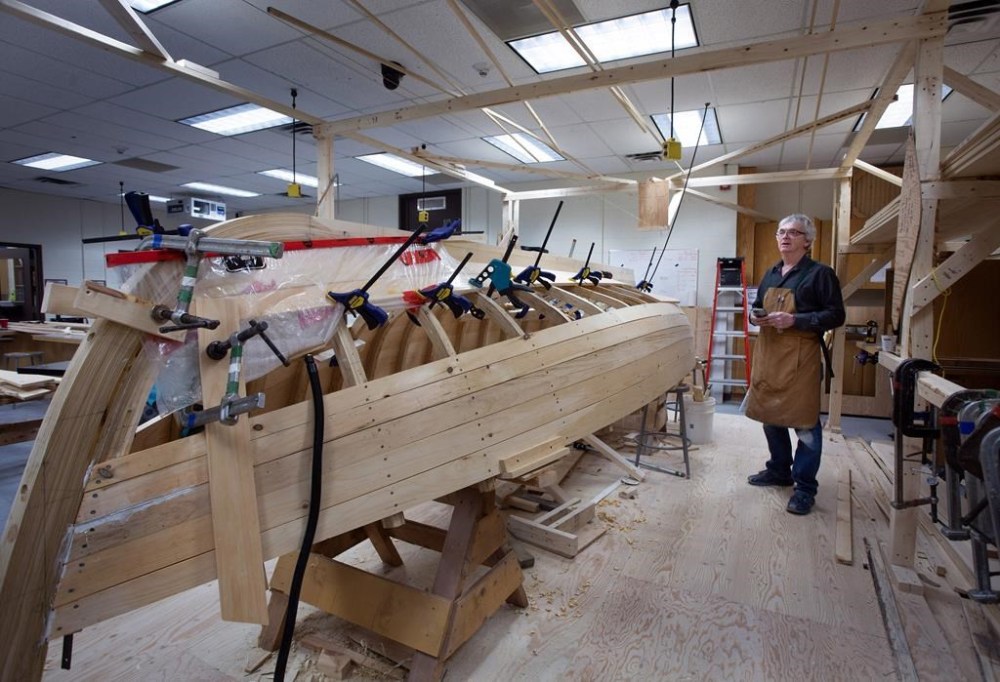
The 12-week course is offered through the Wooden Boat Museum of Newfoundland and Labrador in a wide, bright classroom at Memorial University. From January to late March, students built a 16-foot-long traditional wooden fishing boat, called a punt, or a rodney.

They began by laminating long strips of wood together to form the vessel’s keel, which runs the length of the craft from stern to bow. By late January, they had added the punt’s distinctively flat rear end, with its small planks running perpendicular to the keel below. And in late March, they were steaming and bending long, smile-shaped planks to fasten over the hull.

Instructor Jerome Canning, the museum’s resident wooden boat builder, weaved bits of historical context into his demonstrations, explaining how in the past fishermen would use simple geometry to build boats, since they didn’t have tapes or rulers.

“This is from my great-uncle’s tool box. It could be 100 years old,” Canning said in a late-January class, holding up a planing tool made of rusted black metal.

Once completed, the vessel is seaworthy and offered to the students for purchase, said Jim Dempsey, the museum’s president. They typically sell for about $5,000, and there have been bidding wars in the past among course participants, he said.

Punts and dories — another well-known Newfoundland and Labrador wooden fishing boat — can still be seen in outport communities, often painted in bright primary colours. Some fishermen use signature colours, particularly on the gunnels — or top rails — of the boat. Dempsey’s personal hallmark hue is forest green.

The 12-week course was first held in 2017, and several students have since gone on to construct their own boats, Dempsey said. The students often become close, and after they complete the course they follow each other’s progress on personal carpentry projects.

Ken Snelgrove, a retired Memorial University engineering professor, took the course with the museum in 2018. He loved it so much, he joined the museum’s board of directors and vowed to build a punt of his own, though he admits he hasn’t made much headway.

“I’ve tinkered with my own design, but haven’t really got a material start yet,” he said.

Snelgrove goes to every class to help out, joking that he’s there to “make sure (the students) don’t cut their arms off.”

Ellen Davis is not planning to build a boat just yet, but she said the course gave her the skills and confidence to begin building a closet.

“I’m definitely more comfortable with things like power tools, which I probably wouldn’t have even considered before,” she said during a class last month.

This year’s cohort has also become close, as Dempsey predicted. Davis said they learned from one another almost as much as they did from Canning.

She said he began the course by telling everyone to be humble and assume they’re all beginning with no prior knowledge. That made it safe for those who didn’t have building skills, since every question was valued as a learning opportunity, she said.

“It’s a really good environment,” she said. “I would love another course taught this exact way, in anything at all.”

This report by The Canadian Press was first published April 7, 2024.

Report Error Submit a Tip

More Stories

Jets bench boss Arniel talks rebuilding from last season’s struggles

Mike McIntyre and Ken Wiebe 12 minute read Preview

Jets bench boss Arniel talks rebuilding from last season’s struggles

Mike McIntyre and Ken Wiebe 12 minute read Thursday, Oct. 1, 2026

Scott Arniel has a lot on his plate these days.

But the head coach of the Winnipeg Jets took some time Thursday to sit down with Free Press hockey writers Mike McIntyre and Ken Wiebe to discuss a number of topics on the eve of a new hockey season. This interview has been condensed and edited for clarity.

Wiebe: What was the evaluation of last season like? What did you personally do in an attempt to improve after going from first-overall to 26th-overall?

I just went back and looked at things and made sure my communication was where it needed to be with my players. Was my communication where it needed to be with my boss, with my general manager (Kevin Cheveldayoff)? How our coaching staff worked. How we handled highs and lows. Things I felt I could have done better.

Read
Thursday, Oct. 1, 2026

A spiritual vision will help anchor a health civic outlook

John Longhurst 5 minute read 2:01 AM CDT

We have an election coming up. With that in mind, the Free Press asked some of their columnists to write about the challenges ahead and how the city can become better.

For Tom Brodbeck, the main challenge is finances — and how candidates will pay for their many promises for fixing roads, improving public safety and making transit better.

Rebecca Chambers said that the concerns of inner-city residents need to be taken seriously by those who aspire to work at city hall.

Niigaan Sinclair said the most pressing issue in Winnipeg isn’t construction projects, light-rail transit, public safety, taxes or social services. For him, it’s the city’s relationship with Indigenous people.

Free Press staff 2 minute read 2:01 AM CDT

Advance voting for civic and school board elections begins next week.

Voters can cast early ballots for the Oct. 28 election in certain locations from Monday through Oct. 23.

Eligible voters can use their address to search for a convenient location.

Early votes can be cast at the council building at city hall (510 Main St.) every day, except weekends and Thanksgiving, from Monday to Oct. 23.

Gordon Bell rings in a century

Maggie Macintosh 13 minute read Preview

Gordon Bell rings in a century

Maggie Macintosh 13 minute read Updated: Yesterday at 8:06 PM CDT

Mischka Valencia had gotten used to the hum of heavy machinery at Gordon Bell High School.

“Ever since I’ve been here, it’s all been under construction,” the Grade 12 student said, standing on the sidelines of the brightly painted revamped outdoor basketball court. “I had no idea this was a court.”

The Filipina teenager landed in Winnipeg several months after the inner-city campus had transformed into a construction site.

It was the fall of 2023 and Mischka’s priorities were fitting in, befriending classmates and learning a third language via first-period French.

Read
Updated: Yesterday at 8:06 PM CDT

Volunteer pop-up library axed from Manitoba Youth Centre

Matthew Frank 4 minute read Preview

Volunteer pop-up library axed from Manitoba Youth Centre

Matthew Frank 4 minute read 2:01 AM CDT

Manitoba Corrections has cancelled a pop-up library program at the Manitoba Youth Centre, leaving inmates without librarian services and fewer options to borrow certain books.

The Prison Libraries Committee, part of the non-profit Manitoba Library Association, operated and funded the volunteer program since 2024 before it was shut down by the province last month. The group previously partnered with the province to offer the service because the facility has no dedicated library of its own.

“It is concerning that community members who are incarcerated, especially youth, are losing out on meaningful programming, access to information and rehabilitation efforts, which are offered at no cost to (Manitoba) Corrections. We urge Manitoba Justice to promote more library services and programming, not less,” said a Sept. 24 letter from the non-profit addressed to the justice minister.

Ashley Huot, chair of the Prison Libraries Committee, said she was puzzled when she received an email last month from Manitoba Corrections stating that the pop-up library was no longer needed.

Read
2:01 AM CDT

Health minister warns $1.2 billion in annual federal funding set to expire in March

Scott Billeck 4 minute read Preview

Health minister warns $1.2 billion in annual federal funding set to expire in March

Scott Billeck 4 minute read Thursday, Oct. 1, 2026

Manitoba’s health minister is warning of possible cuts to health care with $1.2 billion in annual funding from Ottawa set to expire next year.

“We’re very concerned that what would be the largest cut to health care in a generation is right in front of us,” Health Minister Uzoma Asagwara said Thursday at the Manitoba legislature. “It means that services that Manitobans depend on will be in jeopardy and be at risk.

“Any reductions, any cuts from Canada, will have direct impacts on the health outcomes of Manitobans.”

Asagwara, who serves as the provincial and territorial health minister lead, chaired a virtual meeting Tuesday with provincial and territorial health ministers to discuss federal funding for health care, mental health care and substance use services, which is scheduled to expire March 31, 2027.

Read
Thursday, Oct. 1, 2026