The House votes for possible TikTok ban in the US, but don’t expect the app to go away anytime soon

Advertisement

Advertise with us

WASHINGTON (AP) — The House passed legislation Saturday that would ban TikTok in the United States if the popular social media platform's China-based owner doesn’t sell its stake within a year, but don't expect the app to go away anytime soon.

Read this article for free:


or

Already have an account? Log in here »

To continue reading, please subscribe:

Subscribe and receive a limited-edition Free Press branded hat or tote.

Digital Subscription

One year of digital access for only $205*

  • Enjoy unlimited reading on winnipegfreepress.com
  • Read the E-Edition, our digital replica newspaper
  • Access News Break, our award-winning app
  • Play interactive puzzles

*First annual payment billed as $205.00 + GST for one year. This annual subscription will automatically renew at $233.00 + GST every 52 weeks (10% off the regular annual price of $259.35). Offer available to new and qualified returning subscribers only. Cancel any time.

To continue reading, please subscribe:

Add Free Press access to your Brandon Sun subscription for only an additional

$1 for the first 4 weeks*

  • Enjoy unlimited reading on winnipegfreepress.com
  • Read the E-Edition, our digital replica newspaper
  • Access News Break, our award-winning app
  • Play interactive puzzles
Start now

*Your next Brandon Sun subscription payment will increase by $1.00 and you will be charged $17.95 plus GST for four weeks. After four weeks, your payment will increase to $24.95 plus GST every four weeks.

Hey there, time traveller!
This article was published 20/04/2024 (897 days ago), so information in it may no longer be current.

WASHINGTON (AP) — The House passed legislation Saturday that would ban TikTok in the United States if the popular social media platform’s China-based owner doesn’t sell its stake within a year, but don’t expect the app to go away anytime soon.

The decision by House Republicans to include TikTok as part of a larger foreign aid package, a priority for President Joe Biden with broad congressional support for Ukraine and Israel, fast-tracked the ban after an earlier version had stalled in the Senate. A standalone bill with a shorter, six-month selling deadline passed the House in March by an overwhelming bipartisan vote as both Democrats and Republicans voiced national security concerns about the app’s owner, the Chinese technology firm ByteDance Ltd.

The modified measure, passed by a 360-58 vote, now goes to the Senate after negotiations that lengthened the timeline for the company to sell to nine months, with a possible additional three months if a sale is in progress.
FILE - The TikTok Inc. building is seen in Culver City, Calif., March 17, 2023. The House has passed legislation Saturday, April 20, 2024, to ban TikTok in the U.S. if its China-based owner doesn't sell its stake, sending it to the Senate as part of a larger package of bills that would send aid to Ukraine and Israel. House Republicans' decision to add the TikTok bill to the foreign aid package fast-tracked the legislation after it had stalled in the Senate. The aid bill is a priority for President Joe Biden that has broad congressional support. (AP Photo/Damian Dovarganes, File)

Legal challenges could extend that timeline even further. The company has indicated that it would likely go to court to try and block the law if it passes, arguing it would deprive the app’s millions of users of their First Amendment rights.

TikTok has lobbied hard against the legislation, pushing the app’s 170 million U.S. users — many of whom are young — to call Congress and voice opposition. But the ferocity of the pushback angered lawmakers on Capitol Hill, where there is broad concern about Chinese threats to the U.S. and where few members use the platform themselves.

“We will not stop fighting and advocating for you,” TikTok CEO Shou Zi Chew said in a video that was posted on the platform last month and directed toward the app’s users. “We will continue to do all we can, including exercising our legal rights, to protect this amazing platform that we have built with you.”

The bill’s quick path through Congress is extraordinary because it targets one company and because Congress has taken a hands-off approach to tech regulation for decades. Lawmakers had failed to act despite efforts to protect children online, safeguard users’ privacy and make companies more liable for content posted on their platforms, among other measures. But the TikTok ban reflects widespread concerns from lawmakers about China.

Members of both parties, along with intelligence officials, have worried that Chinese authorities could force ByteDance to hand over American user data or direct the company to suppress or boost TikTok content favorable to its interests. TikTok has denied assertions that it could be used as a tool of the Chinese government and has said it has not shared U.S. user data with Chinese authorities.

The U.S. government has not publicly provided evidence that shows TikTok shared U.S. user data with the Chinese government or tinkered with the company’s popular algorithm, which influences what Americans see.

The company has good reason to think a legal challenge could be successful, having seen some success in previous legal fights over its operations in the U.S.. In November, a federal judge blocked a Montana law that would ban TikTok use across the state after the company and five content creators who use the platform sued.

In 2020, federal courts blocked an executive order issued by then-President Donald Trump to ban TikTok after the company sued on the grounds that the order violated free speech and due process rights. His administration brokered a deal that would have had U.S. corporations Oracle and Walmart take a large stake in TikTok. The sale never went through for a number of reasons; one was China, which imposed stricter export controls on its technology providers.

Dozens of states and the federal government have put in place TikTok bans on government devices. Texas’ ban was challenged last year by The Knight First Amendment Institute at Columbia University, which argued in a lawsuit that the policy was impeding academic freedom because it extended to public universities. In December, a federal judge ruled in favor of the state.

Organizations such as the American Civil Liberties Union have backed the app. “Congress cannot take away the rights of over 170 million Americans who use TikTok to express themselves, engage in political advocacy, and access information from around the world,” said Jenna Leventoff, a lawyer for the group.

Since mid-March, TikTok has spent $5 million on TV ads opposing the legislation, according to AdImpact, an advertising tracking firm. The ads have included a range of content creators, including a nun, extolling the positive impacts of the platform on their lives and arguing a ban would trample on the First Amendment. The company has also encouraged its users to contact Congress, and some lawmakers have received profanity-laced calls.
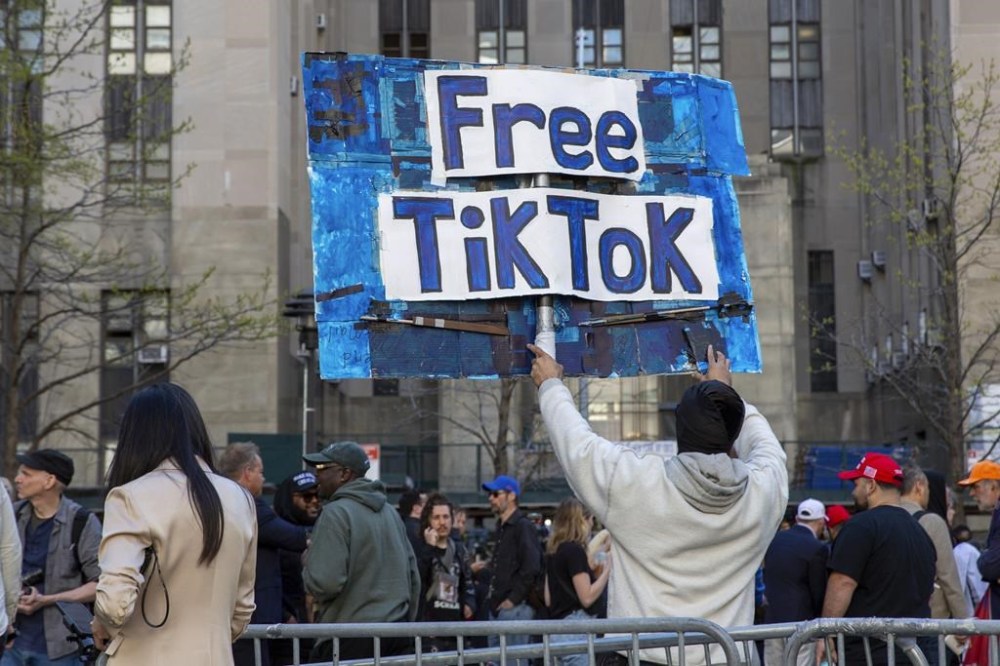
FILE - A man carries a Free TikTok sign in front of the courthouse where the hush-money trial of Donald Trump got underway April 15, 2024, in New York. The House has passed legislation Saturday, April 20, to ban TikTok in the U.S. if its China-based owner doesn't sell its stake, sending it to the Senate as part of a larger package of bills that would send aid to Ukraine and Israel. House Republicans' decision to add the TikTok bill to the foreign aid package fast-tracked the legislation after it had stalled in the Senate. The aid bill is a priority for President Joe Biden that has broad congressional support. (AP Photo/Ted Shaffrey, File)

“It is unfortunate that the House of Representatives is using the cover of important foreign and humanitarian assistance to once again jam through a ban bill that would trample the free speech rights of 170 million Americans, devastate 7 million businesses, and shutter a platform that contributes $24 billion to the U.S. economy, annually,” said Alex Haurek, a spokesman for the company.

California Rep. Ro Khanna, a Democrat, voted against the legislation. He said he thinks there could have been less restrictive ways to go after the company that wouldn’t result in a total ban or threaten free speech.

“I think it’s not going to be well received,” Khanna said. “It’s a sign of the Beltway being out of touch with where voters are.”

Nadya Okamoto, a content creator who has roughly 4 million followers on TikTok, said she has been having conversations with other creators who are experiencing “so much anger and anxiety” about the bill and how it’s going to impact their lives. The 26-year-old, whose company “August” sells menstrual products and is known for her advocacy around destigmatizing menstrual periods, makes most of her income from TikTok.

“This is going to have real repercussions,” she said.

___

Hadero reported from New York.

Report Error Submit a Tip

More Stories

Six high school hockey programs ceased operations following new Hockey Manitoba policy

Joshua Frey-Sam 7 minute read Preview

Six high school hockey programs ceased operations following new Hockey Manitoba policy

Joshua Frey-Sam 7 minute read Friday, Oct. 2, 2026

She lived the best of both worlds.

For the last three years, the 17-year-old wore a sweater for two different hockey programs — her high school team and AAA club in the Manitoba Female Hockey League — and was preparing to flourish in both colours again this winter.

Recently, however, the blue-liner was disappointed to learn she is no longer eligible to play her Grade 12 season with her school owing to a new policy imposed by Hockey Manitoba that bans players from participating in the Manitoba Women’s High School Hockey League if they are rostered on a U18 AAA team.

The rule applies to all athletes who play for both Winnipeg-based and rural AAA teams.

Read
Friday, Oct. 2, 2026

Bombers get ‘whopped’ in Montreal

Taylor Allen 5 minute read Preview

Bombers get ‘whopped’ in Montreal

Taylor Allen 5 minute read Yesterday at 11:32 PM CDT

MONTREAL — It’s hard to fathom that the Winnipeg Blue Bombers smacked these Montreal Alouettes five weeks ago.

The team that pulled off that 44-28 upset at Princess Auto Stadium was nowhere to be found in La Belle Province on Saturday night.

You can, however, now find them in the basement of the West Division at 7-8 after getting completely outmatched and outclassed by the Als in a 37-10 beatdown.

“This was bad,” left tackle Stanley Bryant told the Free Press postgame. “They basically had their way all around. They whopped our ass.”

Read
Yesterday at 11:32 PM CDT

Puzzles Palace

1 minute read Monday, Jul. 27, 2026

To solve our puzzles, please subscribe with this special offer: |

May be whiff of truth to ex’s odour ardour

Maureen Scurfield 5 minute read Yesterday at 2:01 AM CDT

DEAR MISS LONELYHEARTS: I ran into an old boyfriend I used to curl on a team with, and we went for drinks. We’ve been almost eight years apart, and I couldn’t remember why we broke up, as we always had such a great time together.

It wasn’t until the second date — this time on a weekend — that it came back to me, with a jolt. Pee-yew! I remembered he doesn’t use deodorant on weekends. Why? He enjoys his own body odour. I recalled that a bit too late, and it was just as awful as ever! I went home early.

Tonight, he called and I refused him another date. I said, “Think back. You remember why we broke up?” Then he said, “Oh yeah, you hated my no-deodorant weekend policy. Well, guess what? Some women don’t mind!” I said I really doubted that, and that ended the conversation. Miss L., wouldn’t any women find stinky underarms offensive?

— Sensitive Nose, Fort Richmond

Winnipeggers witness unveiling of Japanese Canadian monument in B.C.

Morgan Modjeski 6 minute read Preview

Winnipeggers witness unveiling of Japanese Canadian monument in B.C.

Morgan Modjeski 6 minute read Yesterday at 8:39 PM CDT

As Miki Stewart gathered with her family at the Japanese Cultural Association of Manitoba on Saturday afternoon, she was thinking of her parents, Yoshimaru and Yoshi Abe.

Both Stewart, 80, and her sister Yumi Falk, 81, alongside an older brother, were born in the Tashme internment camp in British Columbia. They were among more than 2,600 Japanese Canadians who were forcefully removed and interred at the camp following the bombing of Pearl Harbour and Canada’s declaration of war on Japan in 1941.

“They didn’t talk much about how they suffered,” Stewart said of her parents. “But they did.”

She was amongst a group of more than 150 people who gathered at the association’s McPhillips headquarters on Saturday afternoon to watch the unveiling of the Japanese Canadian Monument in Victoria B.C.

Read
Yesterday at 8:39 PM CDT

Letters, Oct. 3

7 minute read Yesterday at 2:01 AM CDT

A morning in the life …

My very first lesson does not start when I walk into that lecture hall, oh no — it starts long before. It begins when I walk to my car, check the estimated arrival time to the University of Manitoba and hope that Winnipeg traffic agrees with it.

A drive that appears completely manageable changes almost immediately when I’m greeted by a tsunami of orange pylons and a line of cars that appears to go on forever. Traffic moves by the inch, lanes magically disappear and the detour I took yesterday now has a detour of its own. These factors make me do a calculation that I have become all too familiar with. How late can I arrive and still find parking, run to my class across campus and get to class with enough time left to make it worth it?

I have grown used to people saying, “Why not just leave earlier?” I do. But when I’m already leaving for my 8:30 a.m. class at 7 a.m., there’s only so much I can do. This drive that some would think is relaxing is one that feels like an assignment that I didn’t know I had to complete and is due at 8:30 a.m.