Ottawa puts up $50M in federal budget to hedge against job-stealing AI
Advertisement
Read this article for free:
or
Already have an account? Log in here »
To continue reading, please subscribe:

Digital Subscription
One year of digital access for only $205*
- Enjoy unlimited reading on winnipegfreepress.com
- Read the E-Edition, our digital replica newspaper
- Access News Break, our award-winning app
- Play interactive puzzles
*First annual payment billed as $205.00 + GST for one year. This annual subscription will automatically renew at $233.00 + GST every 52 weeks (10% off the regular annual price of $259.35). Offer available to new and qualified returning subscribers only. Cancel any time.
To continue reading, please subscribe:
Add Free Press access to your Brandon Sun subscription for only an additional
$1 for the first 4 weeks*
- Enjoy unlimited reading on winnipegfreepress.com
- Read the E-Edition, our digital replica newspaper
- Access News Break, our award-winning app
- Play interactive puzzles
*Your next Brandon Sun subscription payment will increase by $1.00 and you will be charged $17.95 plus GST for four weeks. After four weeks, your payment will increase to $24.95 plus GST every four weeks.
Read unlimited articles for free today:
or
Already have an account? Log in here »
Hey there, time traveller!
This article was published 21/04/2024 (895 days ago), so information in it may no longer be current.
OTTAWA – Worried artificial intelligence is coming for your job? So is the federal government — enough, at least, to set aside $50 million for skills retraining for workers.
One of the centrepiece promises in the federal budget released Tuesday was $2.3 billion in investments aiming to boost adoption of the technology and the artificial intelligence industry in Canada.
But tucked alongside that was a promise to invest $50 million over four years “to support workers who may be impacted by AI.” Workers in “potentially disrupted sectors and communities” will receive new skills training through the Sectoral Workforce Solutions Program.
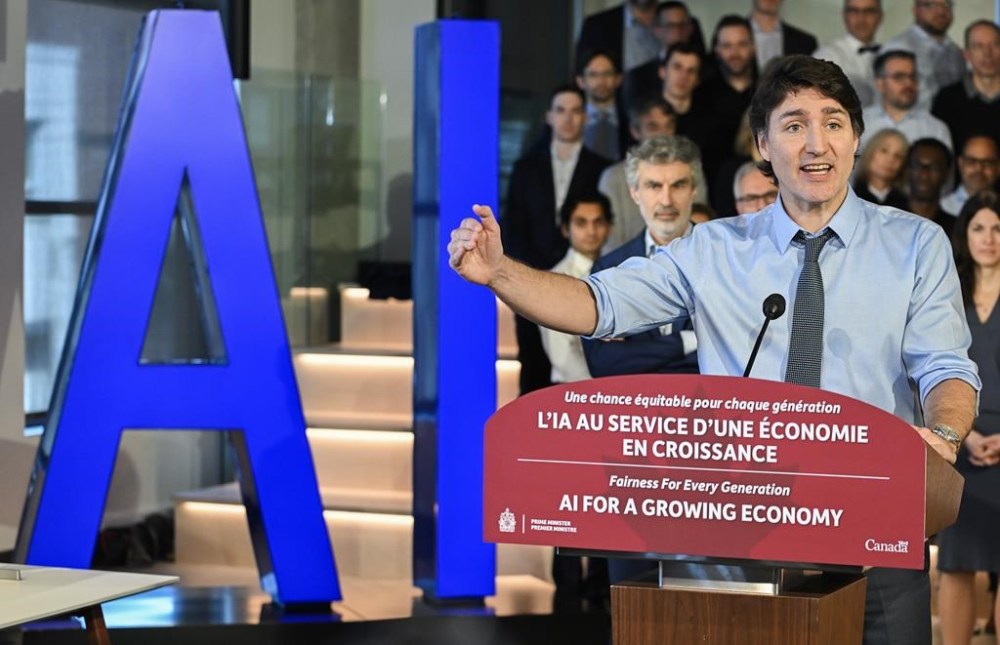
“There is a significant transformation of the economy and society on the horizon around artificial intelligence,” said Joel Blit, an associate professor of economics at the University of Waterloo.
Some jobs will be lost, others will be created, “but there’s going to be a transition period that could be somewhat chaotic.”
While jokes about robots coming to take jobs predate the emergence of generative AI systems in late 2022, the widespread availability of systems like ChatGPT made those fears real for many, even as workers across industries began integrating the technology into their workday.
In June 2023, a briefing note for Finance Minister Chrystia Freeland warned the impact of generative AI “will be felt across all industries and around 40 per cent of all working hours could be impacted.”
“Banking, insurance and energy appear to have higher potential for automation compared to other sectors,” says the note, obtained through access to information and citing information from Accenture.
“This could have substantial impacts on jobs and skills requirements.”
The budget only singles out “creative industries” as an affected sector that will be covered by the program. In February, the Canadian TV, film, and music industries asked MPs for protection against AI, saying the tech threatens their livelihood and reputations.
Finance Canada did not respond to questions asking what other sectors or types of jobs would be covered under the program.
“The creative industries was used as an illustrative example, and not intended as an exclusion of other affected areas,” deputy Finance spokesperson Caroline Thériault said in a statement.
In an interview earlier this year, Bea Bruske, president of the Canadian Labour Congress, said unions representing actors and directors have been very worried about how their likenesses or their work could be used by AI systems. But the “reality is that we have to look at the implication of AI in all jobs,” she said.
Blit explained large language models and other generative AI can write, come up with new ideas and then test those ideas, analyze data, as well as generate computer programming code, music, images, and video.
Those set to be affected are individuals in white-collar professions, like people working in marketing, health care, law and accounting.
In the longer run, “it’s actually quite hard to predict who is going to be impacted,” he said. “What’s going to happen is that entire industries, entire processes are going to be reimagined around this new technology.”
AI is an issue “across sectors, but certainly clerical and customer service jobs are more vulnerable,” Hugh Pouliot, a spokesperson for the Canadian Union of Public Employees, said in an email.
The federal government has used AI in nearly 300 projects and initiatives, new research published earlier this month revealed.
According to Viet Vu, manager of economic research at Toronto Metropolitan University’s the Dais, the impact of AI on workers in a sector like the creative industry doesn’t have to be negative.
“That’s only the case if you adopt it irresponsibly,” he said, pointing out creative professionals have been adopting new digital tools in their work for years.
He noted only four per cent of Canadian businesses are using any kind of artificial intelligence or machine learning. “And so we’re really not there yet for these frontier models and frontier technologies” to be making an impact.
When it comes to the question of how AI will affect the labour market, it’s more useful to think about what types of tasks technology can do better, as opposed to whether it will replace entire jobs, Vu said.
“A job is composed of so many different tasks that sometimes even if a new technology comes along and 20, 30 per cent of your job can be done using AI, you still have that 60, 70 per cent left,” he said.
“So it’s rare that (an) entire occupation is actually sort of erased out of existence because of technology.”
Finance Canada also did not respond to questions about what new skills the workers would be learning.
Vu said there are two types of skills it makes sense to focus on in retraining — computational thinking, or understanding how computers operate and make decisions, and skills dealing with data.
There is no AI system in the world that does not use data, he said. “And so being able to actually understand how data is curated, how data is used, even some basic data analytics skills, will go a really long way.”
But given the scope of the change the AI technology is set to trigger, critics say a lot more than $50 million will be necessary.
Blit said the money is a good first step but won’t be “close to enough” when it comes to the scale of the coming transformation, which will be comparable to globalization or the adoption of computers.

Valerio De Stefano, Canada research chair in innovation law and society at York University, agreed more resources will be necessary.
“Jobs may be reduced to an extent that reskilling may be insufficient,” and the government should look at “forms of unconditional income support such as basic income,” he said.
The government should also consider demanding AI companies “contribute directly to pay for any social initiative that takes care of people who lose their jobs to technology” and asking “employers who reduce payrolls and increase profits thanks to AI to do the same.”
“Otherwise, society will end up subsidizing tech businesses and other companies as they increase profit without giving back enough for technology to benefit us all.”
This report by The Canadian Press was first published April 21, 2024.
Related Articles
Eight U.S. newspapers sue ChatGPT-maker OpenAI and Microsoft for copyright infringement
Advertisement Advertise With Us
Advertisement Advertise With Us