Corals bred in a zoo have joined Europe’s largest reef. This is offering scientists hope

Advertisement

Advertise with us

ARNHEM, Netherlands (AP) — Just like the animals on Noah’s Ark, the corals arrived in a pair.

Read this article for free:


or

Already have an account? Log in here »

To continue reading, please subscribe:

Subscribe and receive a limited-edition Free Press branded hat or tote.

Digital Subscription

One year of digital access for only $205*

  • Enjoy unlimited reading on winnipegfreepress.com
  • Read the E-Edition, our digital replica newspaper
  • Access News Break, our award-winning app
  • Play interactive puzzles

*First annual payment billed as $205.00 + GST for one year. This annual subscription will automatically renew at $233.00 + GST every 52 weeks (10% off the regular annual price of $259.35). Offer available to new and qualified returning subscribers only. Cancel any time.

To continue reading, please subscribe:

Add Free Press access to your Brandon Sun subscription for only an additional

$1 for the first 4 weeks*

  • Enjoy unlimited reading on winnipegfreepress.com
  • Read the E-Edition, our digital replica newspaper
  • Access News Break, our award-winning app
  • Play interactive puzzles
Start now

*Your next Brandon Sun subscription payment will increase by $1.00 and you will be charged $17.95 plus GST for four weeks. After four weeks, your payment will increase to $24.95 plus GST every four weeks.

Hey there, time traveller!
This article was published 26/04/2024 (870 days ago), so information in it may no longer be current.

ARNHEM, Netherlands (AP) — Just like the animals on Noah’s Ark, the corals arrived in a pair.

On Monday, divers with gloved hands gently nestled the self-bred corals from the World Coral Conservatory project among their cousins in Europe’s largest coral reef at the Burgers’ Zoo in the Netherlands.

“This is the first project where we started to keep these corals with a known origin. As we know exactly where they’re coming from, they have the potential to be placed back into the wild. … So it is very important to keep these corals, as it’s going not very well in the wild,” Nienke Klerks, a biologist at the Royal Burgers’ Zoo in Arnhem, told The Associated Press.
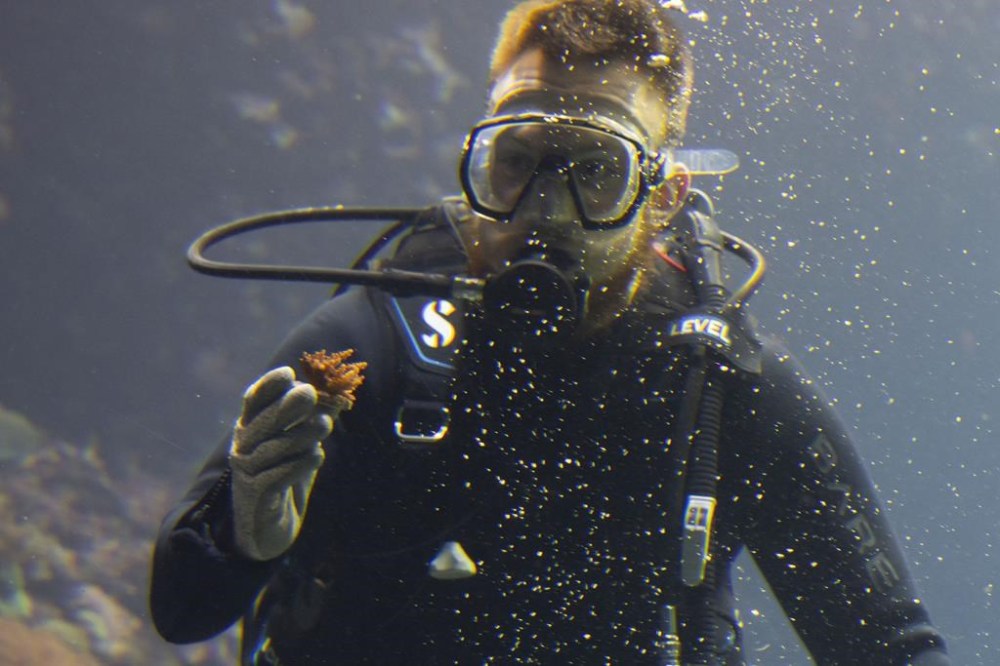
Divers with gloved hands gently nestled the first self-bred corals from the World Coral Conservatory project amongst their cousins in Europe's largest coral reef at the Burgers' Zoo in Arnhem, eastern Netherlands, Monday, April 22, 2024. (AP Photo/Peter Dejong)

It’s among several projects worldwide seeking to address the decline of coral reef populations, which are suffering from bleaching caused by rising sea temperatures. Corals are central to marine ecosystems, and while these projects won’t stem the tide of damage from human-caused climate change, they are seen as part of broader solutions.

The World Coral Conservatory hopes to create a bank of corals in aquariums across Europe that could be used to repopulate wild coral reefs if they succumb to the stress of climate change or pollution.

Along with two zoos in France and the originator of the project — the Monaco Scientific Center — the zoo in the east of the Netherlands took in more than a dozen coral fragments from off the coast of Seychelles in east Africa.

The Dutch zoo has been propagating the corals since 2022, allowing them to grow in a highly regulated environment before they were large enough to join the rest of the reef.

“We test it behind the scenes … what works for these corals. In that way, we know where to place them and how to keep them,” zookeeper Pascal Kik said.

Each diver held up a coral — one that resembled a large mushroom, the other a decorative cookie — to be photographed by reporters before placing them on a ledge near the center of the 8-million-liter (2.1-million-gallon) tank.

Few of the other corals at the zoo come from the wild. They are either shared by other zoos or turned over by Dutch customs officers after being confiscated. Coral poaching is a major threat to coral reefs in parts of Asia.

That would make it difficult to return the corals to the wild. But the team knows exactly where their 14 corals came from, making it more likely they could be successfully reintroduced if needed.

Corals area keystone marine species, according to Mark Eakin, executive secretary for the International Coral Reef Society. Eakin, retired coral monitoring chief at the U.S. National Oceanic and Atmospheric Administration, says that around 25% of marine animals spend some part of their lives dependent on coral reefs.

That makes projects such as the one in Arnhem all the more important to pursue, he said.

“We are in a situation where we really need to be taking any possible action we can,” Eakin told AP.

Earlier in April, scientists from the NOAA and International Coral Reef Initiative said that coral reefs around the world are experiencing global bleaching for the fourth time.

Bleaching occurs when coral under stress expels the algae that gives them their vibrant colors. The algae is also a coral’s food source, and if the bleaching lasts for too long or is too severe, the coral could die.

In the world’s largest coral reef ecosystem, Australia’s Great Barrier Reef, bleaching affected 90% of the coral assessed in 2022. The Florida Coral Reef, the third-largest, experienced significant bleaching last year.

Terry Hughes of Australia’s James Cook University, an expert on the Great Barrier Reef, argues that the world needs faster, bolder efforts to stop the damage from climate change, instead of small-scale restoration projects like this one.

“You can’t replace a magnificent ecosystem with an aquarium,” he said.

Others say every little bit helps.

“Coral reefs would be one of the first systems to totally collapse due to climate change,’’ said Ronald Osinga, a marine biologist who specializes in corals at Wageningen University in the Netherlands.

“It’s sad that it has to be like this,” said Osinga, who is not involved in the Dutch zoo initiative. But projects like this are a “good backup plan.”

___

Follow AP climate coverage at: https://apnews.com/hub/climate-change

Report Error Submit a Tip

More Stories

Corals bred in a zoo have joined Europe’s largest reef. This is offering scientists hope

Molly Quell, The Associated Press 4 minute read Preview

Corals bred in a zoo have joined Europe’s largest reef. This is offering scientists hope

Molly Quell, The Associated Press 4 minute read Friday, Apr. 26, 2024

ARNHEM, Netherlands (AP) — Just like the animals on Noah’s Ark, the corals arrived in a pair.

On Monday, divers with gloved hands gently nestled the self-bred corals from the World Coral Conservatory project among their cousins in Europe’s largest coral reef at the Burgers’ Zoo in the Netherlands.

“This is the first project where we started to keep these corals with a known origin. As we know exactly where they’re coming from, they have the potential to be placed back into the wild. … So it is very important to keep these corals, as it’s going not very well in the wild,” Nienke Klerks, a biologist at the Royal Burgers’ Zoo in Arnhem, told The Associated Press.

It’s among several projects worldwide seeking to address the decline of coral reef populations, which are suffering from bleaching caused by rising sea temperatures. Corals are central to marine ecosystems, and while these projects won’t stem the tide of damage from human-caused climate change, they are seen as part of broader solutions.

Read
Friday, Apr. 26, 2024

Fallis’s comic thriller infiltrates book club

Ben Sigurdson 3 minute read Preview

Fallis’s comic thriller infiltrates book club

Ben Sigurdson 3 minute read 6:00 AM CDT

The Free Press Book Club and McNally Robinson Booksellers are pleased to welcome Toronto author Terry Fallis to the next virtual meeting on Tuesday, September 29 at 7 p.m. to read from and discuss his novel The Marionette.

Fallis, a former lawyer, bureaucrat and political consultant, is the author of 10 bestselling novels and the two-time winner of the Stephen Leacock Medal for Humour (in 2015 for No Relation and in 2008 for The Best Laid Plans, which also won CBC’s Canada Reads in 2011).

His 11th novel, An End In Itself, will be published in November by McClelland & Stewart, who also published The Marionette in October 2025 (and which was also longlisted for the Leacock medal).

The Marionette follows James Norval, bestselling author of a series of thrillers featuring fictional CIA agent Hunter Chase. While in Tajikistan researching his next Hunter Chase novel, Norval is detained by local officials and subsequently freed and ferried away by the Canadian Security Intelligence Service (CSIS).

Read
6:00 AM CDT

Sunday-night auto aficionados work to steer away from unwelcome elements they say aren’t a part of their tradition

Zoe Pierce 12 minute read Preview

Sunday-night auto aficionados work to steer away from unwelcome elements they say aren’t a part of their tradition

Zoe Pierce 12 minute read Yesterday at 1:37 PM CDT

The red 1969 Dodge Coronet Super Bee out for a cruise on Portage Avenue draws admiring eyes from onlookers on a recent Sunday night, many of them seeing a specimen of the now-rare muscle car for the first time on a Winnipeg street. Or any other street, for that matter.

Longtime car enthusiast Bob Sudoma was behind the wheel, participating in the decades-old show-offy summer tradition.

The Sunday night cruise is built around a simple idea: proud car owners take their beloved vehicles for a spin to meet up with others of the same autophile ilk.

Less-fortunate appreciators, or just curious folks, also gather along the route to watch the highly-polished parade. Portage Avenue is one of cruise night’s best-known stretches.

Read
Yesterday at 1:37 PM CDT

Sex assault charges against basketball referee stayed

Dean Pritchard 3 minute read Preview

Sex assault charges against basketball referee stayed

Dean Pritchard 3 minute read Yesterday at 6:09 PM CDT

A Winnipeg basketball referee accused of sexual offences involving three men has had criminal charges against him stayed.

Michael Shane Maryk, 45, had been set to stand trial July 20 on five counts of sexual assault and two counts of committing an indecent act, but instead agreed to a one-year peace bond prohibiting him from having any contact with the three men.

Maryk was employed by the Manitoba Association of Basketball Officials at the time the offences were alleged to have occurred.

The peace bond requires that Maryk not come within 200 metres of the men’s homes, schools or places of worship and have no contact with their families.

Read
Yesterday at 6:09 PM CDT

Nifty neighbours also jonesing for geniality

Maureen Scurfield 4 minute read 2:01 AM CDT

DEAR MISS LONELYHEARTS: Recently, a new couple with no children moved onto our cul de sac, and everybody is taking notice! This attractive pair with no kids both drive amazing cars, work from home and leave their garage doors up a lot. Everybody on the street walks by to sneak a peek into the big garage at just about any time of day.

Lately, the man’s been out on his front lawn in a muscle shirt in the late afternoon, planting shrubs and putting up stylish fall-themed ornaments. At night they often leave the living-room curtains open. That makes for convenient viewing for curious neighbours like us!

A few days ago, my wife invited the new couple over for a barbecue and swim in our pool. They are really nice people, but mentioned that other people nearby have been pretty stand-offish. They wonder why. Should I tell them it’s probably just jealousy over their beautiful vehicles and enviable lifestyle, or should I just shut up?

—Wanting to Help, Sage Creek

City rapped for taking five days to remove animal carcass

Morgan Modjeski 2 minute read Thursday, Sep. 10, 2026

A Winnipeg resident said she’s upset it took the city five days to retrieve a dead fawn from her yard after she reported it to 311.

Amy Gelhorn said she and her family noticed the animal carcass in her garden on Saturday. She called 311 and was told it would be picked up after the long weekend.

“It was removed this afternoon,” the north River Heights resident said Thursday. “So it took six days to remove it and we had to basically phone every day.”

She said neighbours on both sides of her house told her they saw the animal acting strangely on Friday and reported their concerns to 311. It’s believed the animal died overnight. As the days dragged on, the body continued to rot.