Climate change, not habitat loss, may be biggest threat to caribou herds: study

Advertisement

Advertise with us

Climate change, not habitat loss, may be the biggest threat to the survival of threatened caribou herds, new research suggests.

Read this article for free:


or

Already have an account? Log in here »

To continue reading, please subscribe:

Subscribe and receive a limited-edition Free Press branded hat or tote.

Digital Subscription

One year of digital access for only $205*

  • Enjoy unlimited reading on winnipegfreepress.com
  • Read the E-Edition, our digital replica newspaper
  • Access News Break, our award-winning app
  • Play interactive puzzles

*First annual payment billed as $205.00 + GST for one year. This annual subscription will automatically renew at $233.00 + GST every 52 weeks (10% off the regular annual price of $259.35). Offer available to new and qualified returning subscribers only. Cancel any time.

To continue reading, please subscribe:

Add Free Press access to your Brandon Sun subscription for only an additional

$1 for the first 4 weeks*

  • Enjoy unlimited reading on winnipegfreepress.com
  • Read the E-Edition, our digital replica newspaper
  • Access News Break, our award-winning app
  • Play interactive puzzles
Start now

*Your next Brandon Sun subscription payment will increase by $1.00 and you will be charged $17.95 plus GST for four weeks. After four weeks, your payment will increase to $24.95 plus GST every four weeks.

Hey there, time traveller!
This article was published 29/04/2024 (860 days ago), so information in it may no longer be current.

Climate change, not habitat loss, may be the biggest threat to the survival of threatened caribou herds, new research suggests.

“We might need to do additional management actions if our goal is to conserve caribou,” said Melanie Dickie, lead author of a new paper in the journal Global Change Biology.

For years, biologists have pointed to sustained industry-caused damage to the old-growth forests preferred by caribou as the reason the species is now threatened. Many argue that the cutlines and clearcuts left behind are pathways for deer, which lure along packs of wolves that end up preying on caribou as well.
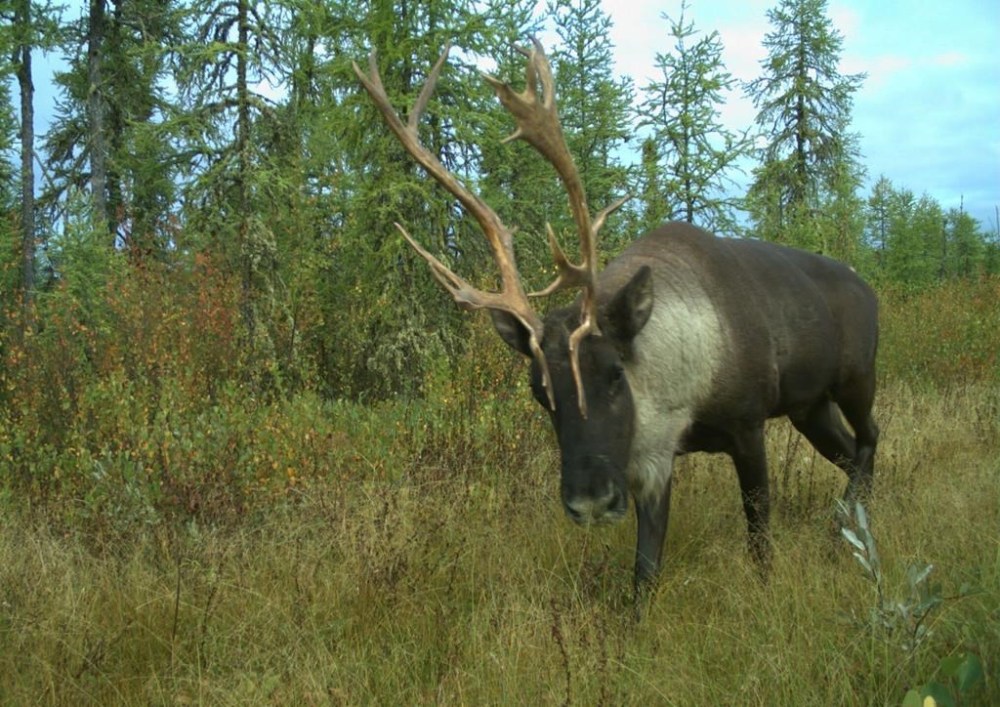
Research suggests climate change, not habitat loss, may be the biggest threat to the survival of threatened caribou herds. A caribou moves through the Algar region of northeastern Alberta in September 2017 in a handout photo. THE CANADIAN PRESS/HO-University of British Columbia-Cole Burton MANDATORY CREDIT

But climate change has also been at work in the forests. Slowly warming temperatures have greatly expanded the range in which whitetail deer can thrive.

“Climate is spreading the envelope of where deer can establish themselves,” said Dickie, senior caribou ecologist for the Alberta Biodiversity Monitoring Institute.

In the late 1990s, whitetails were scarce in the northern boreal, Dickie said. By the turn of the century, they were abundant.

In order to establish whether that envelope was spread by climate or by habitat, the authors looked to a region of northeastern Alberta and northwestern Saskatchewan.

On the Alberta side of the boundary, industrial disturbance was almost four times greater than in Saskatchewan. Meanwhile, the region was large enough that its northern end was significantly colder and snowier than its southern.

Using an extensive network of camera traps that captured tens of thousands of images of whitetail deer, the researchers concluded that the north-south temperature gradient made a much larger difference to deer density than the east-west differences in human disturbance.

“We found far fewer deer in places where the climate was snowier and colder,” Dickie said. “We did not find an effect (from) habitat alteration — it was half the magnitude of the climate impact.

“It was surprising the signal was so clear. Overwhelmingly, it was climate.”

Although human impacts on caribou range are much heavier in western Alberta — some ranges are more than 90 per cent disturbed — Dickie said she would expect similar results for that region as her paper found in the east.

“Habitat alteration might indeed provide more food for deer. But if the climate is such that they can’t make it through the winter, then it’s going to be climate that sets the envelope.”

The consequences for caribou conservation could be profound.

Efforts to keep the species on the landscape focus on remediating disturbed habitat. The Alberta government alone has spent more than $49 million on such efforts.

If Dickie’s paper is correct, no amount of tree-planting and cutline remediation will be enough.

“It might not, on its own, reduce deer densities sufficiently to reduce wolf densities,” she said.

Tough choices are on their way.

“Perhaps we prioritize the northern populations and give caribou a safe haven in the north,” Dickie said. “Places where we have deer established, we might need to do additional management.”

That means killing more wolves, Dickie acknowledged. Hunting more deer might help, too.

“There are some real social, economic and ethical considerations for all of these various management options,” she said.

Dickie maintains caribou can have a future in the boreal forest and that her findings aren’t a reason to stop trying to repair industrial impacts.

“There are a litany of reasons to do restoration and caribou aren’t the only species on the landscape. I think it behooves society to undo the disturbances we’ve created.”

This report by The Canadian Press was first published April 29, 2024.

Report Error Submit a Tip

More Stories

Woman who saved child, father from Red River uncomfortable with hero label

Scott Billeck 5 minute read Preview

Woman who saved child, father from Red River uncomfortable with hero label

Scott Billeck 5 minute read Wednesday, Sep. 2, 2026

A Winnipeg woman who’s been hailed as a hero by police for saving a father and his young child from the Red River says she doesn’t feel like one.

“I’m a mom… and I would do it again,” said Jayclyn Morrissette, who was walking with her neighbour through St. John’s Park on Aug. 24 when they spotted a young girl flailing in the nearby river. “I was meant to be there and that was supposed to happen.”

Morrissette, who spoke to the Free Press Wednesday after police released details about the rescue, said she and her neighbour began looking for the child’s parents and found them at the nearby playground searching for her.

Morrissette waved them over. The father, who she said could not swim, jumped into the river first and immediately began to sink.

Read
Wednesday, Sep. 2, 2026

Controlling pace of response path to success

Tim Kist 5 minute read Yesterday at 2:01 AM CDT

WITH the recent collapse of Canada-U.S. trade talks, the economic, political and social changes are coming at business leaders on a daily basis.

While you cannot control the pace of these changes, you can control the pace of response and timing of actions your organization takes. This is a time for thoughtful analysis and careful action, not chasing the latest trends.

Artificial intelligence, for example, can write articles, create images, draft emails and perform seemingly countless other tasks. But is this new tool solving a current business problem?

Successful companies know they must develop a strategy before launching any tactics. Otherwise, the strategy is based on “hope” — and we all know hope is not a strategy.

Mayoralty candidate Vogiatzakis decries war of words

Joyanne Pursaga 4 minute read Preview

Mayoralty candidate Vogiatzakis decries war of words

Joyanne Pursaga 4 minute read Friday, Sep. 4, 2026

A mayoral candidate took aim at personal insults among two of his competitors Friday, stressing the election campaign should focus on city issues instead.

“I’m really embarrassed by the mayoral candidates slinging mud at each other. We should be more professional … I don’t think we need to bring up people’s past or garbage that they’ve been involved in. I think this needs to be about the City of Winnipeg and what we’re going to do for the City of Winnipeg,” Mike Vogiatzakis said at a press conference Friday.

He confirmed he was referring specifically to skirmishes between Scott Gillingham, who is seeking re-election as mayor, and Kevin Klein, a former city councillor and provincial cabinet minister who registered for the race this week.

Within a few hours of Klein’s Tuesday announcement that he would enter the mayoral contest, Gillingham issued a statement labelling Klein “toxic,” a “Caribbean political fixer” for Peter Nygard and a supporter of U.S. President Donald Trump.

Read
Friday, Sep. 4, 2026

‘Soapy disco’ for your ride

Aaron Epp 4 minute read Preview

‘Soapy disco’ for your ride

Aaron Epp 4 minute read Friday, Sep. 4, 2026

For Kyle Thompson, foam is where the heart is.

As a high school student at Winnipeg’s Transcona Collegiate, one of his classes required him to create a business plan. He was cleaning vehicles part-time at the Chamois Car Wash and Detail Centre, so he used the assignment to envision a car wash of his own — one with a Regent Avenue address.

Fast forward some 25 years later and that dream is a reality. Thompson is the co-owner and general manager at Flamingo Express Car Wash.

Located at 868 Regent Ave. West — east of the row of car dealerships that call the thoroughfare home and across the street from an Amazon distribution hub — Flamingo opened last month.

Read
Friday, Sep. 4, 2026

For newcomer pizza purveyors, it’s all about crafting solid foundations

David Sanderson 7 minute read Preview

For newcomer pizza purveyors, it’s all about crafting solid foundations

David Sanderson 7 minute read Yesterday at 2:00 AM CDT

A recent poll conducted by an Internet-based market-research firm determined that close to 20 per cent of people eschew their leftover pizza crust.

Some argued that the residual crust lacks flavour. Others submitted that it’s too hard or crunchy to enjoy sans toppings. Given that information, what are we to make of Crusty Craft Pizza, a five-month-old takeout spot whose owners are so confident in their European-style pizza crust that they’ve chosen to highlight it in their business moniker?

Whenever somebody informs them they don’t like pizza crust, their response is, well, they haven’t tried theirs, says Oleksii Samokvhal, who together with his wife, Iryna Mehedyn, opened Crusty Craft Pizza in early April, at 1311 Day St. in Transcona.

“It’s thin in the middle, with raised edges we hand-form ourselves,” says Mehedyn, a native of Ukraine who, like her Kyiv-born husband, relocated to Winnipeg to escape the conflict in their home country.

Read
Yesterday at 2:00 AM CDT

(Un)friendly competition

Ken Wiebe 6 minute read Preview

(Un)friendly competition

Ken Wiebe 6 minute read Yesterday at 5:26 PM CDT

REGINA – Jermarcus Hardrick knows exactly what kind of battle he is in for on Sunday in the 61st edition of the Labour Day Classic.

The Saskatchewan Roughriders right tackle has ample experience lining up opposite Winnipeg Blue Bombers defensive end Willie Jefferson, both as teammates and opponents during the past decade and change.

In this pivotal matchup between Prairie rivals jockeying for position in the CFL West Division, this head-to-head battle in the trenches figures to be must-see TV.

“Willie is one of my best friends, one of the best players in the league. It’s amazing to see what he’s doing on film, what he’s always done on film,” said Hardrick, who spent eight seasons with the Blue Bombers before joining the Roughriders in 2024 as a free agent. “With the way that you know he plays and what he can do to a team with his energy and knowing that’s on the other side from you all game, that’s a big challenge that you look forward to.

Read
Yesterday at 5:26 PM CDT