Concerns raised over mining exploration in caribou habitat
Read this article for free:
or
Already have an account? Log in here »
To continue reading, please subscribe:
Digital Subscription
One year of digital access for only $1.44 a week*
- Enjoy unlimited reading on winnipegfreepress.com
- Read the E-Edition, our digital replica newspaper
- Access News Break, our award-winning app
- Play interactive puzzles
*Billed as $5.77 plus GST every four weeks. After 52 weeks, price increases to the regular rate of $19.95 plus GST every four weeks. Offer available to new and qualified returning subscribers only. Cancel any time.
To continue reading, please subscribe:
Add Free Press access to your Brandon Sun subscription for only an additional
$1 for the first 4 weeks*
- Enjoy unlimited reading on winnipegfreepress.com
- Read the E-Edition, our digital replica newspaper
- Access News Break, our award-winning app
- Play interactive puzzles
*Your next Brandon Sun subscription payment will increase by $1.00 and you will be charged $17.95 plus GST for four weeks. After four weeks, your payment will increase to $24.95 plus GST every four weeks.
Read unlimited articles for free today:
or
Already have an account? Log in here »
Hey there, time traveller!
This article was published 13/03/2024 (950 days ago), so information in it may no longer be current.
Manitoba’s efforts to champion its critical mineral sector may be putting one of the province’s most iconic species — the boreal woodland caribou — at risk.
During the Prospectors and Developers Association of Canada conference in Toronto earlier this month, Manitoba doubled down on its critical mineral commitments as it revealed the latest round of funding distributed under the Manitoba Mineral Development Fund.
Among the $3.3 million in funds announced was a $300,000 grant to nickel mining company NiCan Limited to support “ongoing drill exploration” in Grass River Provincial Park in northern Manitoba.
Supplied photo
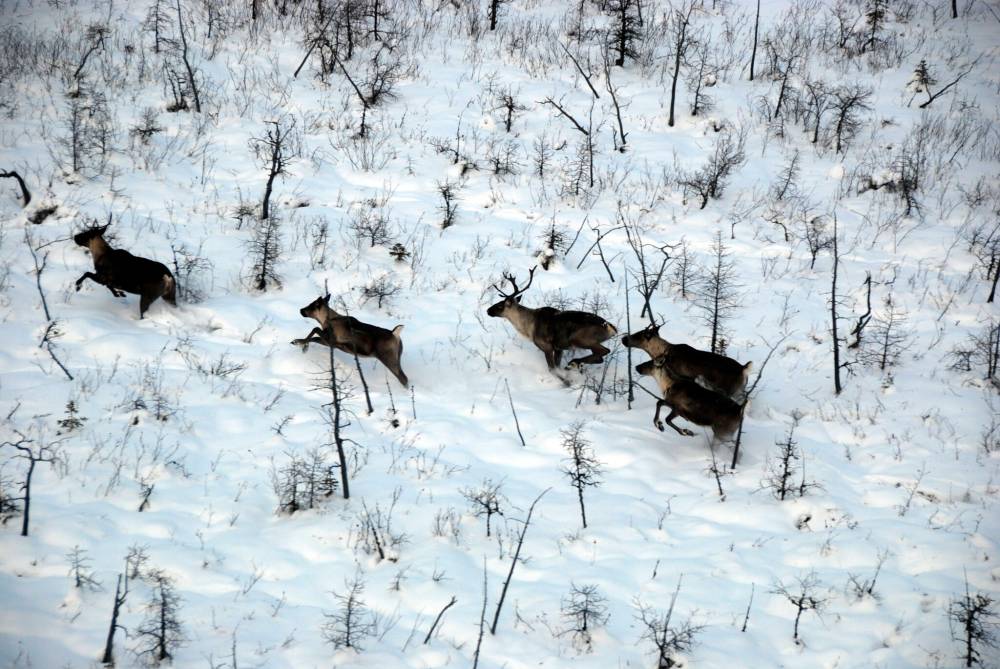
Boreal woodland caribou have been listed as a threatened species both provincially and federally since the early 2000s.
According to environmental group The Wilderness Committee, NiCan’s mineral claims not only fall within park boundaries — they also overlap the calving and rutting grounds for a herd of threatened boreal woodland caribou.
“The Manitoba government is paying a company to bulldoze a provincial park and bulldoze boreal caribou habitat,” said Eric Reder, director of The Wilderness Committee’s Manitoba field office.
“The Manitoba government is paying a company to bulldoze a provincial park and bulldoze boreal caribou habitat”–Eric Reder
A provincial spokesperson confirmed the mineral exploration company was issued a permit for a fly-in only drilling, adding the permit did not include building roads or trails, there is no existing use of heaving equipment such as bulldozers and that industrial activity must stop if caribou are observed within 500 metres of an exploration site.
“Parks mining exploration permits are issued annually and scrutinized to ensure exploration operations are sustainable and compatible within parks settings,” the spokesperson wrote in an email statement, noting Grass River is classified as a natural park with land-use categories for backcountry, recreational development and resource management.
Boreal woodland caribou have been listed as a threatened species both provincially and federally since the early 2000s. They’re sensitive to habitat disruption and tend to steer clear of human activity and industrial developments, which are widely recognized as the primary cause of caribou population decline.
The Naosap-Reed herd, whose range includes the Grass River park, is among Manitoba’s most high-risk populations. More than half of the herd’s habitat has been lost to wildfire or human activity over the last 20 years.
That’s in part because the Naosap-Reed caribou traverse Manitoba’s lucrative nickel belt — a geological formation known for its extensive critical mineral deposits, including nickel, copper and zinc.
The region has always been a mining hotspot, but as the province invests in building its critical mineral sector with the goal of providing the resources needed for an economic shift away from fossil fuels, exploration in the area has been on the rise. Nickel is used in electric car batteries and solar panels.
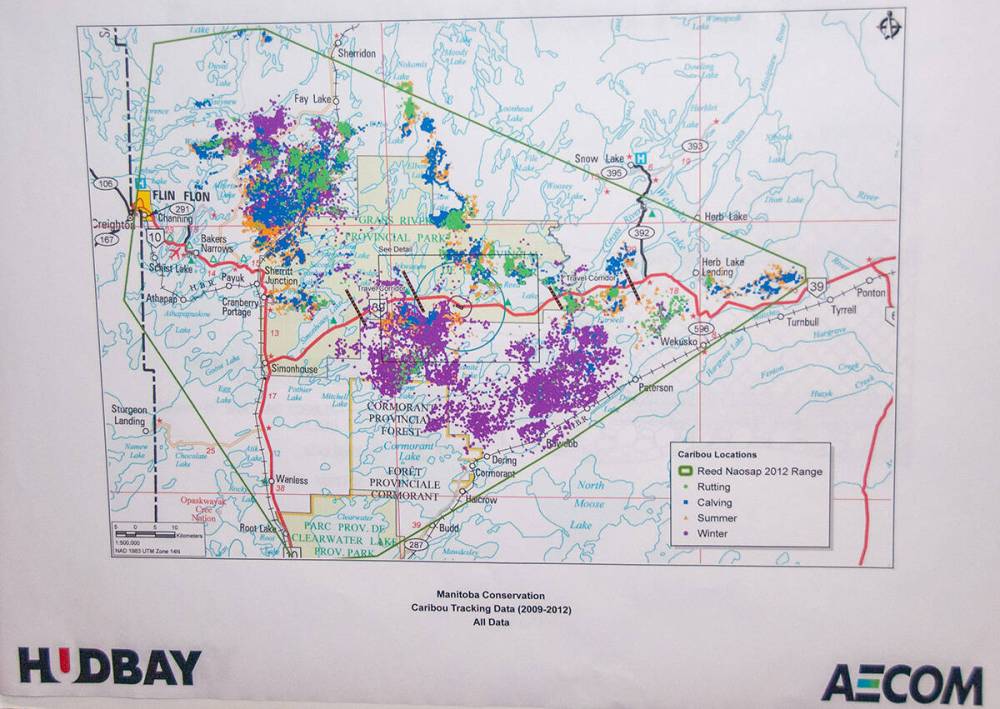
Caribou collar data for Grass River Provincial Park area released by HudBay in 2013 for the Reed Mine.
“The climate crisis and the biodiversity crisis are occurring together. Everyone is saying that you can’t do one without the other, you need to fix both of them,” Reder said. “Bulldozing species habitat — caribou habitat — so that you can fix the climate crisis doesn’t fly.”
“The climate crisis and the biodiversity crisis are occurring together. Everyone is saying that you can’t do one without the other, you need to fix both of them”–Eric Reder
According to Environment and Climate Change Canada’s boreal caribou recovery strategy, caribou need large, undisturbed tracts of forest, rich in old-growth trees, lichen, muskeg and peat moss to survive.
For herds to recover and become self-sustaining, the federal government has established that 65 per cent of the caribou’s range — the area they will roam over the course of a year — must be left undisturbed.
Just 48 per cent of the Naosap-Reed range around Grass River Provincial Park is currently intact.
According to collaring data compiled between 2009 and 2012 (funded in part by Hudbay Minerals as part of a proposal to mine within Grass River Provincial Park), NiCan’s claims fall on caribou calving, rutting and summering habitat.
In 2012, the federal government directed provinces to develop action plans to help recover their caribou populations. Manitoba committed to a recovery strategy in 2015, promising population studies and management plans for each of its herds by 2020.
More recently, the province signed a conservation agreement with the federal government that aimed to have all management plans and population reports complete by 2025. As a high-risk population, the Naosap-Reed herd report was due in 2023. Environment Canada said the province has still not produced a draft range plan.
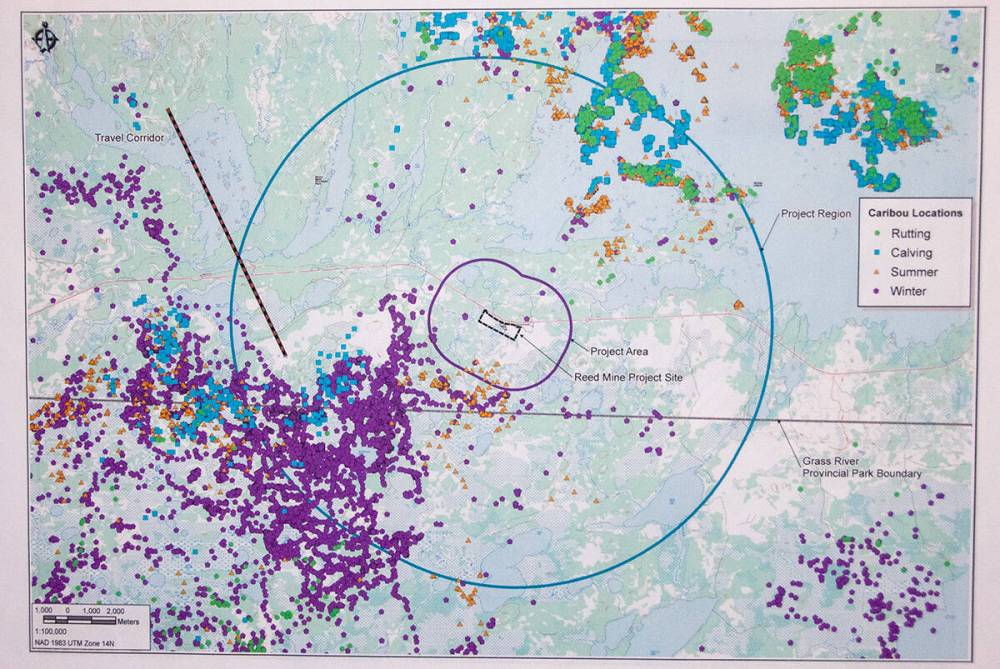
Caribou collar data near Reed Lake released by HudBay in 2013 for the Reed Mine.
“The Manitoba government did not fulfill their legal obligation,” Reder said. “Despite asking the government to act on caribou, we haven’t seen it. We have a new government, we expect that they are going to adhere to the federal Species At Risk Act and restart the work on action plans for caribou.”
A spokesperson said in an email statement the province is continuing to complete range plans for each of the nine boreal woodland caribou management units, as per the federal agreement.
In the meantime, mining activity has continued in Manitoba’s parks. According to Reder, there are now 681 mining claims in 16 parks — a number that has climbed since the NDP was elected last October.
Mineral exploration is allowed in approximately 10 per cent of provincial park lands — in areas zoned for resource management or recreational development — provided it doesn’t interfere with the park’s other purposes.
In the case of Grass River, 99 per cent of the land is open to industrial activity, but one of the park’s purposes is to “preserve … habitat for the threatened woodland caribou,” according to the park’s management plan.
Manitoba’s Endangered Species and Ecosystems Act generally prohibits destroying, disturbing or otherwise interfering with endangered and threatened species’ habitat, but includes some exemptions for developments licensed under the provincial Environment Act.
Because NiCan’s project is still in an exploratory phase, it’s not required to apply for an Environment Act licence, and it’s unclear whether the Endangered Species and Ecosystems Act applies.
Mineral exploration in provincial parks is regulated by work permits, issued by parks staff. Those permits, and the conditions they set out, are not publicly available.
“Mitigation recommendations are provided from the wildlife branch to the permitting authority and are site-specific depending on the location and type of activity proposed,” the government spokesperson said in the email statement, noting recommendations could include buffers around important habitat or restrictions on the timing of some work. The spokesperson added the wildlife branch tracks the cumulative impact of mining and other human activity.
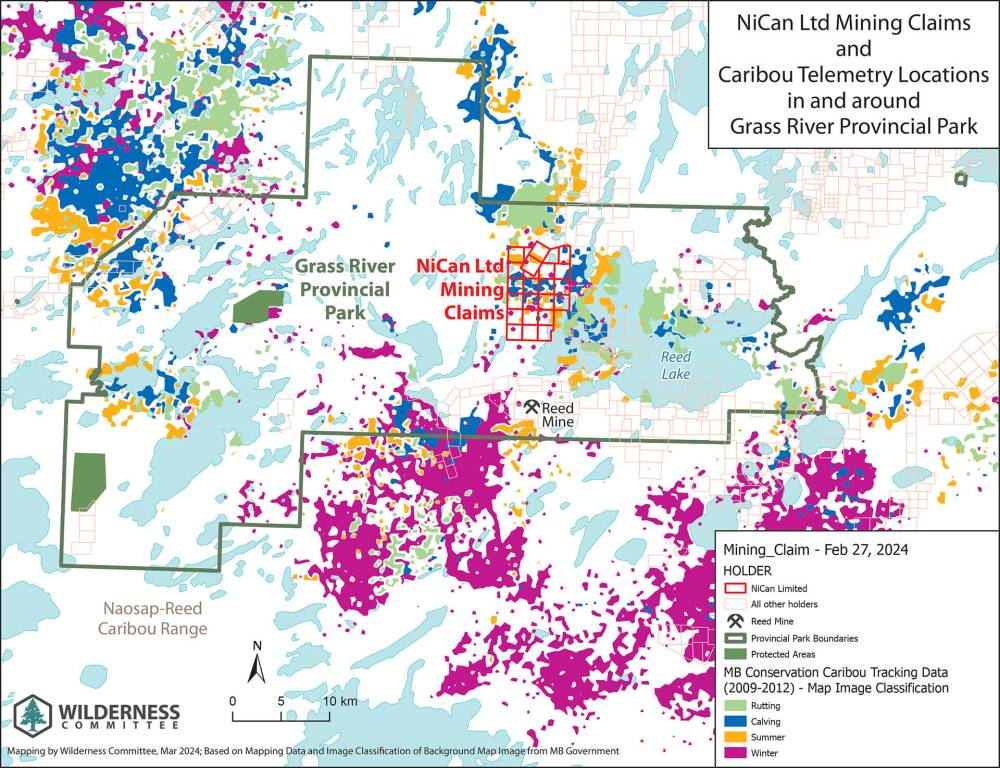
NiCan Ltd. Mining Claims and Caribou Telemetry Locations in and around Grass River Provincial Park. (Wilderness Committee)
“There’s got to be a path forward for caribou, for protected areas, and there’s got to be a path forward for the mining community”–Eric Reder
“Permits contain requirements to follow wildlife guidelines, including monitoring for wildlife movement near exploration sites and reporting this information to wildlife staff,” the spokesperson said.
As the new Manitoba government prepares to rewrite its critical mineral strategy, Reder hopes to see a focus on climate impacts — including habitat disruption — written into the plan.
“We need to see a transition away from mining in parks,” Reder said. “There’s got to be a path forward for caribou, for protected areas, and there’s got to be a path forward for the mining community.”
julia-simone.rutgers@freepress.mb.ca

Julia-Simone Rutgers is an investigative reporter who joined the Free Press in 2020. Read more about Julia-Simone.
Every piece of reporting Julia-Simone produces is reviewed by an editing team before it is posted online or published in print — part of the Free Press‘s tradition, since 1872, of producing reliable independent journalism. Read more about Free Press’s history and mandate, and learn how our newsroom operates.
Our newsroom depends on a growing audience of readers to power our journalism. If you are not a paid reader, please consider becoming a subscriber.
Our newsroom depends on its audience of readers to power our journalism. Thank you for your support.
Related Articles
Signing first formal step in creating historic conservation area

History
Updated on Wednesday, March 13, 2024 11:04 AM CDT: Adds image cutlines for maps
Updated on Wednesday, March 13, 2024 4:24 PM CDT: Adds government response