Astronomers find the biggest known batch of planet ingredients swirling around young star
Advertisement
Read this article for free:
or
Already have an account? Log in here »
To continue reading, please subscribe:

Digital Subscription
One year of digital access for only $205*
- Enjoy unlimited reading on winnipegfreepress.com
- Read the E-Edition, our digital replica newspaper
- Access News Break, our award-winning app
- Play interactive puzzles
*First annual payment billed as $205.00 + GST for one year. This annual subscription will automatically renew at $233.00 + GST every 52 weeks (10% off the regular annual price of $259.35). Offer available to new and qualified returning subscribers only. Cancel any time.
To continue reading, please subscribe:
Add Free Press access to your Brandon Sun subscription for only an additional
$1 for the first 4 weeks*
- Enjoy unlimited reading on winnipegfreepress.com
- Read the E-Edition, our digital replica newspaper
- Access News Break, our award-winning app
- Play interactive puzzles
*Your next Brandon Sun subscription payment will increase by $1.00 and you will be charged $17.95 plus GST for four weeks. After four weeks, your payment will increase to $24.95 plus GST every four weeks.
Read unlimited articles for free today:
or
Already have an account? Log in here »
Hey there, time traveller!
This article was published 14/05/2024 (882 days ago), so information in it may no longer be current.
CAPE CANAVERAL, Fla. (AP) — Astronomers have discovered what they believe is the biggest known batch of planet-making ingredients swirling around a young star.
The diameter of this colossal disk is roughly 3,300 times the distance between Earth and the sun, with enough gas and dust to form super-sized planets in far-flung orbits, the U.S. and German researchers reported this week.
First spotted in 2016, the disk around a star 1,000 light-years away was not confirmed to be a hotbed for new, emerging planets until recent observations by telescopes in Hawaii. A light-year is 5.8 trillion miles.
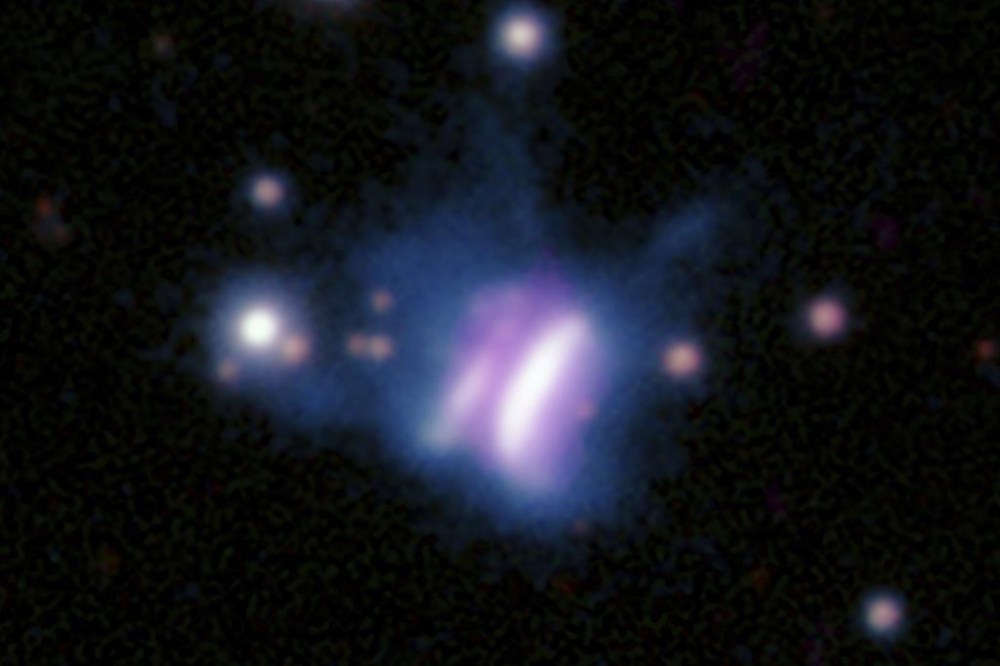
It’s so massive and rich in dust and gas, the building blocks of planets, that scientists can learn more about “the birth and evolution of worlds beyond our own,” said lead author Kristina Monsch of the Harvard-Smithsonian Center for Astrophysics.
This so-called protoplanetary disk looks like a butterfly in the images, according to Monsch. The dark, dusty strip in the middle resembles the elongated body of a butterfly, she said, while the blue and white lobes seem like wings and the two narrow filaments on top the antennae.
Findings were described in Monday’s Astrophysical Journal Letters. Another paper by some of the same researchers also has been accepted for publication.
The disk, designated as IRAS 23077, is about double the size of the previous record-holder, Monsch said.
NASA’s Hubble and Webb space telescopes may be able to discern whether planets the size of Jupiter or even bigger are already forming, Monsch said. Any rocky planets like our own would likely be too small to see and even bigger planet-forming systems are probably out there.
“We just have to look for them,” she said.
___
The Associated Press Health and Science Department receives support from the Howard Hughes Medical Institute’s Science and Educational Media Group. The AP is solely responsible for all content.