Voice-cloning technology bringing a key Supreme Court moment to ‘life’

Advertisement

Advertise with us

NEW YORK (AP) — Seventy years ago on Friday, no one outside of the U.S. Supreme Court building heard it when Chief Justice Earl Warren announced the historic Brown v. Board of Education decision on school desegregation.

Read this article for free:


or

Already have an account? Log in here »

To continue reading, please subscribe:

Subscribe and receive a limited-edition Free Press branded hat or tote.

Digital Subscription

One year of digital access for only $205*

  • Enjoy unlimited reading on winnipegfreepress.com
  • Read the E-Edition, our digital replica newspaper
  • Access News Break, our award-winning app
  • Play interactive puzzles

*First annual payment billed as $205.00 + GST for one year. This annual subscription will automatically renew at $233.00 + GST every 52 weeks (10% off the regular annual price of $259.35). Offer available to new and qualified returning subscribers only. Cancel any time.

To continue reading, please subscribe:

Add Free Press access to your Brandon Sun subscription for only an additional

$1 for the first 4 weeks*

  • Enjoy unlimited reading on winnipegfreepress.com
  • Read the E-Edition, our digital replica newspaper
  • Access News Break, our award-winning app
  • Play interactive puzzles
Start now

*Your next Brandon Sun subscription payment will increase by $1.00 and you will be charged $17.95 plus GST for four weeks. After four weeks, your payment will increase to $24.95 plus GST every four weeks.

Hey there, time traveller!
This article was published 15/05/2024 (879 days ago), so information in it may no longer be current.

NEW YORK (AP) — Seventy years ago on Friday, no one outside of the U.S. Supreme Court building heard it when Chief Justice Earl Warren announced the historic Brown v. Board of Education decision on school desegregation.

Now, through the use of an innovative voice-cloning technology, it is becoming possible for people to “hear” Warren read the decision as he did on May 17, 1954, along with oral arguments by lawyers including a future Supreme Court justice, Thurgood Marshall.

The “Brown Revisited” recreation is being made available at brown.oyez.org. It will be part of a website, painstakingly put together by former Northwestern University professor Jerry Goldman, that allows people to hear oral arguments in decades worth of Supreme Court cases and follow along with written transcriptions. Yet it always frustrated Goldman that the court did not begin recording oral arguments until 1955 — a year after the Brown decision was handed down. Print transcripts just aren’t the same.
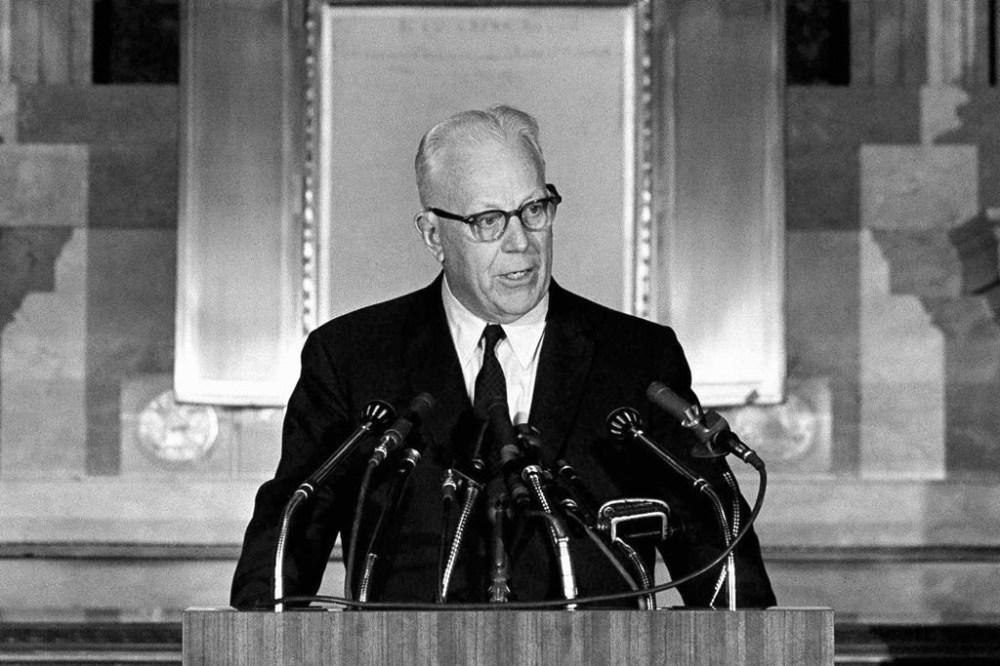
FILE - Chief Justice Earl Warren speaks at the Washington National Archives during a ceremony marking the 175th anniversary of congressional passage of legislation establishing the federal judicial system in the U.S., on Sept. 22, 1964. Seventy years ago, no one outside of the U.S. Supreme Court building heard it when Warren announced the historic Brown vs. Board of Education decision on school desegregation. Now, through the use of a voice-cloning technology, it is becoming possible for people to “hear” Warren read the decision as he did on May 17, 1954, along with oral arguments by lawyers. (AP Photo/Bill Allen, File)

“I could give you the libretto to ‘Madame Butterfly,’” he said. “But would you rather read it, or would you rather sit and listen to the performance?”

The Brown decision was a landmark in the civil rights movement. The court struck down an 1896 decision that institutionalized racial segregation with “separate but equal” schools for Black and white students, ruling that such accommodations were anything but equal.

While the court began recording arguments in 1955, virtually no one heard them until 1969, when they were made available through the National Archives for scholarly and legal research. Full public access wasn’t granted until 1993. The court began posting arguments on its website in the 2000s, but usually at a delay of several days.

It wasn’t until 2020 that the court regularly made livestreams of the arguments available. Cameras have never been allowed.

A year ago, Goldman said, he attended a play where artificial intelligence was used to recreate a familiar voice, and he wondered if this technology could be put to use for historic court arguments. A Northwestern alum, James Boggs, CEO of the interactive audio firm Spooler, took interest when contacted.

“It’s good to draw attention to this case,” Goldman said, “because it’s fundamental to our understanding to the Constitution and it changed America.”

The first step was to find recordings of the long-dead principals in the case, preferably made around 1954 to approximate what they sounded like then. That wasn’t difficult in the cases of Warren, a former governor of California, and Marshall. It was harder for integration opponent John W. Davis, whose lengthy career included the 1924 Democratic presidential nomination. He died in 1955.

A Davis recording was tracked down through the Library of Congress. Recordings for some other participants could not be located.

Through artificial intelligence, these voice samples were melded with those of actors who read the historical transcripts to make it sound like they were speaking anew.

Actual arguments were sprawling — 18 hours over three days, with 38 participants. Goldman whittled things down to a one hour, 45 minute presentation, including Warren’s reading of the decision. Goldman consulted written notes left behind by Warren, enabling the recreation to include the chief justice’s emphasis that the decision had been unanimous.

The growing ability of technology to recreate voices is a marvel, yet deeply troubling to many who worry it could put false words into familiar mouths — such deepfakes are a particular concern heading into the presidential election.

Ravit Dotan, CEO of TechBetter and an instructor on the ethics of technology, said she’s concerned about the practice of cloning people’s voices without their consent, although consent isn’t possible from people who are no longer alive. She believes “Brown Revisited” sets a bad precedent.

“In the future, I can envision laws that determine how long a person’s likeness rights persist after their death, similar to copyright, which expires 70 years after the creator’s death,” Dotan said. “But currently, there is no legal guidance, and I worry about people taking advantage of that, exploiting people’s likeness or even disseminating disinformation.”

Instead of a deepfake, the Brown project is a “deep true,” Boggs said.

“We are not creating new content,” he said. “These were things that were actually said and we have the historical documentation to prove it.”

Similar recreations have a natural limit. It was only in the late 1800s that sound recordings of voices have been available. Go back further, and they’d essentially be guesses. Who knows what George Washington actually sounded like?

But for the curious, the “Brown Revisited” project offers a new window into history.

___

David Bauder writes about media for The Associated Press. Follow him at http://twitter.com/dbauder.


Report Error Submit a Tip

More Stories

Puerto Vallarta boards up as Hurricane Simon hits Category 4 strength

The Associated Press 3 minute read Preview

Puerto Vallarta boards up as Hurricane Simon hits Category 4 strength

The Associated Press 3 minute read Updated: Yesterday at 9:51 PM CDT

PUERTO VALLARTA, Mexico (AP) — Simon has strengthened into a powerful Category 4 hurricane as it barrels toward Mexico’s coast.

The National Hurricane Center in Miami said Saturday that Simon’s maximum sustained winds increased to 150 mph (240 kph). A storm of that strength or greater is considered a major hurricane.

The center said it expected Simon “to be near or just inland” of Mexico's west-central coast on Sunday. The hurricane could bring as much as 10 to 20 inches (25-50 cm) of rain over parts of southwestern Mexico, with some areas in the states of Michoacan, Colima and Jalisco receiving up to 30 inches (76 centimeters).

“This rainfall will produce life-threatening flooding and mudslides, especially in areas of steep terrain,” the center warned in a bulletin that also urged residents to take immediate action to prepare as tropical-storm conditions were expected to arrive Saturday afternoon.

Read
Updated: Yesterday at 9:51 PM CDT

Landlords will face fines for breaching confidentiality

Carol Sanders 4 minute read Preview

Landlords will face fines for breaching confidentiality

Carol Sanders 4 minute read Friday, Oct. 9, 2026

The province is amending legislation to allow landlords to be penalized if they breach the confidentiality of tenants who break their lease by obtaining a domestic violence certificate.

“Hopefully, now there’s going to be measures in place so that if this happens again, and God forbid it happens again to anyone else, that there would be penalties imposed on landlords who do that,” said one victim whose concerns were published on the front page of the Free Press last month.

Under current legislation, landlords must ensure that any information received from those tenants regarding the termination of the tenancy is kept confidential, but there are no penalties for landlords who violate that section of the act. After hearing from victims put at risk when landlords broke the law by violating their confidentiality, the government announced Monday that it is amending the Residential Tenancies Act to allow for penalties.

The young woman who spoke to the Free Press showed that her landlord copied her alleged abuser in email correspondence that included her personal email address and the domestic violence certificate she obtained in 2025 to end a tenancy agreement early and leave an abusive relationship.

Read
Friday, Oct. 9, 2026

Jets’ game flies south against Ducks

Mike McIntyre 7 minute read Preview

Jets’ game flies south against Ducks

Mike McIntyre 7 minute read Friday, Oct. 9, 2026

The Winnipeg Jets sure looked like a team that was running on fumes Friday night.

Playing for the fifth time in eight days, the club suffered its first regulation loss of the young season — a lacklustre 5-1 showing against the Anaheim Ducks at Canada Life Centre.

While we won’t question the effort, the execution was a different story. Sloppy plays, missed passes, porous defensive-zone coverage and iffy goaltending made this a tough watch for the 13,693 fans in attendance.

“Just some mental things that happened. Obviously some physical things as well,” said head coach Scott Arniel.

Read
Friday, Oct. 9, 2026

Protein crests current appetite wave

Laura Rance-Unger 4 minute read Preview

Protein crests current appetite wave

Laura Rance-Unger 4 minute read Yesterday at 2:01 AM CDT

Holiday feasts often reflect the latest fads and trends influencing how we eat.

This Thanksgiving’s table is likely to feature more Canadian content than it might otherwise as a point of national pride.

In the recent past, the carb-free craze has made cauliflower a substitute for the mashed potatoes on some family spreads. Some have gone meatless, while others have added more. Still others offer gluten-free, dairy-free or fat-free alternatives.

Nowadays, it seems consumers can’t get enough protein. Desmond Sobool, deputy chief economist Farm Credit Canada, told a recent economic update for the agri-food sector there are two converging influences in play.

Read
Yesterday at 2:01 AM CDT

Phoneless concert a beautiful chance to bask in moment

Jen Zoratti 5 minute read Preview

Phoneless concert a beautiful chance to bask in moment

Jen Zoratti 5 minute read Yesterday at 2:01 AM CDT

Outside the Scotiabank Arena in Toronto, digital billboards flashed fans their singular photo op for the night: “I took this photo before I saw Phoebe Bridgers: The Lost Tour 2026.”

It is, as it is for so many other people, my only documentation of a concert by one of my favourite artists. The American singer-songwriter — who I discovered at the Winnipeg Folk Festival in 2018 — has had a meteoric rise in the past few years, winning three Grammys in 2024 as one third of Boygenius, the indie-rock supergroup rounded out by Lucy Dacus and Julien Baker, and opening for Taylor Swift on select dates of her titanic Eras Tour.

Now, Bridgers is touring in support of Lost Weekend, her third album and first since 2020’s Punisher. It’s a feat of a record, a richly textured meditation on loss and grief, written in the aftermath of the death of her dad, with whom she had a complicated relationship.

So she is in a position to not only play multiple sold-out arena shows, but also insist that those shows be phone-free.

Read
Yesterday at 2:01 AM CDT

Chopped trees will leave a ‘blight’ on Windsor Park

Kelly-Anne Riess 3 minute read Preview

Chopped trees will leave a ‘blight’ on Windsor Park

Kelly-Anne Riess 3 minute read Friday, Oct. 9, 2026

Robert Gordon has watched the trees grow along a popular Windsor Park walking path for nearly six decades.

Now, as Manitoba Hydro cuts them down to protect nearby power lines, he says a familiar part of his childhood neighbourhood is disappearing.

Although he no longer lives in the area, Gordon regularly returns to walk or cycle along the tree-lined path, which runs parallel to Archibald Street.

He was concerned when he recently spotted crews clearing vegetation near the entrance to the path, but initially assumed they were removing brush. When he returned, he discovered the clearing had extended farther along the corridor.

Read
Friday, Oct. 9, 2026