How cockroaches spread around the globe to become the pest we know today

Advertisement

Advertise with us

DALLAS (AP) — They're six-legged, hairy home invaders that just won't die, no matter how hard you try.

Read this article for free:


or

Already have an account? Log in here »

To continue reading, please subscribe:

Subscribe and receive a limited-edition Free Press branded hat or tote.

Digital Subscription

One year of digital access for only $205*

  • Enjoy unlimited reading on winnipegfreepress.com
  • Read the E-Edition, our digital replica newspaper
  • Access News Break, our award-winning app
  • Play interactive puzzles

*First annual payment billed as $205.00 + GST for one year. This annual subscription will automatically renew at $233.00 + GST every 52 weeks (10% off the regular annual price of $259.35). Offer available to new and qualified returning subscribers only. Cancel any time.

To continue reading, please subscribe:

Add Free Press access to your Brandon Sun subscription for only an additional

$1 for the first 4 weeks*

  • Enjoy unlimited reading on winnipegfreepress.com
  • Read the E-Edition, our digital replica newspaper
  • Access News Break, our award-winning app
  • Play interactive puzzles
Start now

*Your next Brandon Sun subscription payment will increase by $1.00 and you will be charged $17.95 plus GST for four weeks. After four weeks, your payment will increase to $24.95 plus GST every four weeks.

Hey there, time traveller!
This article was published 20/05/2024 (866 days ago), so information in it may no longer be current.

DALLAS (AP) — They’re six-legged, hairy home invaders that just won’t die, no matter how hard you try.

Cockroaches are experts at surviving indoors, hiding in kitchen pipes or musty drawers. But they didn’t start out that way.

A new study uses genetics to chart cockroaches’ spread across the globe, from humble beginnings in southeast Asia to Europe and beyond. The findings span thousands of years of cockroach history and suggest the pests may have scuttled across the globe by hitching a ride with another species: people.
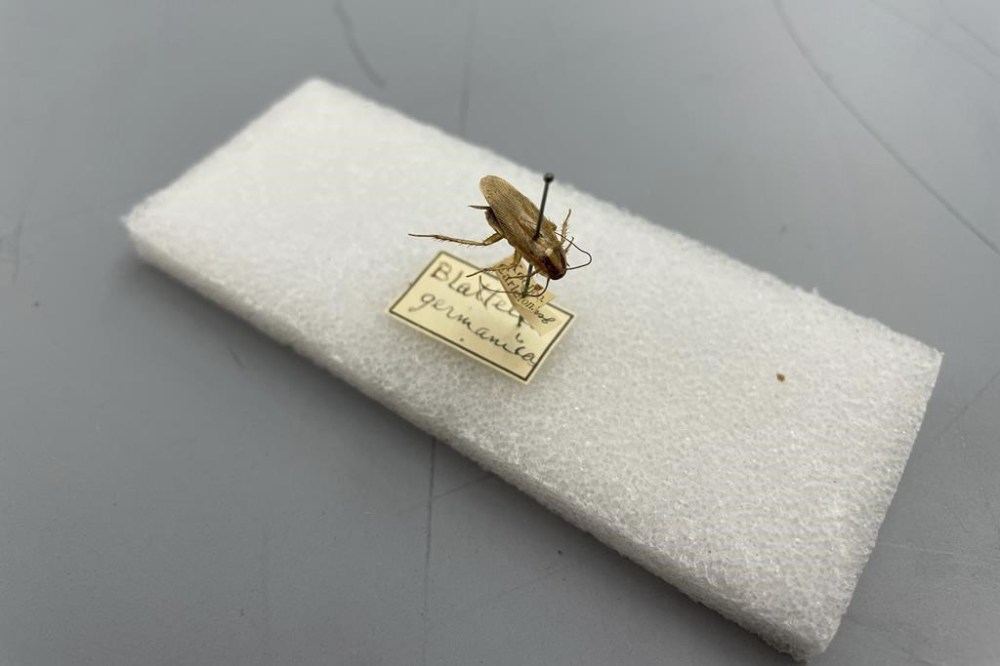
This photo provided by Qian Tang shows a German cockroach, a specimen from Harvard Museum of Comparative Zoology, Friday, May 17, 2024, in Cambridge, Mass. A new study, published Monday, May 20, in the journal Proceedings of the National Academy of Sciences, tracks how cockroaches spread around the globe to become the survival experts we know today. (Qian Tang via AP)

“It’s not just an insect story,” said Stephen Richards, an assistant professor at Baylor College of Medicine who studies insect genes and was not involved with the study. “It’s an insect and humanity story.”

Researchers analyzed the genes of over 280 cockroaches from 17 countries and six continents. They confirmed that the German cockroach — a species found worldwide — actually originated in southeast Asia, likely evolving from the Asian cockroach around 2,100 years ago. Scientists have long suspected the German cockroach’s Asian origins since similar species still live there.

The research was published Monday in the journal Proceedings of the National Academy of Sciences.

The cockroaches then globe-trotted via two major routes. They traveled west to the Middle East about 1,200 years ago, perhaps hitchhiking in soldiers’ breadbaskets. And they may have stowed away on Dutch and British East India Company trade routes to get to Europe about 270 years ago, according to scientists’ reconstruction and historical records.

Once they arrived, inventions like the steam engine and indoor plumbing likely helped the insects travel further and get cozy living indoors, where they are most commonly found today.

Researchers said exploring how cockroaches conquered past environments may lead to better pest control.

Modern-day cockroaches are tough to keep at bay because they evolve quickly to resist pesticides, according to study author Qian Tang, a postdoctoral researcher studying insects at Harvard University.

___

The Associated Press Health and Science Department receives support from the Howard Hughes Medical Institute’s Science and Educational Media Group. The AP is solely responsible for all content.


Report Error Submit a Tip

More Stories

’Disgusting’ posters being investigated by police

Morgan Modjeski 4 minute read 2:22 PM CDT

The Winnipeg Police Service major crimes unit is investigating what some have labelled offensive and hateful posters on full-display at a Winnipeg home.

One of the people irked by the display is Gracie Garrett. She’s has lived on Ashburn Street in Winnipeg’s Minto neighbourhood for almost ten years. She’s never felt unsafe in the neighbourhood before, but now, a set of posters plastered on a nearby house are making her feel uneasy.

The five signs, posted facing the street prominently on a front window, contain a slur, refer to Nazis as “heroes” and call Muslims, Christians and other groups “evil.”

Learning of the signs Friday, Garrett said she’ll be reporting the posters to police, as she worries they incite and promote violence.

Dynacare workers provide essential services that must be maintained during strike, labour board rules

Nicole Buffie 5 minute read Preview

Dynacare workers provide essential services that must be maintained during strike, labour board rules

Nicole Buffie 5 minute read Thursday, Oct. 1, 2026

The Manitoba Labour Board has ruled Dynacare workers are essential employees and their services must be maintained during a labour dispute.

Read
Thursday, Oct. 1, 2026

Gillingham talks trash, pledges big bin boost

Joyanne Pursaga 4 minute read Preview

Gillingham talks trash, pledges big bin boost

Joyanne Pursaga 4 minute read Yesterday at 2:01 AM CDT

Scott Gillingham says he would add hundreds of locked garbage bins downtown to prevent unsightly trash piles if re-elected as mayor.

Read
Yesterday at 2:01 AM CDT

Letters, Oct. 3

7 minute read 2:01 AM CDT

A morning in the life …

My very first lesson does not start when I walk into that lecture hall, oh no — it starts long before. It begins when I walk to my car, check the estimated arrival time to the University of Manitoba and hope that Winnipeg traffic agrees with it.

A drive that appears completely manageable changes almost immediately when I’m greeted by a tsunami of orange pylons and a line of cars that appears to go on forever. Traffic moves by the inch, lanes magically disappear and the detour I took yesterday now has a detour of its own. These factors make me do a calculation that I have become all too familiar with. How late can I arrive and still find parking, run to my class across campus and get to class with enough time left to make it worth it?

I have grown used to people saying, “Why not just leave earlier?” I do. But when I’m already leaving for my 8:30 a.m. class at 7 a.m., there’s only so much I can do. This drive that some would think is relaxing is one that feels like an assignment that I didn’t know I had to complete and is due at 8:30 a.m.

Moving drama at MTYP gives voice to boy who changed law

Holly Harris 5 minute read Preview

Moving drama at MTYP gives voice to boy who changed law

Holly Harris 5 minute read 2:37 PM CDT

The heroic true tale of Norway House Cree Nation-born Jordan River Anderson came home Friday night, as Manitoba Theatre for Young People presented Yvette Nolan’s Jordan.

The touring production, a collaboration with Geordie Theatre, runs weekends through Oct. 11, with additional stops in Toronto, Vancouver and Ottawa’s National Arts Centre.

Having several of Anderson’s family members witness the local première underscored the evening with poignancy. Elder and Pine Creek First Nation member Barbara Nepinak added her own dignified presence and prayers following MTYP artistic director Pablo Felices-Luna’s welcoming remarks.

The season-opener also marks the Winnipeg-raised playwright’s homecoming; the Algonquin playwright, director, dramaturg, actor and educator was a fixture in our local theatre community for many years before going on to serve as artistic director for Native Earth Performing Arts from 2003 to ‘11, among other contributions.

Read
2:37 PM CDT

Nearly four in 10 Manitobans hope Canada restarts trade talks after U.S. midterm elections, poll reveals

Gabrielle Piché 4 minute read Preview

Nearly four in 10 Manitobans hope Canada restarts trade talks after U.S. midterm elections, poll reveals

Gabrielle Piché 4 minute read Yesterday at 7:00 AM CDT

Disorganized — that’s what Marcus Langlois calls recent United States tariffs.

He expects suppliers’ prices to increase — on mugs, pens, hoodies — for his employer, Dreamcatcher Promotions, if the United States–Canada trade war persists.

Still, he’s not pining for a quick trade deal.

“I think it should wait,” said Langlois, Dreamcatcher Promotions’ vice-president. “Let’s hope that it’s later on with proper negotiations happening.”

Read
Yesterday at 7:00 AM CDT