White House pushes tech industry to shut down market for sexually abusive AI deepfakes
Advertisement
Read this article for free:
or
Already have an account? Log in here »
To continue reading, please subscribe:

Digital Subscription
One year of digital access for only $205*
- Enjoy unlimited reading on winnipegfreepress.com
- Read the E-Edition, our digital replica newspaper
- Access News Break, our award-winning app
- Play interactive puzzles
*First annual payment billed as $205.00 + GST for one year. This annual subscription will automatically renew at $233.00 + GST every 52 weeks (10% off the regular annual price of $259.35). Offer available to new and qualified returning subscribers only. Cancel any time.
To continue reading, please subscribe:
Add Free Press access to your Brandon Sun subscription for only an additional
$1 for the first 4 weeks*
- Enjoy unlimited reading on winnipegfreepress.com
- Read the E-Edition, our digital replica newspaper
- Access News Break, our award-winning app
- Play interactive puzzles
*Your next Brandon Sun subscription payment will increase by $1.00 and you will be charged $17.95 plus GST for four weeks. After four weeks, your payment will increase to $24.95 plus GST every four weeks.
Read unlimited articles for free today:
or
Already have an account? Log in here »
Hey there, time traveller!
This article was published 23/05/2024 (864 days ago), so information in it may no longer be current.
President Joe Biden’s administration is pushing the tech industry and financial institutions to shut down a growing market of abusive sexual images made with artificial intelligence technology.
New generative AI tools have made it easy to transform someone’s likeness into a sexually explicit AI deepfake and share those realistic images across chatrooms or social media. The victims — be they celebrities or children — have little recourse to stop it.
The White House is putting out a call Thursday looking for voluntary cooperation from companies in the absence of federal legislation. By committing to a set of specific measures, officials hope the private sector can curb the creation, spread and monetization of such nonconsensual AI images, including explicit images of children.
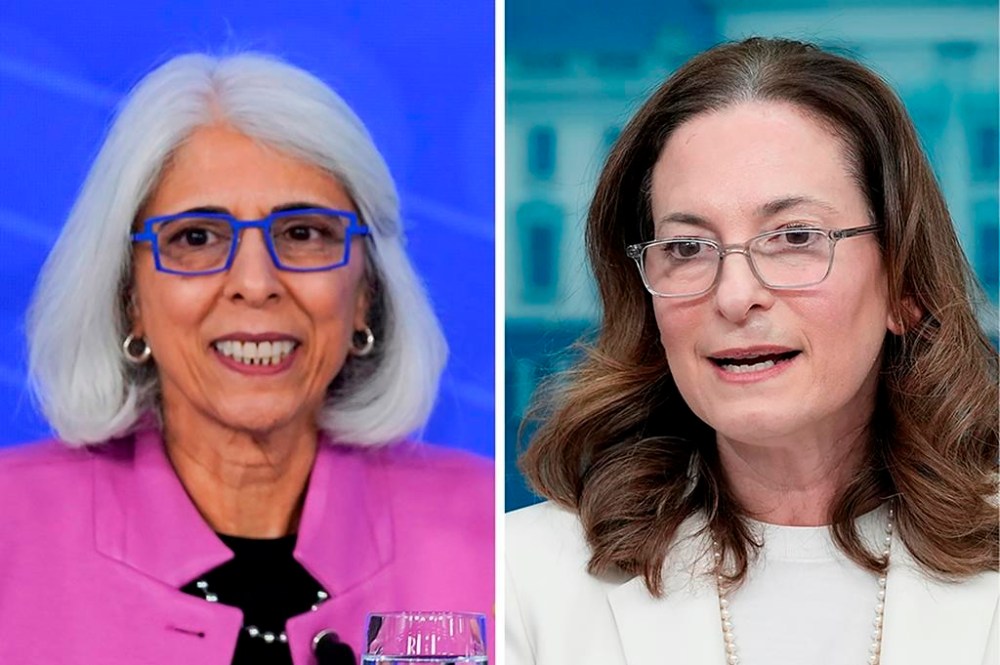
“As generative AI broke on the scene, everyone was speculating about where the first real harms would come. And I think we have the answer,” said Biden’s chief science adviser Arati Prabhakar, director of the White House’s Office of Science and Technology Policy.
She described to The Associated Press a “phenomenal acceleration” of nonconsensual imagery fueled by AI tools and largely targeting women and girls in a way that can upend their lives.
“If you’re a teenage girl, if you’re a gay kid, these are problems that people are experiencing right now,” she said. “We’ve seen an acceleration because of generative AI that’s moving really fast. And the fastest thing that can happen is for companies to step up and take responsibility.”
A document shared with AP ahead of its Thursday release calls for action from not just AI developers but payment processors, financial institutions, cloud computing providers, search engines and the gatekeepers — namely Apple and Google — that control what makes it onto mobile app stores.
The private sector should step up to “disrupt the monetization” of image-based sexual abuse, restricting payment access particularly to sites that advertise explicit images of minors, the administration said.
Prabhakar said many payment platforms and financial institutions already say that they won’t support the kinds of businesses promoting abusive imagery.
“But sometimes it’s not enforced; sometimes they don’t have those terms of service,” she said. “And so that’s an example of something that could be done much more rigorously.”
Cloud service providers and mobile app stores could also “curb web services and mobile applications that are marketed for the purpose of creating or altering sexual images without individuals’ consent,” the document says.
And whether it is AI-generated or a real nude photo put on the internet, survivors should more easily be able to get online platforms to remove them.
The most widely known victim of pornographic deepfake images is Taylor Swift, whose ardent fanbase fought back in January when abusive AI-generated images of the singer-songwriter began circulating on social media. Microsoft promised to strengthen its safeguards after some of the Swift images were traced to its AI visual design tool.
A growing number of schools in the U.S. and elsewhere are also grappling with AI-generated deepfake nudes depicting their students. In some cases, fellow teenagers were found to be creating AI-manipulated images and sharing them with classmates.
Last summer, the Biden administration brokered voluntary commitments by Amazon, Google, Meta, Microsoft and other major technology companies to place a range of safeguards on new AI systems before releasing them publicly.
That was followed by Biden signing an ambitious executive order in October designed to steer how AI is developed so that companies can profit without putting public safety in jeopardy. While focused on broader AI concerns, including national security, it nodded to the emerging problem of AI-generated child abuse imagery and finding better ways to detect it.
But Biden also said the administration’s AI safeguards would need to be supported by legislation. A bipartisan group of U.S. senators is now pushing Congress to spend at least $32 billion over the next three years to develop artificial intelligence and fund measures to safely guide it, though has largely put off calls to enact those safeguards into law.
Encouraging companies to step up and make voluntary commitments “doesn’t change the underlying need for Congress to take action here,” said Jennifer Klein, director of the White House Gender Policy Council.
Longstanding laws already criminalize making and possessing sexual images of children, even if they’re fake. Federal prosecutors brought charges earlier this month against a Wisconsin man they said used a popular AI image-generator, Stable Diffusion, to make thousands of AI-generated realistic images of minors engaged in sexual conduct. An attorney for the man declined to comment after his arraignment hearing Wednesday.
But there’s almost no oversight over the tech tools and services that make it possible to create such images. Some are on fly-by-night commercial websites that reveal little information about who runs them or the technology they’re based on.
The Stanford Internet Observatory in December said it found thousands of images of suspected child sexual abuse in the giant AI database LAION, an index of online images and captions that’s been used to train leading AI image-makers such as Stable Diffusion.

London-based Stability AI, which owns the latest versions of Stable Diffusion, said this week that it “did not approve the release” of the earlier model reportedly used by the Wisconsin man. Such open-sourced models, because their technical components are released publicly on the internet, are hard to put back in the bottle.
Prabhakar said it’s not just open-source AI technology that’s causing harm.
“It’s a broader problem,” she said. “Unfortunately, this is a category that a lot of people seem to be using image generators for. And it’s a place where we’ve just seen such an explosion. But I think it’s not neatly broken down into open source and proprietary systems.”
——
AP Writer Josh Boak contributed to this report.