China lands a spacecraft on the moon’s far side to collect rocks for study

Advertisement

Advertise with us

BEIJING (AP) — A Chinese spacecraft landed on the far side of the moon Sunday to collect soil and rock samples that could provide insights into differences between the less-explored region and the better-known near side.

Read this article for free:


or

Already have an account? Log in here »

To continue reading, please subscribe:

Subscribe and receive a limited-edition Free Press branded hat or tote.

Digital Subscription

One year of digital access for only $205*

  • Enjoy unlimited reading on winnipegfreepress.com
  • Read the E-Edition, our digital replica newspaper
  • Access News Break, our award-winning app
  • Play interactive puzzles

*First annual payment billed as $205.00 + GST for one year. This annual subscription will automatically renew at $233.00 + GST every 52 weeks (10% off the regular annual price of $259.35). Offer available to new and qualified returning subscribers only. Cancel any time.

To continue reading, please subscribe:

Add Free Press access to your Brandon Sun subscription for only an additional

$1 for the first 4 weeks*

  • Enjoy unlimited reading on winnipegfreepress.com
  • Read the E-Edition, our digital replica newspaper
  • Access News Break, our award-winning app
  • Play interactive puzzles
Start now

*Your next Brandon Sun subscription payment will increase by $1.00 and you will be charged $17.95 plus GST for four weeks. After four weeks, your payment will increase to $24.95 plus GST every four weeks.

Hey there, time traveller!
This article was published 01/06/2024 (840 days ago), so information in it may no longer be current.

BEIJING (AP) — A Chinese spacecraft landed on the far side of the moon Sunday to collect soil and rock samples that could provide insights into differences between the less-explored region and the better-known near side.

The landing module touched down at 6:23 a.m. Beijing time in a huge crater known as the South Pole-Aitken Basin, the China National Space Administration said.

The mission is the sixth in the Chang’e moon exploration program, which is named after a Chinese moon goddess. It is the second designed to bring back samples, following the Chang’e 5, which did so from the near side in 2020.
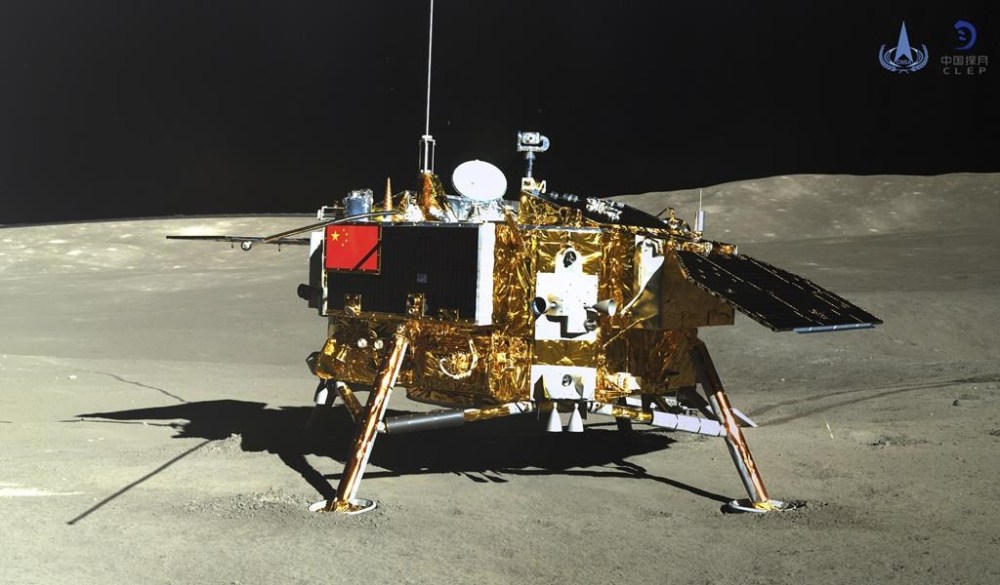
FILE - This photo provided on Jan. 12, 2019, by the China National Space Administration via Xinhua News Agency shows the lunar lander of the Chang'e-4 probe in a photo taken by the rover Yutu-2 on Jan. 11. China is preparing to launch a lunar probe Friday, May 3, 2024, that would land on the far side of the moon and return with samples that could provide insights into geological and other differences between the less-explored region and the better-known near side. (China National Space Administration/Xinhua News Agency via AP, File)

The moon program is part of a growing rivalry with the U.S. — still the leader in space exploration — and others, including Japan and India. China has put its own space station in orbit and regularly sends crews there.

The emerging global power aims to put a person on the moon before 2030, which would make it the second nation after the United States to do so. America is planning to land astronauts on the moon again — for the first time in more than 50 years — though NASA pushed the target date back to 2026 earlier this year.

U.S. efforts to use private-sector rockets to launch spacecraft have been repeatedly delayed. Last-minute computer trouble nixed the planned launch of Boeing’s first astronaut flight Saturday.

Earlier Saturday, a Japanese billionaire called off his plan to orbit the moon because of uncertainty over the development of a mega rocket by SpaceX. NASA is planning to use the rocket to send its astronauts to the moon.

In China’s current mission, the lander is to use a mechanical arm and a drill to gather up to 2 kilograms (4.4 pounds) of surface and underground material over about two days.

An ascender atop the lander will then take the samples in a metal vacuum container back to another module that is orbiting the moon. The container will be transferred to a reentry capsule that is due to return to Earth in the deserts of China’s Inner Mongolia region about June 25.

In this photo released by Xinhua News Agency, technical personnel work at the Beijing Aerospace Control Center (BACC) in Beijing, Sunday, June 2, 2024. A Chinese spacecraft landed on the far side of the moon Sunday to collect soil and rock samples that could provide insights into differences between the less-explored region and the better-known near side. (Jin Liwang/Xinhua via AP)

Missions to the moon’s far side are more difficult because it doesn’t face the Earth, requiring a relay satellite to maintain communications. The terrain is also more rugged, with fewer flat areas to land.

The South Pole-Aitken Basin, an impact crater created more than 4 billion years ago, is 13 kilometers (8 miles) deep and has a diameter of 2,500 kilometers (1,500 miles), according to a report by China’s Xinhua News Agency.

It is the oldest and largest of such craters on the moon, so may provide the earliest information about it, Xinhua said, adding that the huge impact may have ejected materials from deep below the surface.


Report Error Submit a Tip

More Stories

Family account spiced with magic realism, geopolitical intrigue and a ghost story

Reviewed by Zilla Jones 4 minute read Preview

Family account spiced with magic realism, geopolitical intrigue and a ghost story

Reviewed by Zilla Jones 4 minute read 2:01 AM CDT

Tom Lin’s second novel Babylon, South Dakota moves beyond a historical account of an immigrant family’s struggle, delightfully blending and bending genres.

Lin is a Chinese-born novelist whose family emigrated to the U.S. when he was four years old. His debut novel, The Thousand Crimes of Ming Tsu, won the 2022 Andrew Carnegie Medal for Excellence in Fiction, making him the youngest ever recipient of that award. He earned a PhD in English from the University of California Davis and is currently an assistant professor of English and creative writing at the University of Iowa.

Babylon, South Dakota takes place in an unspecified time period that can be understood to be during the Mao era — likely the 1950s or ’60s. A young Chinese couple, the Hsuis, immigrate to the rural community that gives the book its title. They take the names Saul and Mei and settle on a 160-acre homestead left to them by a distant relative.

Saul’s dream is to breed and sell chrysanthemums from seeds he brought from China, while Mei wants to raise livestock. They speak no English, know nothing of life in the United States, are unprepared for the harshness of winter and the isolation of the farm and bring nothing with them except some gold, which Mei hides around the house for emergencies. Their only link to the outside world is a discarded and marginally functioning TV set, which Saul rescues and rigs up.

Read
2:01 AM CDT

Siloam Mission, WFPS discussing on-site paramedic to reduce staggering number of emergency calls

Scott Billeck 4 minute read Preview

Siloam Mission, WFPS discussing on-site paramedic to reduce staggering number of emergency calls

Scott Billeck 4 minute read Yesterday at 2:00 AM CDT

Winnipeg’s fire-paramedic service and its largest homeless-serving organization are discussing what it would look like to station at least one paramedic at Siloam Mission, as emergency calls to the downtown facility surge.

The ongoing discussions come as Winnipeg Fire Paramedic Service crews were dispatched 1,771 times during the first eight months of the year to the two adjacent Siloam properties at 303 Stanley St. and 300 Princess St.

WFPS said most of the calls were related to overdoses or other consequences of substance use, with the total nearly double the 854 calls recorded over the same period last year. By comparison, there were 831 calls during the same span in 2024, and 591 in 2023.

“The number of emergency calls isn’t sustainable for us as a service, but it’s certainly not sustainable for them as an agency trying to provide services,” WFPS chief Ryan Sneath told the Free Press. “And they recognize that they’re impacting emergency services, not them specifically, but the site in a significant way.”

Read
Yesterday at 2:00 AM CDT

Near-future U.S. the setting for surreal dual-world storyline

Reviewed by Morley Walker 4 minute read Preview

Near-future U.S. the setting for surreal dual-world storyline

Reviewed by Morley Walker 4 minute read 2:01 AM CDT

It’s not every day you encounter a seriously intended literary novel that attempts to dramatize a mind-bending physics theory like quantum entanglement.

But then the B.C.-born-and-raised Emily St. John Mandel is not your everyday Canadian literary writer.

In her late 40s, she has lived in the U.S. for her entire writing career. She is best known for her 2014 dystopian novel Station Eleven, about a Shakespearean acting troupe navigating a pandemic-ravaged America.

Her new outing, her seventh, Exit Party, shares DNA with detective and sci-fi genres more than with conventional literary fiction.

Read
2:01 AM CDT

Manitoba abandoning spring, fall clock changes

Carol Sanders 8 minute read Preview

Manitoba abandoning spring, fall clock changes

Carol Sanders 8 minute read Updated: Yesterday at 8:48 AM CDT

Time’s up for the time change in Manitoba.

Manitobans won’t be setting their clocks back an hour in November. The province has decided to permanently stay on daylight time after surveying residents on the twice annual clock adjustment.

“We heard from Manitobans loud and clear — no more changing the clocks in Manitoba,” Premier Wab Kinew said in a news release Thursday.

Most of the 72,000 votes submitted in an online EngageMB survey — 92 per cent — said they would like to see the practice end. The survey asked if they preferred earlier sunrises in winter with standard time or the later sunsets in summer with daylight time. More than half of survey participants (58 per cent) indicated a preference to stay on permanent daylight time; 34 per cent voted to eliminate the time change but stay on standard time.

Read
Updated: Yesterday at 8:48 AM CDT

Puzzles Palace

1 minute read Monday, Jul. 27, 2026

To solve our puzzles, please subscribe with this special offer: |

Not good bet to shoulder gambling issue alone

Maureen Scurfield 5 minute read 2:01 AM CDT

DEAR MISS LONELYHEARTS: We’re living a lie over at our house, but it’s holding the family together.

I know my husband is deeply into gambling. If it weren’t for my steady job I don’t know where the family would be! I insist on paying all of our bills. I also funnel some major cash off to my sister, in case my husband tries to tap into my accounts somehow when I’m out of the house.

He doesn’t know my passwords, since I keep changing them, but he sometimes shows up behind me when I’m online, like he’s dying to ask something.

I say, “What are you looking at? Stop looking over my shoulder!” Then he makes a lame joke and goes away.