Justice Department’s ‘deepfake’ concerns over Biden interview audio highlights AI misuse worries

Advertisement

Advertise with us

WASHINGTON (AP) — Releasing an audio recording of a special counsel's interview with President Joe Biden could spur deepfakes and disinformation that trick Americans, the Justice Department said, conceding the U.S. government could not stop the misuse of artificial intelligence ahead of this year's election.

Read this article for free:


or

Already have an account? Log in here »

To continue reading, please subscribe:

Subscribe and receive a limited-edition Free Press branded hat or tote.

Digital Subscription

One year of digital access for only $205*

  • Enjoy unlimited reading on winnipegfreepress.com
  • Read the E-Edition, our digital replica newspaper
  • Access News Break, our award-winning app
  • Play interactive puzzles

*First annual payment billed as $205.00 + GST for one year. This annual subscription will automatically renew at $233.00 + GST every 52 weeks (10% off the regular annual price of $259.35). Offer available to new and qualified returning subscribers only. Cancel any time.

To continue reading, please subscribe:

Add Free Press access to your Brandon Sun subscription for only an additional

$1 for the first 4 weeks*

  • Enjoy unlimited reading on winnipegfreepress.com
  • Read the E-Edition, our digital replica newspaper
  • Access News Break, our award-winning app
  • Play interactive puzzles
Start now

*Your next Brandon Sun subscription payment will increase by $1.00 and you will be charged $17.95 plus GST for four weeks. After four weeks, your payment will increase to $24.95 plus GST every four weeks.

Hey there, time traveller!
This article was published 03/06/2024 (835 days ago), so information in it may no longer be current.

WASHINGTON (AP) — Releasing an audio recording of a special counsel’s interview with President Joe Biden could spur deepfakes and disinformation that trick Americans, the Justice Department said, conceding the U.S. government could not stop the misuse of artificial intelligence ahead of this year’s election.

A senior Justice Department official raised the concerns in a court filing on Friday that sought to justify keeping the recording under wraps. The Biden administration is seeking to convince a judge to prevent the release of the recording of the president’s interview, which focused on his handling of classified documents.

The admission highlights the impact the AI-manipulated disinformation could have on voting and the limits of the federal government’s ability to combat it.
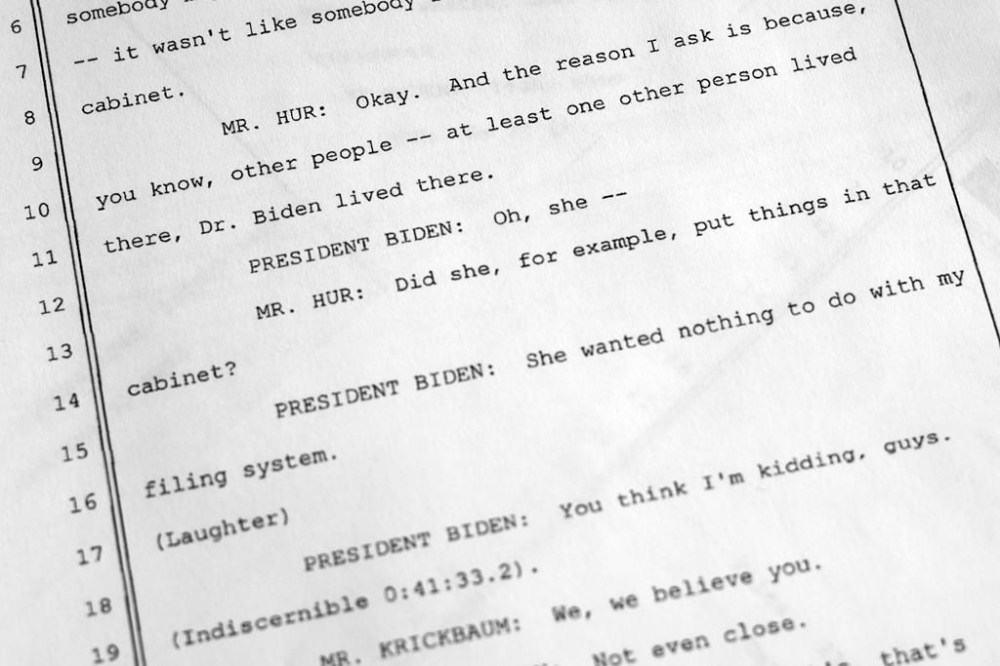
FILE - A photograph of a transcript of a recorded interview between Special Counsel Robert Hur and others, and President Joe Biden, is photographed March 12, 2024 in Washington. The Justice Department says its concerned that releasing audio of President Joe Biden's interview with a special counsel about his handling of classified documents could lead to deepfakes that trick Americans.(AP Photo/Pablo Martinez Monsivais, File)

A conservative group that’s suing to force the release of the recording called the argument a “red herring.”

Mike Howell of the Heritage Foundation accused the Justice Department of trying to protect Biden from potential embarrassment. A transcript of the interview showed the president struggling to recall certain dates and confusing details but showing a deep recall of information at other times.

“They don’t want to release this audio at all,” said Howell, executive director of the group’s oversight project. “They are doing the kitchen sink approach and they are absolutely freaked out they don’t have any good legal argument to stand on.”

The Justice Department declined to comment Monday beyond its filing.

Biden asserted executive privilege last month to prevent the release of the recording of his two-day interview in October with special counsel Robert Hur. The Justice Department has argued witnesses might be less likely to cooperate if they know their interviews might become public. It has also said that Republican efforts to force the audio’s release could make it harder to protect sensitive law enforcement files.

During a hearing before the House Judiciary Committee Tuesday, Garland told lawmakers will “not be intimidated” by Republican efforts to hold him in contempt for blocking their access to the recording.

“I view contempt as a serious matter,” Garland said. “But I will not jeopardize the ability of our prosecutors and agents to do their jobs effectively in future investigations.”

Sen. Mark Warner, the Democratic chair of the Senate Intelligence Committee, told The Associated Press that he was concerned that the audio might be manipulated by bad actors using AI. Nevertheless, the senator said, it should be made public.

“You’ve got to release the audio,” Warner said, though it would need some “watermarking components, so that if it was altered” journalists and others “could cry foul.”

In a lengthy report, Hur concluded no criminal charges were warranted in his handling of classified documents. His report described the 81-year-old Democrat’s memory as “hazy,” “poor” and having “significant limitations.” It noted that Biden could not recall such milestones as when his son Beau died or when he served as vice president.

Biden’s aides have long been defensive about the president’s age, a trait that has drawn relentless attacks from Donald Trump, the presumptive GOP nominee, and other Republicans. Trump is 77.

The Justice Department’s concerns about deepfakes came in a court papers filed in response to legal action brought under the Freedom of Information Act by a coalition of media outlets and other groups, including the Heritage Foundation and the Citizens for Responsibility and Ethics in Washington.

An attorney for the media coalition, which includes The Associated Press, said Monday that the public has the right to hear the recording and weigh whether the special counsel “accurately described” Biden’s interview.
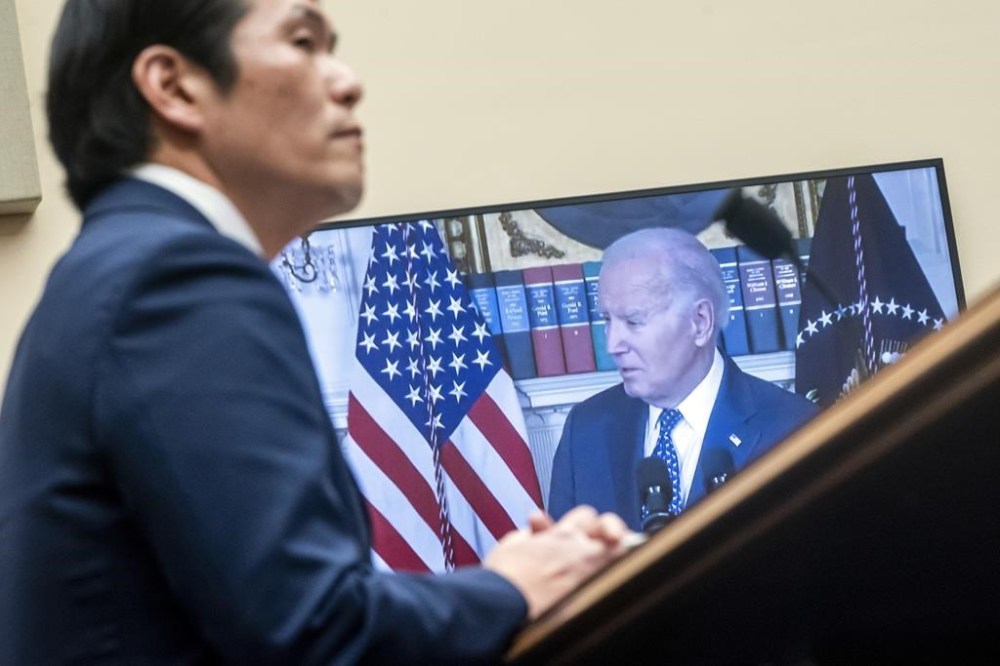
FILE - Special Counsel Robert Hur listens to recorded remarks of President Joe Biden during a hearing of the House Judiciary Committee in the Rayburn Office Building on Capitol Hill in Washington, March 12, 2024. The Justice Department says its concerned that releasing audio of President Joe Biden's interview with a special counsel about his handling of classified documents could lead to deepfakes that trick Americans.(AP Photo/Nathan Howard, File)

“The government stands the Freedom of Information Act on its head by telling the Court that the public can’t be trusted with that information,” the attorney, Chuck Tobin, wrote in an email.

Bradley Weinsheimer, an associate deputy attorney general for the Justice Department, acknowledged “malicious actors” could easily utilize unrelated audio recordings of Hur and Biden to create a fake version of the interview.

However, he argued, releasing the actual audio would make it harder for the public to distinguish deepfakes from the real one.

“If the audio recording is released, the public would know the audio recording is available and malicious actors could create an audio deepfake in which a fake voice of President Biden can be programed to say anything that the creator of the deepfake wishes,” Weinsheimer wrote.

Experts in identifying AI-manipulated content said the Justice Department had legitimate concerns in seeking to limit AI’s dangers, but its arguments could have far-reaching consequences.

“If we were to go with this strategy, then it is going to be hard to release any type of content out there, even if it is original,” said Alon Yamin, co-founder of Copyleaks, an AI-content detection service that primarily focuses on text and code.

Nikhel Sus, deputy chief counsel at Citizens for Responsibility and Ethics in Washington, said he has never seen the government raise concerns about AI in litigation over access to government records. He said he suspected such arguments could become more common.

“Knowing how the Department of Justice works, this brief has to get reviewed by several levels of attorneys,” Sus said. “The fact that they put this in a brief signifies that the Department stands behind it as a legal argument, so we can anticipate that we will see the same argument in future cases.”

—-

The Associated Press receives financial assistance from the Omidyar Network to support coverage of artificial intelligence and its impact on society. AP is solely responsible for all content. Find AP’s standards for working with philanthropies, a list of supporters and funded coverage areas at AP.org.

Report Error Submit a Tip

More Stories

Man, 21, killed in animal attack on Manitoba First Nation

Chris Kitching 5 minute read Preview

Man, 21, killed in animal attack on Manitoba First Nation

Chris Kitching 5 minute read Monday, Sep. 14, 2026

The family of “a kind and gentle giant” is grief-stricken as officials try to determine what kind of animal killed the 21-year-old man in western Manitoba.

Moses Campeau was walking on a road to a friend’s house in Sapotaweyak Cree Nation, about 600 kilometres northwest of Winnipeg, when he was fatally injured Sept. 9, his mother, Paula Campeau, said Monday.

“Moses was a kind and gentle giant,” she said. “He was a person who (people) would ask to come and help them, and he would go without even hesitating.”

Manitoba RCMP said officers from the Swan River detachment responded to a report of a suspicious death at about 3:10 a.m. The scene was held and the RCMP’s major crime services took over the investigation.

Read
Monday, Sep. 14, 2026

Transit safety drives first mayoral debate

Morgan Modjeski 4 minute read Preview

Transit safety drives first mayoral debate

Morgan Modjeski 4 minute read Yesterday at 2:01 AM CDT

The safety of Winnipeg Transit drivers was front and centre Monday as the first mayoral debate of the 2026 election focused on public transit.

Kevin Klein, the most experienced of the 10 candidates at the Amalgamated Transit Union 1505-hosted debate, said the time for partial safety shields has passed.

“The partial shields have failed drivers. That’s why we need change,” the former PC MLA and city councillor said, adding driver safety is not a staffing issue, but a “protection failure.”

If elected, Klein said he will bring in full-shield implementation across the city within two years and start a nine-bus pilot project immediately.

Read
Yesterday at 2:01 AM CDT

Federal Court awards OCN $27M, 62 years after construction of hydro dam

Nicole Buffie 5 minute read Preview

Federal Court awards OCN $27M, 62 years after construction of hydro dam

Nicole Buffie 5 minute read Updated: 12:02 PM CDT

The Federal Court has ordered Ottawa pay Opaskwayak Cree Nation $27 million over damages suffered due to the construction of the Grand Rapids hydro dam in the 1960s.

In a decision dated Sept. 3, Federal Court Justice Sébastien Grammond says the federal government had a fiduciary duty to protect the community from the impacts of the dam.

“When the Crown exercises a discretionary power over an Indigenous interest, it has a fiduciary duty and it must exercise the discretion in the best interests of the Indigenous group,” the ruling said. “Canada breached its fiduciary duty to OCN because it approved the (project) without ensuring that the impacts of the Grand Rapids dam on OCN’s traditional way of life were mitigated or compensated.”

The First Nation took the federal government to court in February over impacts on the community after the dam, located about 145 kilometres southeast of Opaskwayak Cree Nation, was installed on the Saskatchewan River in 1964. The case was heard over 14 days in a judge-alone trial in Winnipeg.

Read
Updated: 12:02 PM CDT

Short-staffed Ste. Rose du Lac hospital overwhelmed by Dauphin ER reopening

Scott Billeck 5 minute read Updated: Yesterday at 10:01 AM CDT

A rural Manitoba physician is warning that Ste. Rose du Lac could face significant emergency department closures after its doctors were stretched thin helping absorb the fallout from the flooding and prolonged shutdown of Dauphin Regional Health Centre.

Winnipeg, police and downtown crime

Editorial 4 minute read Preview

Winnipeg, police and downtown crime

Editorial 4 minute read 2:01 AM CDT

A safer downtown is not much use if people are still afraid to walk there.

That is the uncomfortable message from Winnipeg’s latest police citizen survey, and one city council should take seriously.

Downtown crime has fallen this year, according to the most recent police statistics. Violent crime is down even more. But for most Winnipeggers, the downtown still feels like a place to avoid, particularly after dark.

Only 44 per cent of survey respondents said they feel very or reasonably safe walking alone downtown during the day. At night, that number plunges to just eight per cent. Among women, it is an appalling three per cent, compared with 14 per cent of men.

Read
2:01 AM CDT

Rogers, Telus deny blame for June twister alert barrage

Malak Abas 3 minute read Preview

Rogers, Telus deny blame for June twister alert barrage

Malak Abas 3 minute read Updated: Yesterday at 7:21 AM CDT

Telecom companies say they aren’t to blame for the barrage of tornado alerts Manitobans received during severe thunderstorms in early June.

The Canadian Radio-television and Telecommunications Commission announced in August it would investigate the unusually high number of alerts, and called on the Pelmorex Corp., which operates the national Alert Ready system, along with telecom companies Bell, Rogers and Telus to respond to a number of questions.

They were given until last Friday to describe their possible roles in the creation, receipt, processing or distribution of alerts issued from Environment and Climate Change Canada in the midst of the June 9 storm.

Telus said in its response that it received 133 alert requests targeted to Manitoba created by Environment Canada and forwarded by Pelmorex between 2:35 p.m. June 9 and 3:29 a.m. the following day. While the majority of those messages contained identical information and were automatically suppressed, 17 were ultimately sent out as alerts in Winnipeg.

Read
Updated: Yesterday at 7:21 AM CDT