
Great Barrier Reef waters were hottest in 400 years over the past decade, study finds

Advertisement

Advertise with us

WASHINGTON (AP) — Ocean temperatures in the Great Barrier Reef hit their highest level in 400 years over the past decade, according to researchers who warned that the reef likely won’t survive if planetary warming isn’t stopped.

Read this article for free:


or

Already have an account? Log in here »

To continue reading, please subscribe:

Subscribe and receive a limited-edition Free Press branded hat or tote.

Digital Subscription

One year of digital access for only $205*

  • Enjoy unlimited reading on winnipegfreepress.com
  • Read the E-Edition, our digital replica newspaper
  • Access News Break, our award-winning app
  • Play interactive puzzles

*First annual payment billed as $205.00 + GST for one year. This annual subscription will automatically renew at $233.00 + GST every 52 weeks (10% off the regular annual price of $259.35). Offer available to new and qualified returning subscribers only. Cancel any time.

To continue reading, please subscribe:

Add Free Press access to your Brandon Sun subscription for only an additional

$1 for the first 4 weeks*

  • Enjoy unlimited reading on winnipegfreepress.com
  • Read the E-Edition, our digital replica newspaper
  • Access News Break, our award-winning app
  • Play interactive puzzles
Start now

*Your next Brandon Sun subscription payment will increase by $1.00 and you will be charged $17.95 plus GST for four weeks. After four weeks, your payment will increase to $24.95 plus GST every four weeks.

Hey there, time traveller!
This article was published 07/08/2024 (798 days ago), so information in it may no longer be current.

WASHINGTON (AP) — Ocean temperatures in the Great Barrier Reef hit their highest level in 400 years over the past decade, according to researchers who warned that the reef likely won’t survive if planetary warming isn’t stopped.

During that time, between 2016 and 2024, the Great Barrier Reef, the world’s largest coral reef ecosystem and one of the most biodiverse, suffered mass coral bleaching events. That’s when water temperatures get too hot and coral expel the algae that provide them with color and food, and sometimes die. Earlier this year, aerial surveys of over 300 reefs in the system off Australia’s northeast coast found bleaching in shallow water areas spanning two-thirds of the reef, according to Great Barrier Reef Marine Park Authority.

Researchers from Melbourne University and other universities in Australia, in a paper published Wednesday in the journal Nature, were able to compare recent ocean temperatures to historical ones by using coral skeleton samples from the Coral Sea to reconstruct sea surface temperature data from 1618 to 1995. They coupled that with sea surface temperature data from 1900 to 2024.
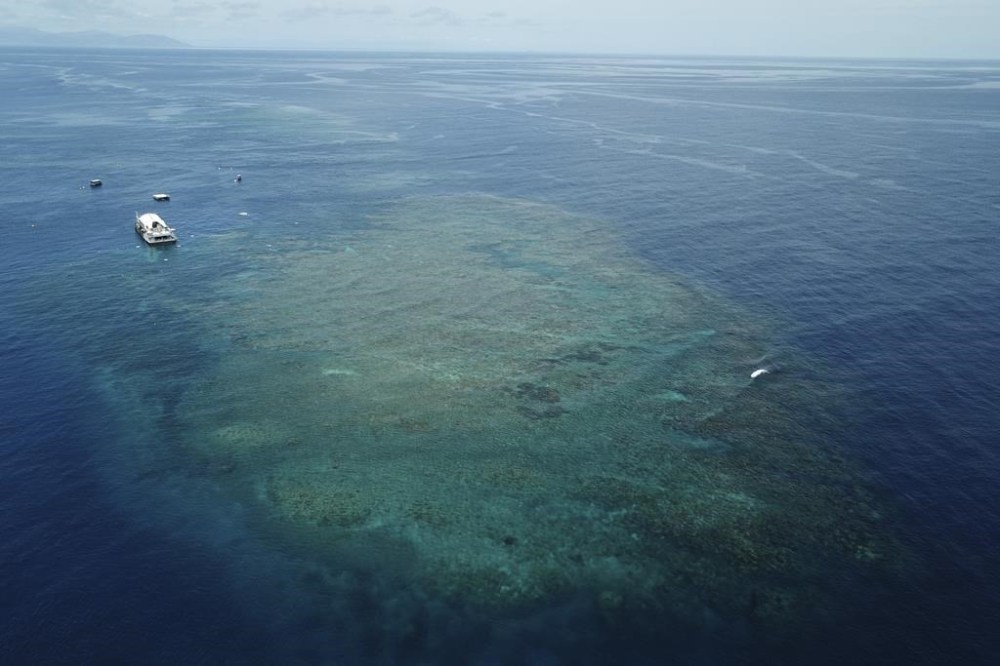
The Remoora pontoon, owned by Reef Magic, sits above a section of the Great Barrier Reef above Moore Reef in Gunggandji Sea Country off coast of Queensland in eastern Australia on Nov. 14, 2022. (AP Photo/Sam McNeil)

They observed largely stable temperatures before 1900, and steady warming from January to March from 1960 to 2024. And during five years of coral bleaching in the past decade — during 2016, 2017, 2020, 2022 and 2024 — temperatures in January and March were significantly higher than anything dating back to 1618, researchers found. They used climate models to attribute the warming rate after 1900 to human-caused climate change. The only other year nearly as warm as the mass bleaching years of the past decade was 2004.

“The reef is in danger and if we don’t divert from our current course, our generation will likely witness the demise of one of those great natural wonders,” said Benjamin Henley, the study’s lead author and a lecturer of sustainable urban management at the University of Melbourne. “If you put all of the evidence together … heat extremes are occurring too often for those corals to effectively adapt and evolve.”

Across the world, reefs are key to seafood production and tourism. Scientists have long said additional loss of coral is likely to be a casualty of future warming as the world approaches the 1.5 degrees Celsius (2.7 degrees Fahrenheit) threshold that countries agreed to try and keep warming under in the 2015 Paris climate agreement.

Even if global warming is kept under the Paris Agreement’s goal, which scientists say Earth is almost guaranteed to cross, 70% to 90% of corals across the globe could be threatened, the study’s authors said. As a result, future coral reefs would likely have less diversity in coral species — which has already been happening as the oceans have grown hotter.

Coral reefs have been evolving over the past quarter century in response to bleaching events like the ones the study’s authors highlighted, said Michael McPhaden, a senior climate scientist at the National Oceanic and Atmospheric Administration who was not involved with the study. But even the most robust coral may soon not be able to withstand the elevated temperatures expected under a warming climate with “the relentless rise in greenhouse gas concentrations in the atmosphere,” he said.

The Great Barrier Reef serves as an economic resource for the region and protects against severe tropical storms.

As more heat-tolerant coral replaces the less heat-tolerant species in the colorful underwater rainbow jungle, McPhaden said there’s “real concern” about the expected extreme loss in the number of species and reduction in area that the world’s largest reef covers.

“It’s the canary in the coal mine in terms of climate change,” McPhaden said.

___

This story has corrected attribution for the aerial surveys in the 2nd paragraph to the Great Barrier Reef Marine Park Authority, rather than NASA.

___

The Associated Press’ climate and environmental coverage receives financial support from multiple private foundations. AP is solely responsible for all content. Find AP’s standards for working with philanthropies, a list of supporters and funded coverage areas at AP.org.

Report Error Submit a Tip

More Stories

Police, street groups looking to extend co-ordinated outreach-first approach to drug-use, trafficking crackdown

Chris Kitching 6 minute read Preview

Police, street groups looking to extend co-ordinated outreach-first approach to drug-use, trafficking crackdown

Chris Kitching 6 minute read Updated: Yesterday at 5:36 PM CDT

Winnipeg police and street outreach groups are discussing how to extend an initiative that tries to link people with addictions and homelessness services, while targeting open drug use and dealing.

Read
Updated: Yesterday at 5:36 PM CDT

Man pleads guilty to five sex assaults at, near HSC

Dean Pritchard 5 minute read Preview

Man pleads guilty to five sex assaults at, near HSC

Dean Pritchard 5 minute read Yesterday at 3:41 PM CDT

A Winnipeg man previously found not criminally responsible for a violent assault on his father has pleaded guilty to sexually assaulting four women and a teen girl in and around the Health Sciences Centre last year.

Donovan Mohammed, 29, admitted responsibility for the attacks, on Friday in Winnipeg court. He remains in custody and will be sentenced at a later date following the completion of a court-ordered pre-sentence report.

Mohammed admitted to sexually assaulting a 14-year-old girl and four women — all strangers to him — within the span of an hour on July 2, 2025.

Court heard three of Mohammed’s victims were nurses and three of the assaults were captured on security video.

Read
Yesterday at 3:41 PM CDT

‘We know we’re not going to beat Mother Nature’: Ice prep begins at Princess Auto Stadium for Heritage Classic

Mike McIntyre 6 minute read Preview

‘We know we’re not going to beat Mother Nature’: Ice prep begins at Princess Auto Stadium for Heritage Classic

Mike McIntyre 6 minute read Yesterday at 5:56 PM CDT

Derek King typically has ice in his veins.

But the Manitoban admits there may be a few more butterflies than usual as he prepares for the ultimate home game — the 2026 Heritage Classic between the Winnipeg Jets and Montreal Canadiens.

“This is so exciting to be back,” King, the NHL’s vice-president of hockey operations and facilities operations, said Tuesday afternoon.

“It’s definitely going to be a fun event to be part of.”

Read
Yesterday at 5:56 PM CDT

Ontario to move northwest regions to permanent daylight time

Liam Casey, The Canadian Press 3 minute read Preview

Ontario to move northwest regions to permanent daylight time

Liam Casey, The Canadian Press 3 minute read Updated: Yesterday at 11:29 AM CDT

TORONTO - Ontario is set to move parts of the province's northwest region to permanent daylight time in order to align with Manitoba, Indigenous Affairs Minister Greg Rickford told The Canadian Press.

Rickford said there is overwhelming consensus among municipalities, First Nations and businesses to make the time change permanent.

The province intends to make a regulatory change in the Time Act on Nov. 1 to allow regions west of the 90th meridian to align with Manitoba, he said.

Manitoba Premier Wab Kinew announced last month the province would stop twice-annual clock changes and stay on daylight time year-round in the central time zone, leaving it one hour ahead of the other Prairie provinces rather than aligned with them.

Read
Updated: Yesterday at 11:29 AM CDT

Hydro’s unpredictable fortunes

Editorial 4 minute read Preview

Hydro’s unpredictable fortunes

Editorial 4 minute read Yesterday at 2:00 AM CDT

Hope for rain. Or snow. Or both. There’s a truism buried deep in a financial outlook in Manitoba Hydro’s 2025-26 annual report, released in late September: “Manitoba Hydro’s net income is highly dependent on several uncontrollable factors.”

Read
Yesterday at 2:00 AM CDT

Tenants battling landlords find help in short supply from province

Scott Billeck 14 minute read Preview

Tenants battling landlords find help in short supply from province

Scott Billeck 14 minute read Yesterday at 6:00 AM CDT

For nearly three years, Quincy Houdayer and Avery Helm repeatedly pressed their landlord to address plumbing failures, water damage and other maintenance problems at their West Broadway apartment, with records showing some issues persisted until the couple turned to the Residential Tenancies Branch.

Emails and text messages between the tenants, Clearwater Management and the RTB reviewed by the Free Press document recurring leaks and flooding, periods without heat or hot water, concerns about mould and basement conditions and repeated followups from the couple seeking repairs.

“Most of the experiences we’ve had with them can be boiled down to, like, they either are very dismissive about it, they act like it’s not their problem… or they will just fully, blatantly ignore you,” Helm said, adding that the only way to get Clearwater to respond was to threaten going to the RTB, a provincial government agency.

RTB data obtained by the Free Press also shows 13 orders involving the three-building complex at 193-197 Furby St. in 2026 alone. All but one favoured the tenant, while the remaining order ruled in favour of both the tenant and landlord on different items.

Read
Yesterday at 6:00 AM CDT


