This bird species was extinct in Europe. Now it’s back, and humans must help it migrate for winter
Advertisement
Read this article for free:
or
Already have an account? Log in here »
To continue reading, please subscribe:

Digital Subscription
One year of digital access for only $205*
- Enjoy unlimited reading on winnipegfreepress.com
- Read the E-Edition, our digital replica newspaper
- Access News Break, our award-winning app
- Play interactive puzzles
*First annual payment billed as $205.00 + GST for one year. This annual subscription will automatically renew at $233.00 + GST every 52 weeks (10% off the regular annual price of $259.35). Offer available to new and qualified returning subscribers only. Cancel any time.
To continue reading, please subscribe:
Add Free Press access to your Brandon Sun subscription for only an additional
$1 for the first 4 weeks*
- Enjoy unlimited reading on winnipegfreepress.com
- Read the E-Edition, our digital replica newspaper
- Access News Break, our award-winning app
- Play interactive puzzles
*Your next Brandon Sun subscription payment will increase by $1.00 and you will be charged $17.95 plus GST for four weeks. After four weeks, your payment will increase to $24.95 plus GST every four weeks.
Read unlimited articles for free today:
or
Already have an account? Log in here »
Hey there, time traveller!
This article was published 25/08/2024 (758 days ago), so information in it may no longer be current.
PATERZELL, Germany (AP) — How do you teach a bird how, and where, to fly?
The distinctive Northern Bald Ibis, hunted essentially to extinction by the 17th century, was revived by breeding and rewilding efforts over the last two decades. But the birds — known for their distinctive black-and-iridescent green plumage, bald red head and long curved beak — don’t instinctively know which direction to fly to migrate without the guidance of wild-born elders. So a team of scientists and conservationists stepped in as foster parents and flight instructors.
“We have to teach them the migration route,” said biologist Johannes Fritz.

The Northern Bald Ibis once soared over North Africa, the Arabian Peninsula and much of Europe, including southern Germany’s Bavaria. The migratory birds were also considered a delicacy and the bird, known as the Waldrapp in German, disappeared from Europe, though a few colonies elsewhere survived.
The efforts of Fritz and the Waldrappteam, a conservation and research group based in Austria, brought the Central European population from zero to almost 300 since the start of their project in 2002.
The feat moved the species from a “critically endangered” classification to “endangered” and, Fritz says, is the first attempt to reintroduce a continentally extinct migratory bird species.
But while Northern Bald Ibises still display the natural urge to migrate, they don’t know which direction to fly without the guidance of wild-born elders. The Waldrappteam’s early reintroduction attempts were largely unsuccessful because, without teaching the birds the migration route, most disappeared soon after release. Instead of returning to suitable wintering grounds such as Tuscany, Italy, they flew in different directions and ultimately died.
So the Waldrappteam stepped in as foster parents and flight instructors for the Central European population, which was made up of descendants from multiple zoo colonies and released into the wild in the hopes of creating a migratory group. This year marks the 17th journey with human-led migration guides, and the second time they’ve been forced to pilot a new route to Spain due to climate change.
To prepare them for travel, the chicks are removed from their breeding colonies when they are just a few days old. They are taken to an aviary that’s overseen by the foster parents in the hopes of “imprinting” — when the birds will bond with those humans to ultimately trust them along the migration route.
Barbara Steininger, a Waldrapp team foster mother, said she acts like “their bird mom.”
“We feed them, we clean them, we clean their nests. We take good care of them and see that they are healthy birds,” she said. “But also we interact with them.”
Steininger and the other foster parents then sit on the back of a microlight aircraft, waving and shouting encouragement through a bullhorn as it flies through the air.
It’s a bizarre scene: The aircraft looks like a flying go-kart with a giant fan on the back and a yellow parachute keeping it aloft. Still, three dozen birds follow the contraption, piloted by Fritz, as it sails over alpine meadows and foothills.
Fritz was inspired by “Father Goose” Bill Lishman, a naturalist who taught Canadian geese to fly alongside his ultra-light plane beginning in 1988. He later guided endangered whooping cranes through safe routes and founded the nonprofit “Operation Migration.” Lishman’s work prompted the 1996 movie “Fly Away Home” but features a young girl as the geese’s “mother.”
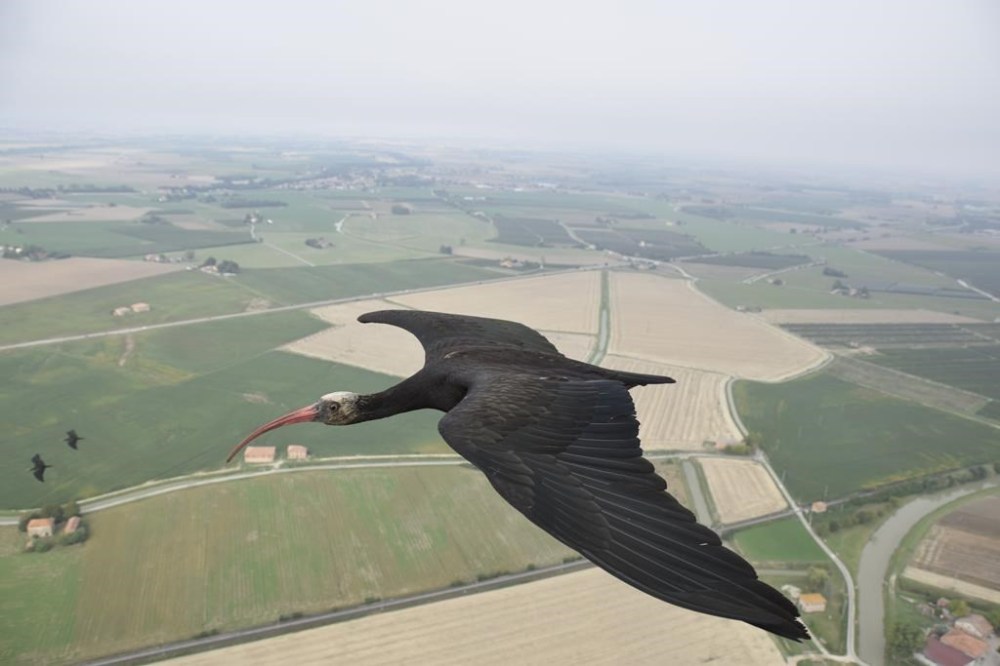
Like Lishman, Fritz and his team’s efforts have worked. The first bird independently migrated back to Bavaria in 2011 from Tuscany. More have flown the route that’s upwards of 550 kilometers (342 miles) each year, and the team hopes the Central European population will be more than 350 birds by 2028 and become self-sustaining.
But the effects of climate change mean the Waldrapp are migrating later in the season now, which forces them to cross the Alps in colder, more dangerous weather — without the aid of warm currents of air, known as thermals, that rise upward and help the birds soar without expending extra energy.
In response, the Waldrappteam piloted a new route in 2023, from Bavaria to Andalusia in southern Spain.
This year, the route is roughly 2,800 kilometers (1,740 miles) — some 300 kilometers (186 miles) longer than last year’s path. Earlier this month from an airfield in Paterzell, in upper Bavaria, the team guided 36 birds along one stage through bright blue skies and a tailwind that increased their speed.
The entire journey to Spain could take up to 50 days and end in early October. But Fritz says the effort is bigger than just the Northern Bald Ibises: It’s about paving the way for other threatened migratory species to fly.
___
Dazio reported from Berlin.
Related Articles
Unique study in northern Manitoba discovers more bird species than previously known
Advertisement Advertise With Us
Advertisement Advertise With Us