

NDP will have to decide whether to make good on 2023 pledge or spend during election year

Advertisement
Read this article for free:
or
Already have an account? Log in here »
To continue reading, please subscribe:

Digital Subscription
One year of digital access for only $205*
- Enjoy unlimited reading on winnipegfreepress.com
- Read the E-Edition, our digital replica newspaper
- Access News Break, our award-winning app
- Play interactive puzzles
*First annual payment billed as $205.00 + GST for one year. This annual subscription will automatically renew at $233.00 + GST every 52 weeks (10% off the regular annual price of $259.35). Offer available to new and qualified returning subscribers only. Cancel any time.
To continue reading, please subscribe:
Add Free Press access to your Brandon Sun subscription for only an additional
$1 for the first 4 weeks*
- Enjoy unlimited reading on winnipegfreepress.com
- Read the E-Edition, our digital replica newspaper
- Access News Break, our award-winning app
- Play interactive puzzles
*Your next Brandon Sun subscription payment will increase by $1.00 and you will be charged $17.95 plus GST for four weeks. After four weeks, your payment will increase to $24.95 plus GST every four weeks.
Read unlimited articles for free today:
or
Already have an account? Log in here »
The good news is the provincial deficit has been shrinking for the past two years. The bad news is the NDP government is still deep in the red.
The province released its public accounts Monday for the 2025-26 fiscal year. It shows the provincial deficit came in at $832 million last year, down from $1.12 billion the previous year and $1.95 billion in 2023-24.
The almost $2-billion shortfall was shared between the former Progressive Conservative government and the NDP, which took the reins of power about halfway through the 2023-24 fiscal year.
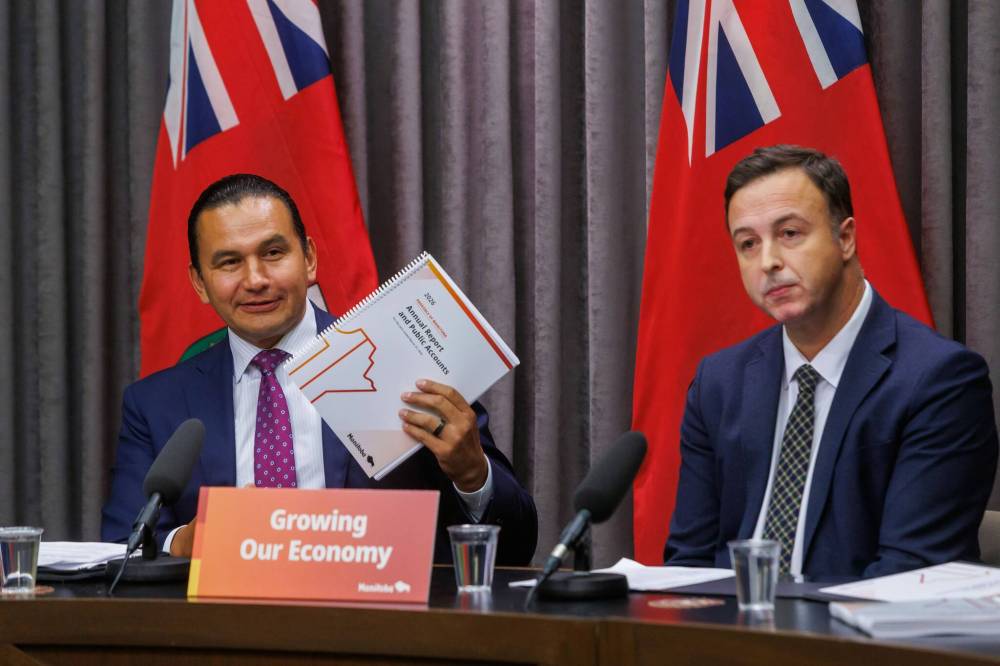
MIKE DEAL / FREE PRESS
Premier Wab Kinew and Finance Minister Adrien Sala announced that the province is on track to balance the budget next year after cutting the deficit in half since the third quarter update during a press conference on Monday.
Premier Wab Kinew and Finance Minister Adrien Sala continued to insist Monday that the NDP inherited a $2-billion deficit from the Tories, which is not entirely accurate.
The NDP took office Oct. 18 2023, nearly seven months into the 2023-24 fiscal year. At that point, the province’s second-quarter report projected a deficit of $1.62 billion.
By the end of that fiscal year, the deficit grew to $2 billion, which means it increased roughly $400 million under the NDP.
Both parties blame each other for the massive shortfall, but the truth is probably somewhere in the middle.
Either way, the deficit is on a downward trajectory, which is good news for the fiscal health of the province.
Still, the province continues to run a large deficit and is racking up record debt. The debt-to-GDP ratio has grown under the NDP, from 34.6 per cent in 2023-24 to 36.4 per cent in 2025-26. That’s manageable in the short to medium term, but it’s not sustainable in the long run.
The NDP projected a $498-million deficit for the current fiscal year in its last budget. If it meets that target, it would be a significant improvement in the province’s bottom line.
But Manitobans won’t know for certain until the audited books come out in September 2027.
There will be a few hints before that, with revised deficit projections in the next few quarterly reports. The first-quarter report is due out next week.
But those are just projections, which often change throughout the year, owing to multiple factors, some of which are out of government’s hands, such as droughts, wildfires, floods and further harm from U.S. tariffs. Governments usually have contingencies for some of them, but they can’t cover them all.
Both parties blame each other for the massive shortfall, but the truth is probably somewhere in the middle.
Meanwhile, next year is an election year — set for Oct. 5 — which means the 2027 budget will be an election budget.
The NDP promised voters in the 2023 election that it would balance the books by the end of its first term. If it wants to make good on that pledge, next year’s budget would have to project a surplus.
Depending on economic growth projections, government spending decisions and the extent to which U.S. President Donald Trump plans to hammer Canada with more tariffs, it is possible the NDP’s next fiscal blueprint could be balanced.
Politically, that would be the goal. But it’s still a tall order.
Unless this year’s projected deficit is significantly reduced, it would be difficult to imagine a balanced budget next year. Erasing a half-billion dollar shortfall in a single year doesn’t usually come without sharp spending cuts or revenue windfalls — such as a substantial increase in federal transfers — or both.
Governments don’t like making spending cuts during election years. In fact, they tend to spend more in the months leading up to a writ period.
Those are the competing goals the NDP will have to juggle next year.
Kinew could call an early election. His government could release a budget in the spring showing a small surplus (whether it materializes or not) and then drop the writ shortly thereafter.
Manitoba has set election dates, but there’s nothing preventing a premier from calling an early vote, as former premier Brian Pallister did in 2019.
In any event, does it matter if the province balances the books next year or a year later? Not really. Bond-rating agencies that determine the government’s borrowing costs don’t usually downgrade a government’s credit rating if its bottom line is moving in the right direction.
In any event, does it matter if the province balances the books next year or a year later? Not really.

And given the NDP’s growing popularity — the latest Abacus Data poll shows NDP support at its highest level since the 2023 election — it’s unlikely a failure to balance the books in its first term would hurt the party politically.
Voters likely care more about the state of health care and education and would prefer to see government tackle crime, mental health, homelessness and addictions more aggressively than rush to achieve a balanced budget.
Governments do have to eventually balance their books or face the wrath of nervous credit-rating agencies. But they also have to support important public services, including hospitals and schools, and ensure the justice system is properly funded (which doesn’t seem to be the case right now).
If the deficit continues to shrink next year — even if it’s not eliminated right away — and the NDP increases funding in key front-line areas, it’s hard to imagine the party not winning a greater majority in 2027 than it did in 2023, whether or not it balances the books.
tom.brodbeck@freepress.mb.ca
Tom Brodbeck is an award-winning author and columnist with over 30 years experience in print media. He joined the Free Press in 2019. Born and raised in Montreal, Tom graduated from the University of Manitoba in 1993 with a Bachelor of Arts degree in economics and commerce. Read more about Tom.
Tom provides commentary and analysis on political and related issues at the municipal, provincial and federal level. His columns are built on research and coverage of local events. The Free Press’s editing team reviews Tom’s columns before they are posted online or published in print – part of the Free Press’s tradition, since 1872, of producing reliable independent journalism. Read more about Free Press’s history and mandate, and learn how our newsroom operates.
Our newsroom depends on a growing audience of readers to power our journalism. If you are not a paid reader, please consider becoming a subscriber.
Our newsroom depends on its audience of readers to power our journalism. Thank you for your support.
Tom Brodbeck is an award-winning author and columnist with over 30 years experience in print media. He joined the Free Press in 2019. Born and raised in Montreal, Tom graduated from the University of Manitoba in 1993 with a Bachelor of Arts degree in economics and commerce. Read more about Tom.
Tom provides commentary and analysis on political and related issues at the municipal, provincial and federal level. His columns are built on research and coverage of local events. The Free Press’s editing team reviews Tom’s columns before they are posted online or published in print – part of the Free Press’s tradition, since 1872, of producing reliable independent journalism. Read more about Free Press’s history and mandate, and learn how our newsroom operates.
Our newsroom depends on a growing audience of readers to power our journalism. If you are not a paid reader, please consider becoming a subscriber.
Our newsroom depends on its audience of readers to power our journalism. Thank you for your support.
Related Articles
Kinew’s political brand appears unstoppable



Advertisement Advertise With Us
Advertisement Advertise With Us