California advances landmark legislation to regulate large AI models

Advertisement

Advertise with us

SACRAMENTO, Calif. (AP) — Efforts in California to establish first-in-the-nation safety measures for the largest artificial intelligence systems cleared an important vote Wednesday that could pave the way for U.S. regulations on the technology evolving at warp speed.

Read this article for free:


By clicking the button above, an account will be created and you will begin to receive some of our recommended newsletters. You may opt out of any newsletter by visiting your Email and Communication Preferences page or by clicking "unsubscribe" at the bottom of any email.

or

Already have an account? Log in here »

To continue reading, please subscribe:

Digital Subscription

One year of digital access for only $1.44 a week*

  • Enjoy unlimited reading on winnipegfreepress.com
  • Read the E-Edition, our digital replica newspaper
  • Access News Break, our award-winning app
  • Play interactive puzzles

*Billed as $5.77 plus GST every four weeks. After 52 weeks, price increases to the regular rate of $19.95 plus GST every four weeks. Offer available to new and qualified returning subscribers only. Cancel any time.

To continue reading, please subscribe:

Add Free Press access to your Brandon Sun subscription for only an additional

$1 for the first 4 weeks*

  • Enjoy unlimited reading on winnipegfreepress.com
  • Read the E-Edition, our digital replica newspaper
  • Access News Break, our award-winning app
  • Play interactive puzzles
Start now

*Your next Brandon Sun subscription payment will increase by $1.00 and you will be charged $17.95 plus GST for four weeks. After four weeks, your payment will increase to $24.95 plus GST every four weeks.

Hey there, time traveller!
This article was published 28/08/2024 (786 days ago), so information in it may no longer be current.

SACRAMENTO, Calif. (AP) — Efforts in California to establish first-in-the-nation safety measures for the largest artificial intelligence systems cleared an important vote Wednesday that could pave the way for U.S. regulations on the technology evolving at warp speed.

The proposal, aiming to reduce potential risks created by AI, would require companies to test their models and publicly disclose their safety protocols to prevent the models from being manipulated to, for example, wipe out the state’s electric grid or help build chemical weapons — scenarios experts say could be possible in the future with such rapid advancements in the industry.

The bill is among hundreds lawmakers are voting on during its final week of session. Gov. Gavin Newsom then has until the end of September to decide whether to sign them into law, veto them or allow them to become law without his signature.
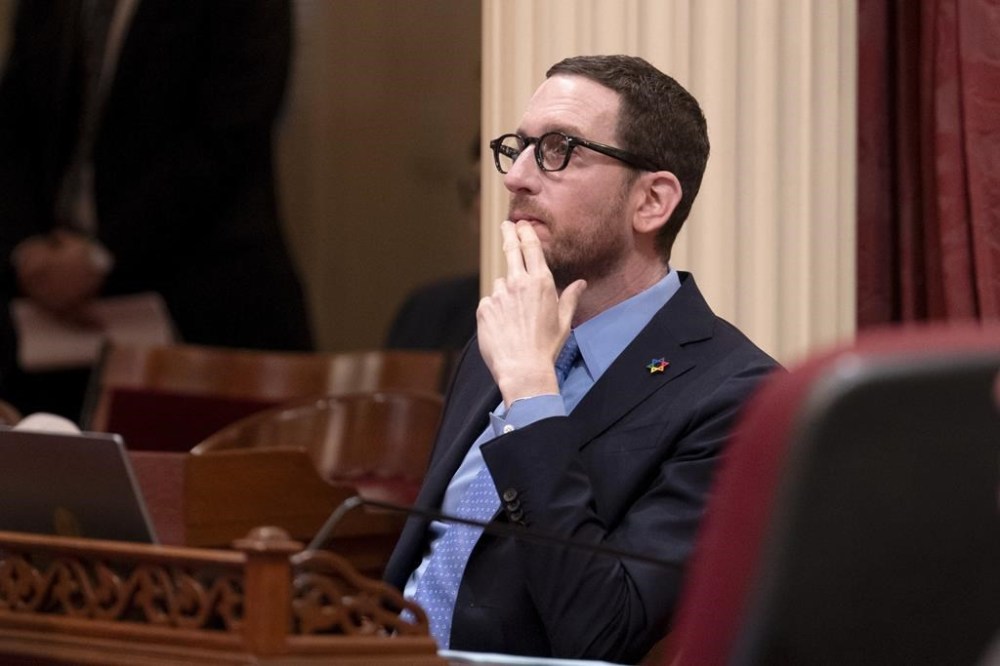
FILE - State Sen. Scott Wiener, D-San Francisco, watches as the Senate votes on a measure at the Capitol in Sacramento, Calif., Thursday, April 11, 2024. (AP Photo/Rich Pedroncelli,File)

The measure squeaked by in the Assembly Wednesday and requires a final Senate vote before reaching the governor’s desk.

Supporters said it would set some of the first much-needed safety ground rules for large-scale AI models in the United States. The bill targets systems that require more than $100 million in data to train. No current AI models have hit that threshold.

“It’s time that Big Tech plays by some kind of a rule, not a lot, but something,” Republican Assemblymember Devon Mathis said in support of the bill Wednesday. “The last thing we need is for a power grid to go out, for water systems to go out.”

The proposal, authored by Democratic Sen. Scott Wiener, faced fierce opposition from venture capital firms and tech companies, including OpenAI, Google and Meta, the parent company of Facebook and Instagram. They say safety regulations should be established by the federal government and that the California legislation takes aim at developers instead of targeting those who use and exploit the AI systems for harm.

A group of several California House members also opposed the bill, with Former House Speaker Nancy Pelosi calling it “ well-intentioned but ill informed.”

Chamber of Progress, a left-leaning Silicon Valley-funded industry group, said the bill is “based on science fiction fantasies of what AI could look like.”

“This bill has more in common with Blade Runner or The Terminator than the real world,” Senior Tech Policy Director Todd O’Boyle said in a statement after the Wednesday vote. “We shouldn’t hamstring California’s leading economic sector over a theoretical scenario.”

The legislation is supported by Anthropic, an AI startup backed by Amazon and Google, after Wiener adjusted the bill earlier this month to include some of the company’s suggestions. The current bill removed the penalty of perjury provision, limited the state attorney general’s power to sue violators and narrowed the responsibilities of a new AI regulatory agency. Social media platform X owner Elon Musk also threw his support behind the proposal this week.

Anthropic said in a letter to Newsom that the bill is crucial to prevent catastrophic misuse of powerful AI systems and that “its benefits likely outweigh its costs.”

FILE - A person stands in front of a Meta sign outside of the company's headquarters in Menlo Park, Calif., March 7, 2023. (AP Photo/Jeff Chiu, File)

Wiener said his legislation took a “light touch” approach.

“Innovation and safety can go hand in hand—and California is leading the way,” Weiner said in a statement after the vote.

He also slammed critics earlier this week for dismissing potential catastrophic risks from powerful AI models as unrealistic: “If they really think the risks are fake, then the bill should present no issue whatsoever.”

Wiener’s proposal is among dozens of AI bills California lawmakers proposed this year to build public trust, fight algorithmic discrimination and outlaw deepfakes that involve elections or pornography. With AI increasingly affecting the daily lives of Americans, state legislators have tried to strike a balance of reigning in the technology and its potential risks without stifling the booming homegrown industry.

California, home of 35 of the world’s top 50 AI companies, has been an early adopter of AI technologies and could soon deploy generative AI tools to address highway congestion and road safety, among other things.

Newsom, who declined to weigh in on the measure earlier this summer, had warned against AI overregulation.
Report Error Submit a Tip

More Stories

Chief medical officer quits, cites work environment ‘challenges’

Chris Kitching 6 minute read Preview

Chief medical officer quits, cites work environment ‘challenges’

Chris Kitching 6 minute read 5:47 PM CDT

Manitoba’s provincial chief medical officer is resigning from his position at Shared Health, citing the role’s demands and work environment challenges in an email viewed by the Free Press.

Dr. José François, who’s held the executive position since April 2024, sent an email to provincial medical specialty leads that said his final day will be Jan. 17, 2027, after he submitted his resignation Wednesday. Several other senior leaders have departed the provincial health authority in recent months.

“Serving in this role has been a privilege,” François, a longtime family physician from Ste. Anne, wrote in the email.

He said his “greatest pleasure” was working alongside and supporting an “exceptional group” of provincial medical specialty leads and chief medical officers.

Read
5:47 PM CDT

Henderson crosswalk has glaring safety gap, say researchers months after pedestrian killed

Maggie Macintosh 6 minute read Preview

Henderson crosswalk has glaring safety gap, say researchers months after pedestrian killed

Maggie Macintosh 6 minute read 2:00 AM CDT

Six months after a fatal collision at a crosswalk on Henderson Highway, two traffic safety researchers question why the intersection remains an outlier that is missing key flashing lights.

The City of Winnipeg is being urged to install “backflashers” to better protect road users moving in all directions at the intersection where a 32-year-old father died in the spring.

“It’s these little, mundane, non-sexy engineering problems that can cause everything right up to fatality,” said Curt Pankratz, an associate professor at the University of Winnipeg who studies traffic engineering and policymaking.

On April 19, shortly before sunrise, Gabe Beardy was struck when he was crossing the six-lane thoroughfare at Neil Avenue.

Read
2:00 AM CDT

Police HQ report ‘outrageous’: Kinew

Joyanne Pursaga 6 minute read Preview

Police HQ report ‘outrageous’: Kinew

Joyanne Pursaga 6 minute read Tuesday, Oct. 20, 2026

Premier Wab Kinew says public inquiry findings that taxpayers were overcharged more than $40 million for the Winnipeg Police Service headquarters project and two city leaders broke the public trust are “outrageous.”

Inquiry commissioner Garth Smorang’s report, which was released Monday, concluded former mayor Sam Katz “violated the public trust” and council code of conduct, while the city’s former chief administrative officer Phil Sheegl suffered from a “complete lack of a moral compass.”

Smorang also found the city was overcharged $43.3 million for the project, with $42 million of that going to key contractor Caspian Projects.

“It’s outrageous that people who were elected betrayed the public here in the city. It’s outrageous that there were people in business who ripped you off, ripped me off — I was paying property taxes in Winnipeg at the time — and ripped all of us off to the tune of $43.3 million. That’s crazy,” said Kinew.

Read
Tuesday, Oct. 20, 2026

Puck set to drop on Heritage Classic festivities

Mike McIntyre 7 minute read Preview

Puck set to drop on Heritage Classic festivities

Mike McIntyre 7 minute read 5:01 PM CDT

It’s the ultimate Manitoba mash-up: Cottage country meets hockey heaven.

And it will be the central theme for the 2026 Tim Hortons NHL Heritage Classic, which features the Winnipeg Jets and Montreal Canadiens facing off Sunday evening at Princess Auto Stadium.

“We’re really excited about this one. It pops. It looks amazing. We think this is one of our better-looking field designs,” Steve Mayer, the president of NHL content and events, told reporters this week as preparation of the outdoor rink and related components reached a fever pitch.

“We want people to walk in the stadium and go, ‘Wow.’”

Read
5:01 PM CDT

California advances landmark legislation to regulate large AI models

Trân Nguyễn, The Associated Press 4 minute read Preview

California advances landmark legislation to regulate large AI models

Trân Nguyễn, The Associated Press 4 minute read Wednesday, Aug. 28, 2024

SACRAMENTO, Calif. (AP) — Efforts in California to establish first-in-the-nation safety measures for the largest artificial intelligence systems cleared an important vote Wednesday that could pave the way for U.S. regulations on the technology evolving at warp speed.

The proposal, aiming to reduce potential risks created by AI, would require companies to test their models and publicly disclose their safety protocols to prevent the models from being manipulated to, for example, wipe out the state’s electric grid or help build chemical weapons — scenarios experts say could be possible in the future with such rapid advancements in the industry.

The bill is among hundreds lawmakers are voting on during its final week of session. Gov. Gavin Newsom then has until the end of September to decide whether to sign them into law, veto them or allow them to become law without his signature.

The measure squeaked by in the Assembly Wednesday and requires a final Senate vote before reaching the governor's desk.

Read
Wednesday, Aug. 28, 2024

Klein, Gillingham trade jabs over megaproject

Malak Abas 6 minute read Preview

Klein, Gillingham trade jabs over megaproject

Malak Abas 6 minute read Yesterday at 9:36 PM CDT

Two of Winnipeg’s mayoral candidates wasted no time trading barbs over who bears responsibility for the skyrocketing cost of overhauling the North End sewage treatment plant, during a televised debate Wednesday.

Scott Gillingham and Kevin Klein pointed the finger at each other for the rising cost of the massive project, which had a cost estimate of $795 million in 2015 and had ballooned to $3.2 billion as of the latest estimate.

“We need to be able to understand how that amount tripled in that short a time,” Klein said at the event held at CBC’s downtown Winnipeg headquarters. He pointed out the first estimate was given when Gillingham was chairman of the city’s finance committee. He questioned what the incumbent did to garner funding for the project.

Gillingham shot back by noting Klein was Manitoba’s environment minister in 2023. He accused his opponent of failing to make a dent on the cost.

Read
Yesterday at 9:36 PM CDT