Georgia school shooting highlights fears about classroom cellphone bans

Advertisement

Advertise with us

Huddling for safety in classrooms as gunfire rang out, students at Apalachee High School texted or called their parents to let them know what was happening and send what they thought could be their final messages. One student texted her mother to say she loved her, adding, “I'm sorry I'm not the best daughter.”

Read this article for free:


or

Already have an account? Log in here »

To continue reading, please subscribe:

Subscribe and receive a limited-edition Free Press branded hat or tote.

Digital Subscription

One year of digital access for only $205*

  • Enjoy unlimited reading on winnipegfreepress.com
  • Read the E-Edition, our digital replica newspaper
  • Access News Break, our award-winning app
  • Play interactive puzzles

*First annual payment billed as $205.00 + GST for one year. This annual subscription will automatically renew at $233.00 + GST every 52 weeks (10% off the regular annual price of $259.35). Offer available to new and qualified returning subscribers only. Cancel any time.

To continue reading, please subscribe:

Add Free Press access to your Brandon Sun subscription for only an additional

$1 for the first 4 weeks*

  • Enjoy unlimited reading on winnipegfreepress.com
  • Read the E-Edition, our digital replica newspaper
  • Access News Break, our award-winning app
  • Play interactive puzzles
Start now

*Your next Brandon Sun subscription payment will increase by $1.00 and you will be charged $17.95 plus GST for four weeks. After four weeks, your payment will increase to $24.95 plus GST every four weeks.

Hey there, time traveller!
This article was published 08/09/2024 (731 days ago), so information in it may no longer be current.

Huddling for safety in classrooms as gunfire rang out, students at Apalachee High School texted or called their parents to let them know what was happening and send what they thought could be their final messages. One student texted her mother to say she loved her, adding, “I’m sorry I’m not the best daughter.”

The Georgia school shooting that left four dead and nine injured last week was every parent’s worst nightmare, and one that highlights potential downsides to efforts among states, school districts and federal lawmakers to ban or restrict access to cellphones in classrooms.

The moves to restrict phone use in schools have been driven by concerns about the impact screentime has on children’s mental health and complaints from teachers that cellphones have become a constant distraction in the classroom. But those opposed to the bans say they cut off a lifeline parents have to make sure their children are safe during school shootings or other emergencies.
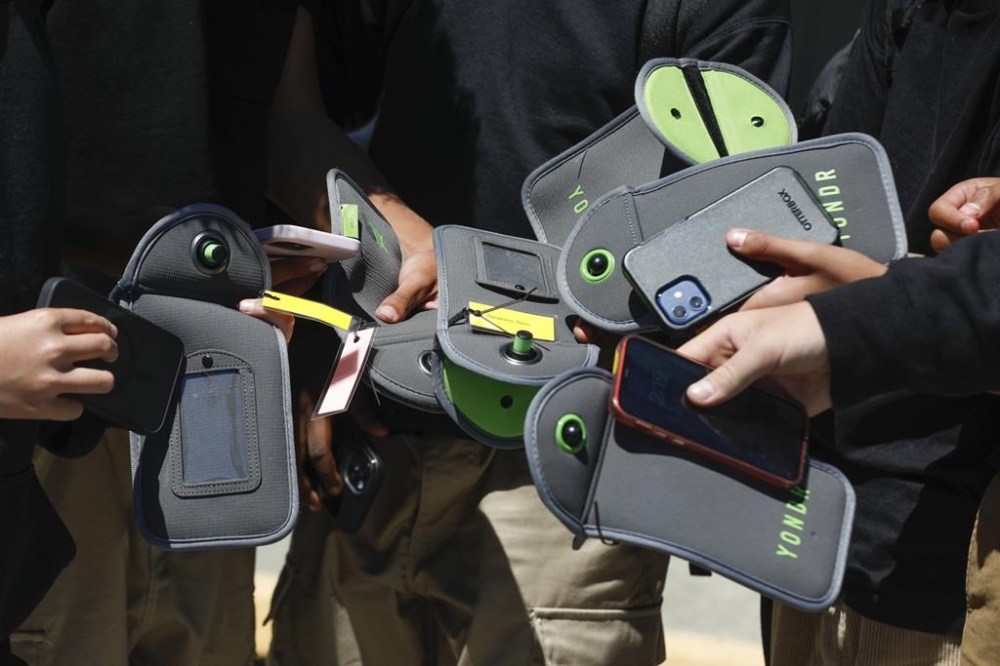
FILE - A student uses their cell phone after unlocking the pouch that secures it from use during the school day at Bayside Academy, Aug. 16, 2024, in San Mateo, Calif. (Lea Suzuki/San Francisco Chronicle via AP, File)

“The fact of the matter is parents and families cannot rely on schools to effectively communicate with us in times of emergency, and this has happened time and again,” said Keri Rodrigues, president of the National Parents Union, an education advocacy group. “There’s a whole host of reasons why parents are deeply concerned about whether or not they’re going to get timely information about whether or not their kids are safe.”

Nationally, 77% of U.S. schools say they prohibit cellphones at school for non-academic use, according to the National Center for Education Statistics. But that number is misleading. It does not mean students are following those bans or all those schools are enforcing them.

The restrictions have been trumpeted by both Republican and Democratic governors who rarely agree on other issues.

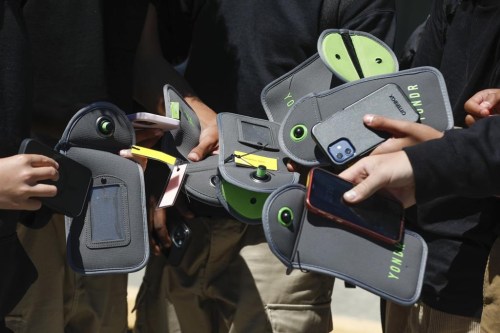
In Arkansas, GOP Gov. Sarah Huckabee Sanders launched a program for school districts to apply for grants to purchase pouches for students to keep their phones in during the school day. In California, Democratic Gov. Gavin Newsom has urged school districts to restrict cellphone use and is weighing whether to sign legislation that would require schools to enact restrictions.

“I’d hate to see another school shooting be the reason that we bring TVs into the classroom and then disrupt our children’s education,” Newsom said Friday. “Because, in essence, that’s what a cellphone is equivalent to — bringing a TV into the classroom and disrupting the ability to get quality academic time.”

But for many students caught in the Apalachee shooting, having access to their phones was the only way they could communicate with loved ones during moments they feared could be their last.

“I love you. I love you so much. Ma I love you,” Junior Julie Sandoval texted her mother. “I’m sorry I’m not the best daughter. I love you.”

Nearby, Sandoval said, another student was on the phone telling their mother, “They’re shooting up the school! They’re shooting up the school!”

But advocates of school phone restrictions warn that allowing access to phones during shootings or other emergencies could put students in even more danger.

“What’s even more important to me is their safety,” said Kim Whitman, co-founder of the Phone-Free Schools Movement, a group that advocates for schools to adopt policies keeping cellphones off and away from students. “If my child was on the phone with me and they missed guidance from the teacher because they were distracted by their phone and they weren’t safe, that’s a worse scenario in my mind.”

Whitman said she understands the concerns about keeping parents informed and that’s why a key part for any phone-free school is being proactive in communicating about emergencies.

Balancing safety and parents’ concerns guided a cellphone ban at Grand Island Senior High, the largest high school in Nebraska, which rolled out a new policy in January that requires students to keep phones out of sight and in their bags or pockets, silenced or off during school hours.

“One of the essential questions that parents asked us was, ‘What if Sally or Johnny doesn’t have their phone if, God forbid, an active shooting happens or there is some sort of crisis in the building?’” said Jeff Gilbertson, the school’s then-principal who now runs leadership training at the state Board of Education.

But the school does lockdown training to remind students of the dangers that phones can cause during emergencies.

“We coach our kids to keep phones silenced. You don’t want to be talking on the phone when we’re in lockdown, because that would reveal your location to an active shooter,” he said.

Students in other school shootings have used cellphones to alert authorities or their parents. During the 2022 school shooting in Uvalde, Texas, that killed 21 people, a fourth-grader begged for help in a series of 911 calls. Students at Marjory Stoneman Douglas High School in Parkland, Florida, sent parents and posted chilling videos during the 2018 shooting that killed 17 people.

The Apalachee school shooting was a painful reminder for Brandi Scire of why she got a cellphone for her daughter, now a high school sophomore in Broward County, Florida. Both her children went to schools nearby Marjory Stoneman Douglas High School during that mass shooting.

Scire’s son’s school was on lockdown and thought it was a drill until she texted him on his phone. Scire purchased a cellphone for her daughter the following year because of that.

Broward County schools now require students to keep their phones stored away and in airplane mode, but Scire has told her daughter to keep her phone on and with her.

“It’s not about me texting my daughter during regular school or anything like that,” Scire said. “It’s a safety measure and I’m sorry, I cannot let that go.”

___

This story was updated to correct that the school shooting in Uvalde, Texas, happened in 2022, not 2020.

___

Associated Press writers Jeff Amy in Winder, Georgia, Sophie Austin in Sacramento, California, and Jocelyn Gecker in San Francisco contributed to this report.
Report Error Submit a Tip

More Stories

South Winnipeg neighbourhood will be first to go geothermal

Chris Kitching 4 minute read Preview

South Winnipeg neighbourhood will be first to go geothermal

Chris Kitching 4 minute read Updated: 5:07 PM CDT

A new neighbourhood in south Winnipeg will be Manitoba’s first to use a shared, large-scale geothermal system to heat and cool hundreds of homes over coming decades.

The province is giving up to $4 million to the developers of Southwood Circle, just north of the University of Manitoba’s Fort Garry campus, for a district geothermal system as part of the NDP’s goal to reach net-zero greenhouse gas emissions by 2050.

“It means a whole neighbourhood can tap into geothermal, which means low-carbon heating and cooling for at least 1,000 homes,” Premier Wab Kinew said at a news conference Wednesday.

Geothermal systems, equipped with pumps and pipes, use underground temperatures to heat and cool one or more buildings. Proponents point to long-term energy and cost savings compared with conventional heating and cooling systems.

Read
Updated: 5:07 PM CDT

Council to consider moving ahead with final phase of sewage plant upgrade before securing expected federal cash

Joyanne Pursaga 5 minute read Preview

Council to consider moving ahead with final phase of sewage plant upgrade before securing expected federal cash

Joyanne Pursaga 5 minute read 6:00 PM CDT

City council will consider approving $115 million toward the final phase of the North End sewage treatment plant upgrade, while civic staff warn sewer rates would soar $200 higher per year if more federal funding isn’t provided.

However, several politicians say a response from Ottawa to the city’s request for more money is expected soon.

A water and waste report asks council to waive a condition that the city finalize funding agreements with the provincial and federal governments for the mega-project before awarding the money for a contractor to complete the $115-million development phase agreement for the final project.

The third and final nutrient removal facilities phase is expected to cost $1.57 billion, bringing the total cost of the entire upgrade to $3.1 billion.

Read
6:00 PM CDT

Trump ramps up retaliation against Canada, banning imports of booze, other products

Kelly Geraldine Malone, The Canadian Press 6 minute read Preview

Trump ramps up retaliation against Canada, banning imports of booze, other products

Kelly Geraldine Malone, The Canadian Press 6 minute read Updated: Yesterday at 10:13 PM CDT

WASHINGTON - U.S. President Donald Trump signed new executive orders on Tuesday, ramping up retaliation after Canada imposed its latest set of duties on the United States. 

The five orders, which will take effect later this month, will completely bar imports of certain Canadian goods, including motorcycles, some dairy products and alcoholic beverages.

U.S. Trade Representative Jamieson Greer, in a statement later Tuesday, said the decision was a "natural consequence" of Canada's "discriminatory" treatment of American exports.

"After weeks of good faith and intensive efforts between U.S. and Canadian negotiators, Canada walked away from a near-final trade deal that offered better treatment than any other trading partner, and instead Canada chose to embark on senseless retaliation against the United States," Greer said in the statement.

Read
Updated: Yesterday at 10:13 PM CDT

Georgia school shooting highlights fears about classroom cellphone bans

Andrew Demillo, The Associated Press 6 minute read Preview

Georgia school shooting highlights fears about classroom cellphone bans

Andrew Demillo, The Associated Press 6 minute read Sunday, Sep. 8, 2024

Huddling for safety in classrooms as gunfire rang out, students at Apalachee High School texted or called their parents to let them know what was happening and send what they thought could be their final messages. One student texted her mother to say she loved her, adding, “I'm sorry I'm not the best daughter.”

The Georgia school shooting that left four dead and nine injured last week was every parent's worst nightmare, and one that highlights potential downsides to efforts among states, school districts and federal lawmakers to ban or restrict access to cellphones in classrooms.

The moves to restrict phone use in schools have been driven by concerns about the impact screentime has on children’s mental health and complaints from teachers that cellphones have become a constant distraction in the classroom. But those opposed to the bans say they cut off a lifeline parents have to make sure their children are safe during school shootings or other emergencies.

“The fact of the matter is parents and families cannot rely on schools to effectively communicate with us in times of emergency, and this has happened time and again,” said Keri Rodrigues, president of the National Parents Union, an education advocacy group. “There's a whole host of reasons why parents are deeply concerned about whether or not they're going to get timely information about whether or not their kids are safe.”

Read
Sunday, Sep. 8, 2024

Senior assaulted at bus stop

1 minute read Yesterday at 12:47 PM CDT

An 18-year-old man has been charged after a 67-year-old woman was randomly attacked at a bus stop on Portage Avenue last month.

The senior was sitting on a bench at a bus stop at Portage and Craig Street on Aug. 10 when a man lay down beside her, the Winnipeg Police Service said in a news release Tuesday.

The woman was “minding her own business” when the man began to kick and punch her, police said. The suspect followed her onto a city bus, but was kicked off shortly after for causing a disturbance.

The victim sustained injuries to her upper body but did not require medical attention.

Gillingham to push for new crisis response model at EPC

Malak Abas 3 minute read Preview

Gillingham to push for new crisis response model at EPC

Malak Abas 3 minute read 3:24 PM CDT

Mayor Scott Gillingham’s proposal to overhaul the city’s crisis-response system to try to divert thousands of calls away from police, firefighter and paramedic response, will be presented to council’s inner circle next week.

The model, described as a “fourth crisis response pathway,” would transfer 911 calls that are non-violent in nature to citywide crisis response teams. Potentially, 10,000 calls could be removed from police, fire and paramedic response, Gillingham said during the July 28 announcement.

Gillingham is set to present his idea to city council’s executive policy committee Tuesday. His motion asks that the city adopt the crisis response model, in part through a “partnership framework” with the provincial government.

The motion notes the partnership would “support a co-ordinated whole-of-government and whole-of-community approach to implementation, recognizing that sustainable crisis response reform cannot be achieved by any single organization, sector, or order of government acting alone.”

Read
3:24 PM CDT