Canada working on military AI; Blair says as he endorses international agreement

Advertisement

Advertise with us

OTTAWA - Defence Minister Bill Blair says Canada is working on incorporating artificial intelligence in its military, but the technology won’t replace humans.

Read this article for free:


or

Already have an account? Log in here »

To continue reading, please subscribe:

Subscribe and receive a limited-edition Free Press branded hat or tote.

Digital Subscription

One year of digital access for only $205*

  • Enjoy unlimited reading on winnipegfreepress.com
  • Read the E-Edition, our digital replica newspaper
  • Access News Break, our award-winning app
  • Play interactive puzzles

*First annual payment billed as $205.00 + GST for one year. This annual subscription will automatically renew at $233.00 + GST every 52 weeks (10% off the regular annual price of $259.35). Offer available to new and qualified returning subscribers only. Cancel any time.

To continue reading, please subscribe:

Add Free Press access to your Brandon Sun subscription for only an additional

$1 for the first 4 weeks*

  • Enjoy unlimited reading on winnipegfreepress.com
  • Read the E-Edition, our digital replica newspaper
  • Access News Break, our award-winning app
  • Play interactive puzzles
Start now

*Your next Brandon Sun subscription payment will increase by $1.00 and you will be charged $17.95 plus GST for four weeks. After four weeks, your payment will increase to $24.95 plus GST every four weeks.

Hey there, time traveller!
This article was published 11/09/2024 (749 days ago), so information in it may no longer be current.

OTTAWA – Defence Minister Bill Blair says Canada is working on incorporating artificial intelligence in its military, but the technology won’t replace humans.

Blair made the remarks at a summit in Seoul, South Korea where Canada was among 61 countries that endorsed a new document on responsible military use of AI.

Canada is working on making the Canadian Armed Forces an “AI-enabled” organization by 2030 under a strategy launched earlier this year, Blair said.
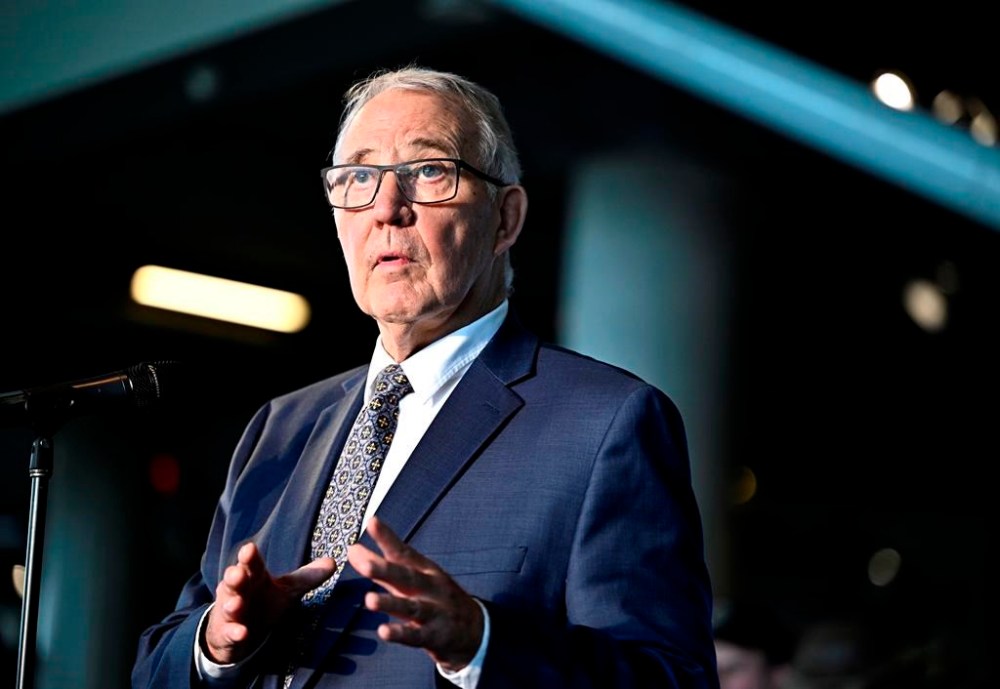
Defence Minister Bill Blair participates in a media availability at the Canadian War Museum in Ottawa, on Thursday, July 18, 2024. Blair says Canada is working on incorporating artificial intelligence in its military, but the technology wonմ replace humans. THE CANADIAN PRESS/Justin Tang

He said it’s “critical that we harness this technology both effectively and ethically,” according to a copy of his remarks at the Responsible AI in the Military Domain summit.

That includes using AI to “improve the work of our military personnel but not to replace it,” Blair said.

“That is why we have committed to ensuring that humans will always remain at the forefront of significant decisions with appropriate accountability mechanisms remaining in place.”

He added the strategy also emphasizes working with allies to “ensure that AI technologies are not only developed efficiently but also effectively integrated and managed.”

The strategy document says Canada’s allies are moving fast to adopt AI, and warns Canada must move to keep pace — noting the technology is also becoming more accessible to potential adversaries.

Countries supporting the “blueprint for action” in Seoul include allies like the United States, United Kingdom, Germany and France, according to a list posted on the summit’s website. China and Russia are not on the list of countries endorsing the agreement. Israel is also absent.

The meeting in South Korea followed an inaugural summit in the Netherlands last year at which countries, including Canada, supported an earlier document.

The “blueprint” from this week’s event says AI “holds extraordinary potential to transform every aspect of military affairs,” but also warns military use of AI could pose humanitarian, societal and ethical risks.

The document says the technology should be used in accordance with applicable national and international law, and that “responsibility and accountability can never be transferred to machines.”

It also calls for “safeguards to reduce the risks of malfunctions or unintended consequences,” including from biases in data or algorithms.

Humans should be able to understand, explain and trust outputs from AI systems, it says.

The document also calls for a shared understanding and an open discussion on the application of AI in the military domain.

It says “AI applications in the military domain should be developed, deployed and used in a way that maintains and does not undermine international peace, security and stability.”

This report by The Canadian Press was first published Sept. 11, 2024.

Report Error Submit a Tip

More Stories

Chalk surprise gift up to lust, not love

Maureen Scurfield 4 minute read Yesterday at 2:00 AM CDT

DEAR MISS LONELYHEARTS: I just got a funny birthday card and a single pink rose delivered to me at work from a boyfriend who broke up with me last spring because I’d gotten too serious (in his opinion). I cried for days back then. He ignored his phone.

I don’t know how to respond to him now. Do you think he’s really had a change of heart, or has he just not gotten lucky for a long time and thought I might be open to hooking up on my birthday?

— Suspicious Ex, Downtown

Dear Suspicious Ex: You just received a birthday card, a single pink rose and no voice contact? He wasn’t taking any chances on being shot down face-to-face, but he definitely is taking a stab at possibly getting some action.

Bombers coach happy to be back at work after backbreaking loss to Argos

Taylor Allen 6 minute read Preview

Bombers coach happy to be back at work after backbreaking loss to Argos

Taylor Allen 6 minute read Yesterday at 8:16 PM CDT

It’s the first practice day after a backbreaking loss.

The Winnipeg Blue Bombers are in a challenging predicament with four games remaining — starting Saturday on the road against the Montreal Alouettes (11-3) — that leaves their playoff aspirations far from solidified.

And yet, head coach Mike O’Shea makes his way behind the podium, looks out at a room of reporters and is grinning ear to ear.

Why so happy?

Read
Yesterday at 8:16 PM CDT

Khan cites infighting, quits as Tory leader

Carol Sanders 5 minute read Preview

Khan cites infighting, quits as Tory leader

Carol Sanders 5 minute read Updated: Yesterday at 9:56 AM CDT

Manitoba’s Leader of the Opposition is stepping down.

Progressive Conservative Leader Obby Khan announced late Monday afternoon he is quitting caucus and will sit in the legislature as an independent MLA, effective today.

He cited internal party fighting for his decision.

The former Winnipeg Blue Bombers offensive lineman survived a caucus confidence vote Friday. He said there were 13 votes for him to remain and six against, with one person absent.

Read
Updated: Yesterday at 9:56 AM CDT

Manitoba PCs choose Narth as interim leader; ‘deeply hurt’ Khan blasts former caucus colleagues

Carol Sanders 7 minute read Preview

Manitoba PCs choose Narth as interim leader; ‘deeply hurt’ Khan blasts former caucus colleagues

Carol Sanders 7 minute read Updated: Yesterday at 9:46 PM CDT

Manitoba’s Progressive Conservative caucus chose MLA Konrad Narth as interim party leader Tuesday to replace Obby Khan, who quit a day earlier after he said he was stabbed in the back by a small group of caucus members plotting in secret to oust him.

Read
Updated: Yesterday at 9:46 PM CDT

Canada resorting to its tried and true playbook

Niigaan Sinclair 5 minute read Preview

Canada resorting to its tried and true playbook

Niigaan Sinclair 5 minute read Monday, Sep. 28, 2026

In 1846, Britain faced an emergency influenced by the Irish famine, so leaders repealed the country’s “Corn Laws” and restrictions on imported food and grain, transitioning to a system of free trade.

This created a crisis in the then Province of Canada, which had relied on British “preferential” status to prop up its agricultural and resource industries.

As a result, Canada looked south for new markets and eventually negotiated a free trade agreement with the United States.

This required land to be acquired and converted for industrial use quickly, so Canada quickly dispatched Commissioner William Robinson to negotiate with Indigenous communities along Lake Huron and Lake Superior for land.

Read
Monday, Sep. 28, 2026

Expert urges food, drink makers to look to foreign markets

Gabrielle Piché 5 minute read Preview

Expert urges food, drink makers to look to foreign markets

Gabrielle Piché 5 minute read Yesterday at 5:04 PM CDT

Canada’s slowing population growth could restrict business expansion, a top economist for Farm Credit Canada warned Manitoba manufacturers.

Craig Johnston, the federal Crown corporation’s chief economist, addressed Prairie businesses at Farm Credit Canada’s Food and Beverage Summit Tuesday.

“There could be some modest growth in Canadian consumption of food and beverage,” Johnston said, relaying population numbers inside a Victoria Inn Hotel conference room.

Still, per-person spending on food is “stagnant, if not somewhat rising,” Johnson later told reporters.

Read
Yesterday at 5:04 PM CDT