UN experts urge United Nations to lay foundations for global governance of artificial intelligence
Advertisement
Read this article for free:
or
Already have an account? Log in here »
To continue reading, please subscribe:

Digital Subscription
One year of digital access for only $205*
- Enjoy unlimited reading on winnipegfreepress.com
- Read the E-Edition, our digital replica newspaper
- Access News Break, our award-winning app
- Play interactive puzzles
*First annual payment billed as $205.00 + GST for one year. This annual subscription will automatically renew at $233.00 + GST every 52 weeks (10% off the regular annual price of $259.35). Offer available to new and qualified returning subscribers only. Cancel any time.
To continue reading, please subscribe:
Add Free Press access to your Brandon Sun subscription for only an additional
$1 for the first 4 weeks*
- Enjoy unlimited reading on winnipegfreepress.com
- Read the E-Edition, our digital replica newspaper
- Access News Break, our award-winning app
- Play interactive puzzles
*Your next Brandon Sun subscription payment will increase by $1.00 and you will be charged $17.95 plus GST for four weeks. After four weeks, your payment will increase to $24.95 plus GST every four weeks.
Read unlimited articles for free today:
or
Already have an account? Log in here »
Hey there, time traveller!
This article was published 19/09/2024 (749 days ago), so information in it may no longer be current.
UNITED NATIONS (AP) — A high-powered U.N. advisory body said Thursday that global governance of artificial intelligence is “imperative” and urged the United Nations to lay the foundations for the first inclusive global institutions to regulate the fast-growing technology.
In a 100-page report, the group said AI “is transforming our world,” offering tremendous potential for good from opening new areas of science and accelerating economic growth to improving public health, agriculture and optimizing energy grids.
But left ungoverned, it said, AI’s benefits could be limited to a handful of countries, companies and individuals, while even more powerful systems than exist today “could upend the world of work,” create autonomous weapons, and pose risks to peace and security.
The advisory body outlined principles that should guide formation of new institutions to govern AI including international law, and especially human rights law. It calls on all governments and parties involved in AI to work together to protect human rights.
The group made wide-ranging recommendations including establishing an international scientific panel on AI to create a global understanding of its capabilities and risks, and a global dialogue on AI governance at the U.N. to anchor future institutions on human rights principles and international law.
The recommendations also call for a global AI fund to ensure that the technology bridges the divide between rich and poor nations and promotes achievement of U.N. development goals for 2030, and a “Standards Exchange” to foster technical compatibility.
At present, the report said, only seven of the 193 U.N. member nations are party to seven recent prominent AI governance initiatives while 118 countries, primarily in the global South, “are missing entirely” from any conversation.
Among the initiatives are the European Union’s first-ever legal framework to regulate AI, which entered into force on Aug. 1. This month,. the Group of 20 leading world economies agreed to establish guidelines for developing artificial intelligence, calling for “ethical, transparent, and accountable use of AI,” with human oversight and compliance with privacy and human rights laws. And lawmakers in California — home to many of the world’s biggest AI companies — recently adopted legislation to regulate AI which is before the governor.
The advisory board’s report concluded on a positive but cautious note.
“As experts, we remain optimistic about the future of AI and its potential for good,” the report said. “That optimism depends, however, on realism about the risks and the inadequacy of structures and incentives currently in place.”
The board stressed that “The technology is too important, and the stakes are too high, to rely only on market forces and a fragmented patchwork of national and multilateral action.”
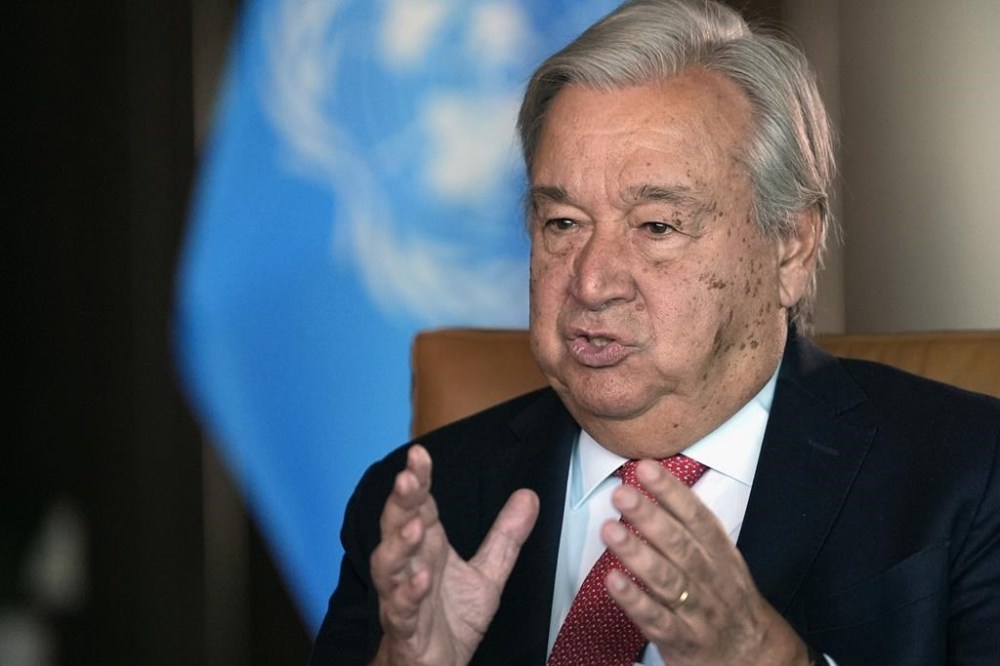
U.N. Secretary-General Antonio Guterres appointed the advisory body last October, saying coordinated action is needed to keep the threat of artificial intelligence from becoming an uncontrolled “monster.”
The group comprises 39 prominent AI leaders from 33 countries — chosen from over 2,000 nominations. They represent all regions of the world, are serving in their personal capacity, and include experts from government, the private sector and civil society.
Guterres commended the group’s work Thursday, expressing full support for its recommendations “which provide a blueprint to build on existing efforts and together, shape an international AI architecture that is inclusive, agile and effective – for today and the future.”
When the secretary-general told reporters last year that he planned to appoint the advisory body, Guterres said he would react favorably to a new U.N. agency on artificial intelligence and suggested as a model the International Atomic Energy Agency, which is knowledge-based and has some regulatory powers.
But the advisory body said it wasn’t recommending establishment of an agency.
Amandeep Singh Gill, the secretary-general’s chief’s envoy on technology and a member of the advisory body, told a news conference launching the report that for now an agency isn’t needed, “but it’s not saying that we would never need something like that.” The board wants that possibility to be studied, he said.
The report was issued ahead of the Summit of the Future starting Sunday which Guterres has called to try to unite the world’s divided nations and address the challenges and threats confronting humanity from conflicts and climate change to artificial intelligence and reforming the U.N.