NASA, Boeing describe limited roles despite Titan’s owner touting aerospace ties

Advertisement

Advertise with us

OceanGate co-founder Stockton Rush said the carbon fiber hull used in an experimental submersible that imploded was developed with help of NASA and aerospace manufacturers, but a NASA official said Thursday that the agency had little involvement and a Boeing official said some recommendations were ignored.

Read this article for free:


or

Already have an account? Log in here »

To continue reading, please subscribe:

Subscribe and receive a limited-edition Free Press branded hat or tote.

Digital Subscription

One year of digital access for only $205*

  • Enjoy unlimited reading on winnipegfreepress.com
  • Read the E-Edition, our digital replica newspaper
  • Access News Break, our award-winning app
  • Play interactive puzzles

*First annual payment billed as $205.00 + GST for one year. This annual subscription will automatically renew at $233.00 + GST every 52 weeks (10% off the regular annual price of $259.35). Offer available to new and qualified returning subscribers only. Cancel any time.

To continue reading, please subscribe:

Add Free Press access to your Brandon Sun subscription for only an additional

$1 for the first 4 weeks*

  • Enjoy unlimited reading on winnipegfreepress.com
  • Read the E-Edition, our digital replica newspaper
  • Access News Break, our award-winning app
  • Play interactive puzzles
Start now

*Your next Brandon Sun subscription payment will increase by $1.00 and you will be charged $17.95 plus GST for four weeks. After four weeks, your payment will increase to $24.95 plus GST every four weeks.

Hey there, time traveller!
This article was published 26/09/2024 (715 days ago), so information in it may no longer be current.

OceanGate co-founder Stockton Rush said the carbon fiber hull used in an experimental submersible that imploded was developed with help of NASA and aerospace manufacturers, but a NASA official said Thursday that the agency had little involvement and a Boeing official said some recommendations were ignored.

NASA intended to play a role in building and testing the carbon fiber hull. But the COVID-19 pandemic prevented NASA from fulfilling its role, other than consulting on a one-third scale mockup, not the submersible Titan that imploded while attempting to go to the Titanic wreckage, said Justin Jackson, a materials engineer for NASA.

At one point, Jackson said NASA balked at allowing its name to be invoked by OceanGate. “The language they were using was getting too close to us endorsing, so our folks had some heartburn,” he told a Coast Guard panel.

In a still from from a video animation provided by the United States Coast Guard an illustration of the Titan submersible, right, is shown near the ocean floor of the Atlantic Ocean, as June 18, 2023 communications between the submersible and the support vessel Polar Prince, not shown, are represented at left. (United States Coast Guard via AP)

Boeing was involved in an early feasibility study of the use of carbon fiber for Titan’s hull and in OceanGate’s acoustic sensors on the hull, but OceanGate departed from recommendations on the hull thickness and orientation of carbon fiber layers for greatest strength, said Mark Negley, material and process engineer at Boeing.

Rush was among the five people who died when the submersible imploded in June 2023.

The Coast Guard opened a public hearing earlier this month that is part of a high-level investigation into the cause of the implosion. Coast Guard officials noted at the start of the hearing that the submersible had not been independently reviewed, as is standard practice. That and Titan’s unusual design subjected it to scrutiny in the undersea exploration community.

John Winters, a Coast Guard marine inspector in Washingon state, testified that Rush railed against regulations that he said stifled innovation but also noted that Rush did not attempt to circumvent any Coast Guard regulations.

He testified Thursday that he was familiar with two other OceanGate submersibles before learning that the company had created a new submersible that could go deeper to reach Titanic. Winters said he was not aware that Oceangate ever notified the Coast Guard of its construction or requested a Coast Guard guidance or inspection.
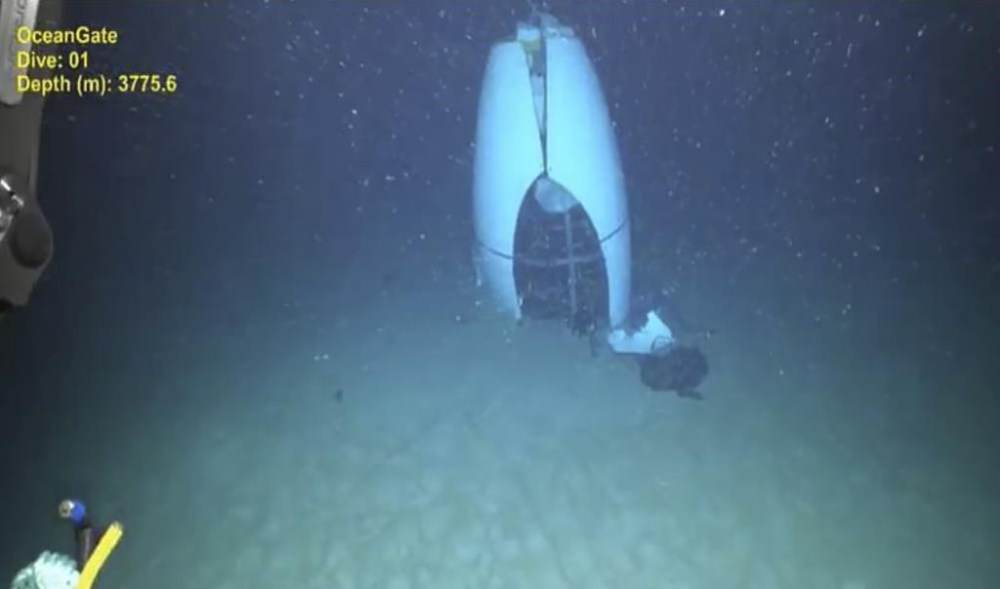
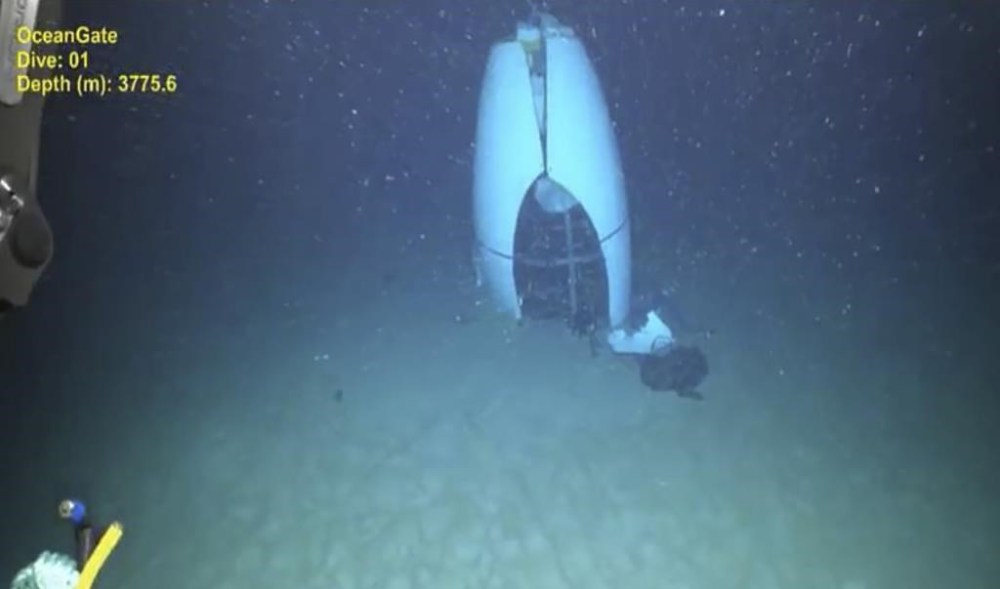
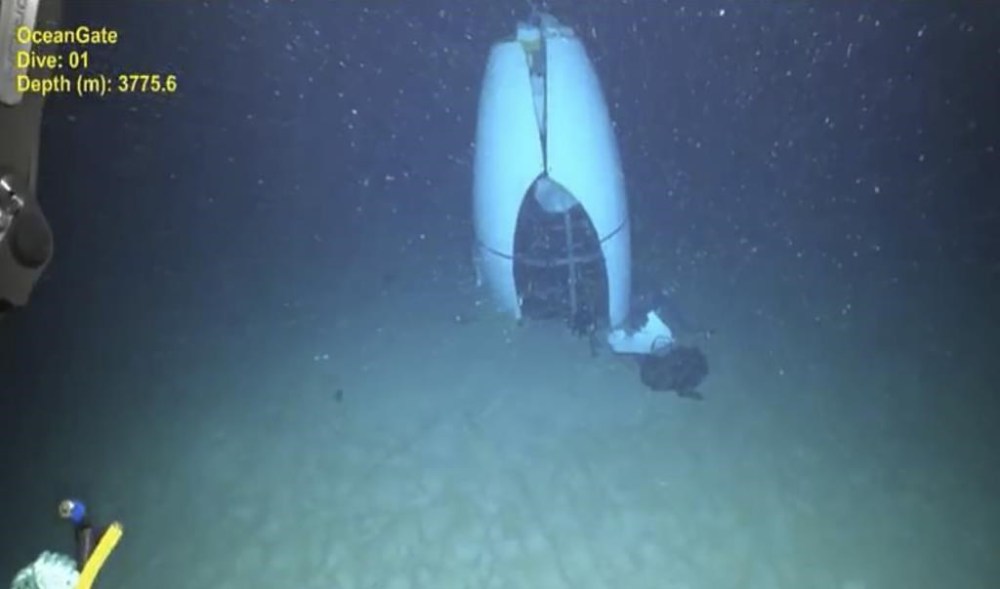
This June 2023 image provided by Pelagic Research Services shows remains of the Titan submersible on the floor of the Atlantic Ocean. (Pelagic Research Services via AP)

“We didn’t get into about what standards it was built to, who built it. None of that was discussed,” Winters said. “It was just, ‘Hey, we have a submarine. It’s good for 4,000 meters. We have a submarine to do that now,’” he said.

The hearing is expected to run through Friday and include more witnesses.

Earlier in the hearing, former OceanGate operations director David Lochridge said he frequently clashed with Rush and felt the company was committed only to making money. “The whole idea behind the company was to make money,” Lochridge testified. “There was very little in the way of science.”

Lochridge and other previous witnesses painted a picture of a company that was impatient to get its unconventionally designed craft into the water. The accident set off a worldwide debate about the future of private undersea exploration.

OceanGate, based in Washington state, suspended its operations after the implosion. The company has no full-time employees currently, but has been represented by an attorney during the hearing.
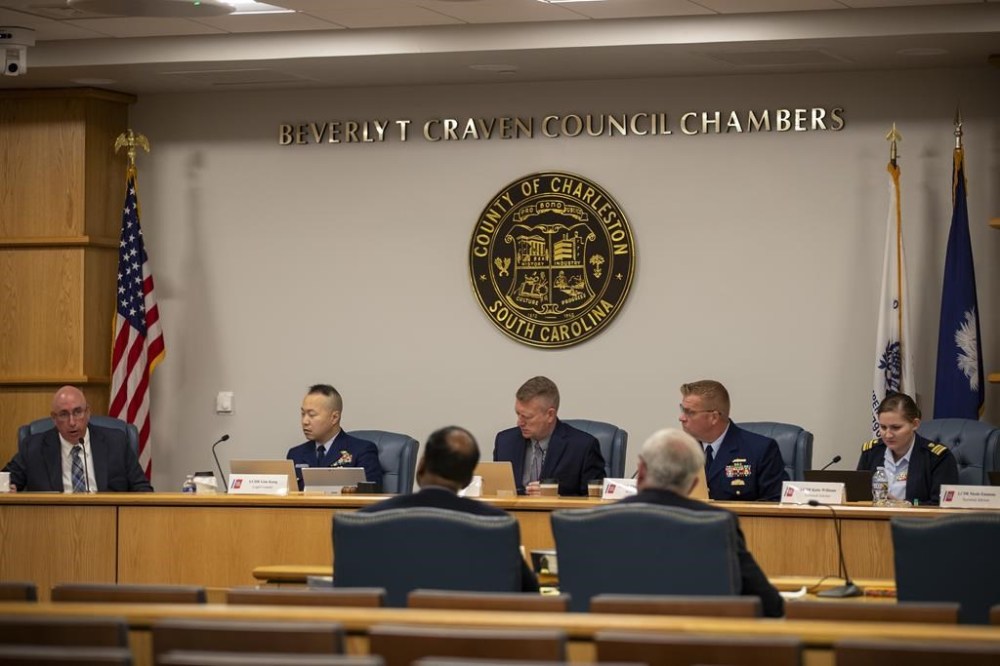
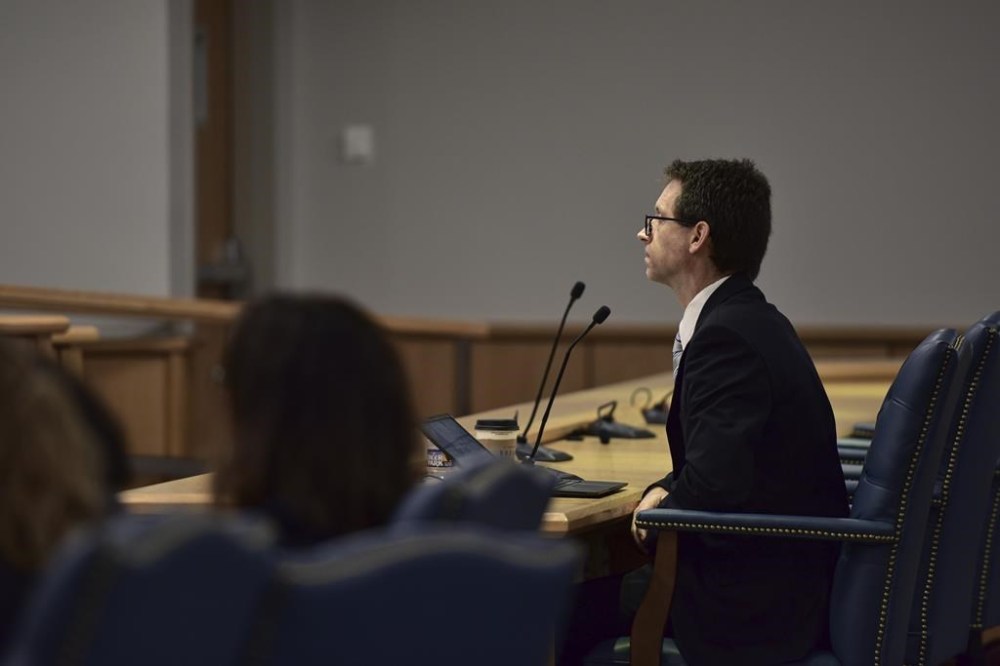
Members of the Coast Guard's Titan Submersible Marine Board of Investigation listen during the formal hearing inside the Charleston County Council Chambers, Monday, Sept. 23, 2024, in North Charleston, S.C. (Laura Bilson/The Post And Courier via AP, Pool)

During the submersible’s final dive on June 18, 2023, the crew lost contact after an exchange of texts about Titan’s depth and weight as it descended, and concern grew on the support ship Polar Prince. One of the last messages from Titan’s crew before the submersible imploded stated, “all good here,” the Coast Guard said.

When the submersible was reported overdue, rescuers rushed ships, planes and other equipment to an area about 435 miles (700 kilometers) south of St. John’s, Newfoundland. Wreckage of the Titan was subsequently found on the ocean floor about 330 yards (300 meters) off the bow of the Titanic, Coast Guard officials said. No one on board survived.

OceanGate said it has been fully cooperating with the Coast Guard and NTSB investigations since they began. Titan had been making voyages to the Titanic wreckage site going back to 2021.
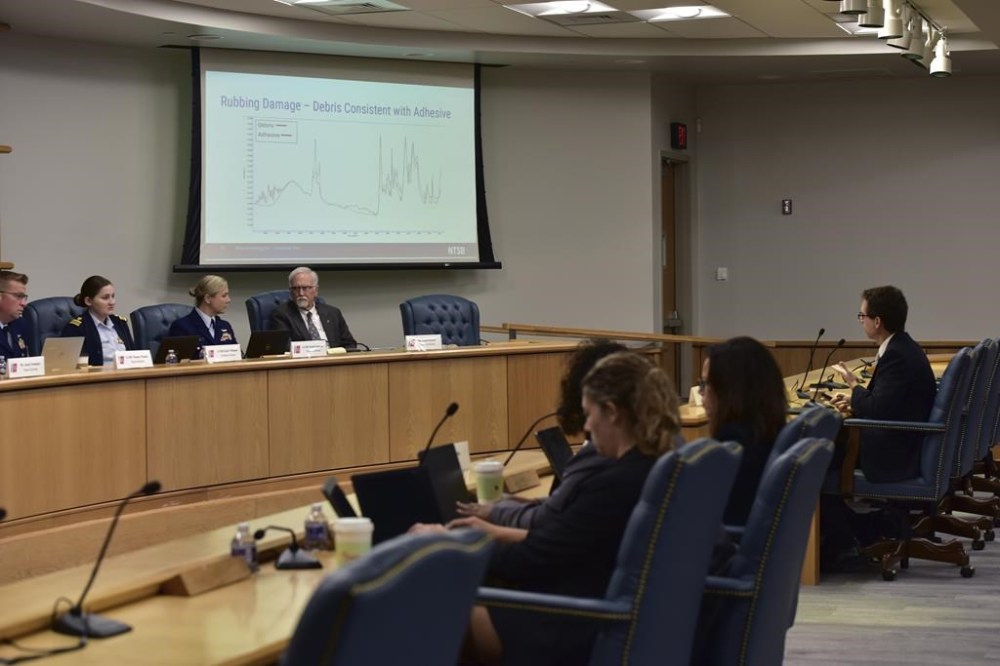
Don Kramer, National Transportation Safety Board engineer, right, testifies Wednesday, Sept. 25, 2024, at the U.S. Coast Guard Marine Board of Investigation hearing into the June 2023 loss of the Titan submersible, in North Charleston, S.C. (Petty Officer 2nd Class Kate Kilroy/U.S. Coast Guard via AP, Pool)
This June 2023 image provided by Pelagic Research Services shows remains of the Titan submersible on the floor of the Atlantic Ocean. (Pelagic Research Services via AP)
Don Kramer, National Transportation Safety Board engineer, right, testifies Wednesday, Sept. 25, 2024, at the U.S. Coast Guard Marine Board of Investigation hearing into the June 2023 loss of the Titan submersible, in North Charleston, S.C. (Petty Officer 2nd Class Kate Kilroy/U.S. Coast Guard via AP, Pool)
This June 2023 image provided by Pelagic Research Services shows remains of the Titan submersible on the floor of the Atlantic Ocean. (Pelagic Research Services via AP)
Report Error Submit a Tip

More Stories

‘Huge resource gaps’: judge shortage leads to circuit court cuts

Dean Pritchard 4 minute read Preview

‘Huge resource gaps’: judge shortage leads to circuit court cuts

Dean Pritchard 4 minute read Wednesday, Sep. 9, 2026

A shortage of judges is forcing Manitoba’s provincial court to slash sittings across the province.

The court announced in a notice to the profession Wednesday that it will be reducing the number of annual court sittings at nine rural circuit locations and St. Boniface provincial court in Winnipeg by 68 sittings, effective April 1, 2027.

The reductions are necessary to balance “access to justice needs with the complement of judicial resources currently insufficient to maintain the current court schedule,” said the notice, signed by provincial court Chief Judge Ryan Rolston.

Affected circuit courts include Altona, Arborg, Beausejour, Easterville, Cranberry Portage, Lundar, Grand Rapids, Moose Lake, and Pine Falls.

Read
Wednesday, Sep. 9, 2026

NASA, Boeing describe limited roles despite Titan’s owner touting aerospace ties

Michael Casey, The Associated Press 5 minute read Preview

NASA, Boeing describe limited roles despite Titan’s owner touting aerospace ties

Michael Casey, The Associated Press 5 minute read Thursday, Sep. 26, 2024

OceanGate co-founder Stockton Rush said the carbon fiber hull used in an experimental submersible that imploded was developed with help of NASA and aerospace manufacturers, but a NASA official said Thursday that the agency had little involvement and a Boeing official said some recommendations were ignored.

NASA intended to play a role in building and testing the carbon fiber hull. But the COVID-19 pandemic prevented NASA from fulfilling its role, other than consulting on a one-third scale mockup, not the submersible Titan that imploded while attempting to go to the Titanic wreckage, said Justin Jackson, a materials engineer for NASA.

At one point, Jackson said NASA balked at allowing its name to be invoked by OceanGate. “The language they were using was getting too close to us endorsing, so our folks had some heartburn,” he told a Coast Guard panel.

Boeing was involved in an early feasibility study of the use of carbon fiber for Titan's hull and in OceanGate's acoustic sensors on the hull, but OceanGate departed from recommendations on the hull thickness and orientation of carbon fiber layers for greatest strength, said Mark Negley, material and process engineer at Boeing.

Read
Thursday, Sep. 26, 2024

South Winnipeg neighbourhood will be first to go geothermal

Chris Kitching 4 minute read Preview

South Winnipeg neighbourhood will be first to go geothermal

Chris Kitching 4 minute read Wednesday, Sep. 9, 2026

A new neighbourhood in south Winnipeg will be Manitoba’s first to use a shared, large-scale geothermal system to heat and cool hundreds of homes over coming decades.

The province is giving up to $4 million to the developers of Southwood Circle, just north of the University of Manitoba’s Fort Garry campus, for a district geothermal system as part of the NDP’s goal to reach net-zero greenhouse gas emissions by 2050.

“It means a whole neighbourhood can tap into geothermal, which means low-carbon heating and cooling for at least 1,000 homes,” Premier Wab Kinew said at a news conference Wednesday.

Geothermal systems, equipped with pumps and pipes, use underground temperatures to heat and cool one or more buildings. Proponents point to long-term energy and cost savings compared with conventional heating and cooling systems.

Read
Wednesday, Sep. 9, 2026

Is ‘tornado alley’ moving north?

Editorial 4 minute read Preview

Is ‘tornado alley’ moving north?

Editorial 4 minute read 2:00 AM CDT

There’s a famous fictional story in which a ruby-slippered, tornado-tossed traveller takes a wide-eyed look around and declares, “I’ve a feeling we’re not in Kansas anymore.”

Read
2:00 AM CDT

Childfree Winnipeg group gives women without kids a place to gather

AV Kitching 5 minute read Preview

Childfree Winnipeg group gives women without kids a place to gather

AV Kitching 5 minute read Wednesday, Sep. 9, 2026

Katelyn Sawatzky founded Childfree Winnipeg Women in 2021 to bring together women who don’t have kids — be it by choice or circumstance — and do not plan on raising children.

The group is designed to help them share experiences and build meaningful friendships.

The community welcomes cisgender, straight, transgender, bisexual and lesbian women. Parents, including empty nesters and men, are turned away.

“Our group is a safe space where women can hang out with other women without being asked when you’re going to have kids or why you don’t have kids … where you don’t feel like you have to validate or defend your choices in any way, because everyone gets it,” Sawatzky says.

Read
Wednesday, Sep. 9, 2026

Letters, Sept. 11

7 minute read Preview

Letters, Sept. 11

7 minute read Updated: 8:07 AM CDT

In his letter to the editor — "Both education systems work", Sept. 9 — Paulo Borges states he “pays 100 per cent” of his school taxes, even though his children do not attend public school. I don’t think he’s unique — all property owners pay the full amount of school taxes, regardless of family status. He went on to suggest he “saved” the government money.

Read
Updated: 8:07 AM CDT