Takeaways on AP’s story about challenges to forest recovery and replanting after wildfires
Advertisement
Read this article for free:
or
Already have an account? Log in here »
To continue reading, please subscribe:

Digital Subscription
One year of digital access for only $205*
- Enjoy unlimited reading on winnipegfreepress.com
- Read the E-Edition, our digital replica newspaper
- Access News Break, our award-winning app
- Play interactive puzzles
*First annual payment billed as $205.00 + GST for one year. This annual subscription will automatically renew at $233.00 + GST every 52 weeks (10% off the regular annual price of $259.35). Offer available to new and qualified returning subscribers only. Cancel any time.
To continue reading, please subscribe:
Add Free Press access to your Brandon Sun subscription for only an additional
$1 for the first 4 weeks*
- Enjoy unlimited reading on winnipegfreepress.com
- Read the E-Edition, our digital replica newspaper
- Access News Break, our award-winning app
- Play interactive puzzles
*Your next Brandon Sun subscription payment will increase by $1.00 and you will be charged $17.95 plus GST for four weeks. After four weeks, your payment will increase to $24.95 plus GST every four weeks.
Read unlimited articles for free today:
or
Already have an account? Log in here »
Hey there, time traveller!
This article was published 27/09/2024 (741 days ago), so information in it may no longer be current.
The U.S. is struggling to replant forests destroyed by increasingly intense wildfires, with many areas unlikely to recover on their own.
Researchers are studying which species are likely to survive — and where — as climate change makes it difficult or impossible for many forests to regrow. But they say the U.S. also lacks enough seed collection, seedling production and workers trained to replant trees on a scale needed to offset accelerating losses.
The Forest Service says the biggest roadblock is the yearslong task of completing environmental and cultural assessments and preparing severely burned land for replanting.
Here’s what to know:
Climate impact
Larger and more intense fires stoked by climate change destroy seed trees that normally allow regeneration or leave burn scars too large for trees to naturally bridge the gap.
Climate has changed so markedly trees often can’t regrow. Even when seedlings take hold, drought and repeat fires often kill them.
Especially hot fires also can harden the ground and leave barren slopes susceptible to washing away in rainstorms, polluting waterways. Researchers say some once-forested areas in the Southwest and West may never recover and instead will convert to grassland or shrubland.
Reforestation gap
Nineteen of the 20 largest wildfires ever recorded in the contiguous U.S. have occurred in Western states since 2000, according to Sean Parks, a Forest Service research ecologist. That’s when the region slipped into an ongoing megadrought.
The U.S. once was able to reliably replant burned forests. But now the gap between areas that need replanting and the ability to do so has grown to at least 3.8 million acres (1.5 million hectares) — and that could triple by 2050, said Solomon Z. Dobrowski, a University of Montana forest management expert.
Researchers say the odds of forests growing back will worsen regardless of fire intensity because of hotter, drier weather.
Targeted tree planting
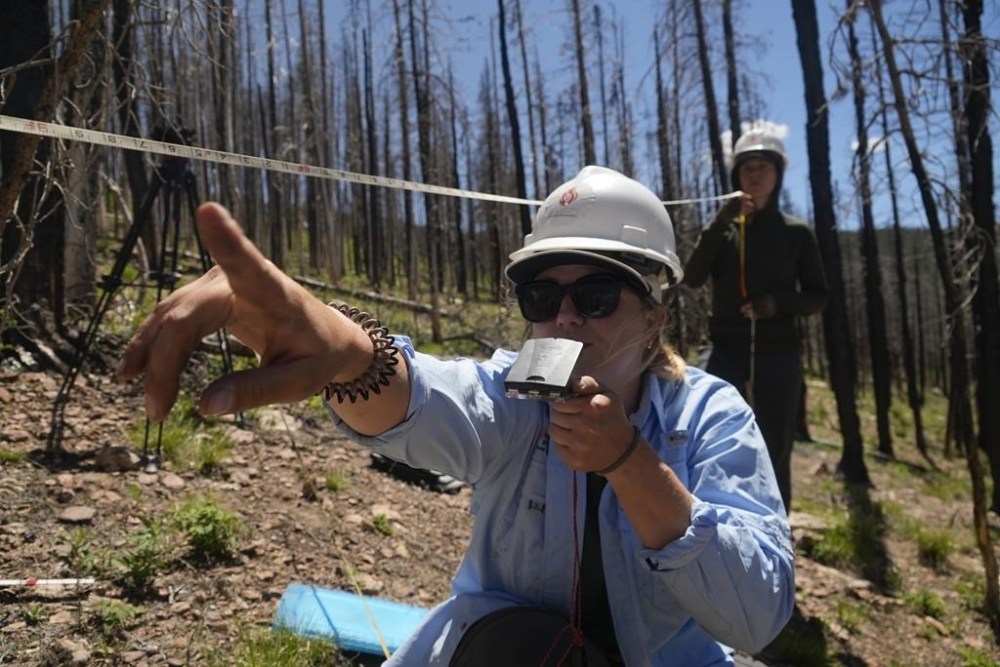
Researchers are trying to find which seedling species survive and where. Survival generally is worse at lower elevations, where it’s hotter, drier and more open — so replanting the same trees in the same areas is likely to fail.
Scientists are replanting at higher elevations and also studying whether seedlings survive better when planted in clusters or near trees that might provide shade and aid water uptake. Some researchers are even asking whether different species should replace trees wiped out by fire.
University of New Mexico forest ecologist Matthew Hurteau said the 2011 Los Conchas fire decimated a huge swath of Ponderosa pine forest, and most replanting efforts failed.
So he planted seedlings of different species at various elevations and on slopes facing different directions, then monitored soil moisture, temperature and humidity. A resulting computer model can predict the probability a seedling will survive in a particular spot with about 63% accuracy, and will be used for planting this fall.
“Let’s not do the old plant-and-pray” method, said Hurteau. “Let’s plant where we know that their chance of survival is quite high.”
Forest Service rules generally require planting the same species at the same elevations as before a fire, but the agency will “need to be flexible moving forward,” said Jason Sieg, acting supervisor of the Arapaho and Roosevelt National Forests & Pawnee National Grassland.
For now, that might mean replanting at different elevations or collecting seeds from another location. Eventually, researchers say it could require planting species not found in an area originally — an option many have resisted.
“I’ve seen people go from saying, ‘Absolutely, we cannot move trees around’ to, ‘Well, maybe let’s try it at least, and do a few experiments to see if this will work,’” said Camille Stevens-Rumann, interim director at the Colorado Forest Restoration Institute.
“We need to start being creative if we want trees on our landscapes,” she said. “We’re in a place of such drastic climate change that we are not talking about whether or not some of these places will be a different kind of forest, but whether or not they will be forests at all.”
Restoration challenges
Hurteau, the University of New Mexico researcher, said ecologists and the state realized there would not be enough seedlings to reforest millions of acres burned in wildfires.
So several New Mexico universities and the state’s forestry division started the New Mexico Reforestation Center to build a nursery that could produce 5 million seedlings per year for government, tribal and private lands. The first seedlings will be planted this year.
The number of Forest Service nurseries — once financed by deposits on timber sales — dropped from 14 to six in the 1990s as timber harvests declined and habitat protections were enacted, according to a Forest Service report on the nurseries’ history.
Most Western seedling production is private and occurs in Oregon, California and Washington, said Solomon Dobrowski, a University of Montana forest management expert.
In places like New Mexico and the Rocky Mountains, “we don’t really have a base of facilities to support widespread reforestation,” Dobrowski said. “We’re (asking) ‘What’s going to fill the gap?’”
The Forest Service is modernizing nurseries and seeking ways to expand internal capacity and work with private industry, states and groups like the New Mexico Reforestation Center. But officials say the biggest challenge is that the number of intense wildfires is outpacing the ability to prepare sites for replanting.
Experts say more seed collection and trained workers are needed to make even modest progress in closing the reforestation gap. And they say public and private cooperation is essential.
Seed collection is expensive and labor-intensive. It takes a few years for a typical Western conifer to develop cones before contractors harvest them. Growing, planting and monitoring seedlings amid frequent droughts adds uncertainty, time and money.
Experts say there will be areas where trees never return but it’s critical that the U.S. does as much possible in a thoughtful way.
“Trees live for hundreds of years so we need to be thinking about what’s right as we plant trees today,” Hurteau said. “Are we putting the right species and densities on the landscape given what the next 100, 200 and 300 years will look like?”
___ AP data reporter Mary Katherine Wildeman contributed from Hartford, Connecticut. ___
The Associated Press’ climate and environmental coverage receives financial support from multiple private foundations. AP is solely responsible for all content. Find AP’s standards for working with philanthropies, a list of supporters and funded coverage areas at AP.org.