Civilization 7 makers work with Shawnee to bring sincere representation of the tribe to the game
Advertisement
Read this article for free:
or
Already have an account? Log in here »
To continue reading, please subscribe:

Digital Subscription
One year of digital access for only $205*
- Enjoy unlimited reading on winnipegfreepress.com
- Read the E-Edition, our digital replica newspaper
- Access News Break, our award-winning app
- Play interactive puzzles
*First annual payment billed as $205.00 + GST for one year. This annual subscription will automatically renew at $233.00 + GST every 52 weeks (10% off the regular annual price of $259.35). Offer available to new and qualified returning subscribers only. Cancel any time.
To continue reading, please subscribe:
Add Free Press access to your Brandon Sun subscription for only an additional
$1 for the first 4 weeks*
- Enjoy unlimited reading on winnipegfreepress.com
- Read the E-Edition, our digital replica newspaper
- Access News Break, our award-winning app
- Play interactive puzzles
*Your next Brandon Sun subscription payment will increase by $1.00 and you will be charged $17.95 plus GST for four weeks. After four weeks, your payment will increase to $24.95 plus GST every four weeks.
Read unlimited articles for free today:
or
Already have an account? Log in here »
Hey there, time traveller!
This article was published 04/10/2024 (733 days ago), so information in it may no longer be current.
MIAMI, Okla. (AP) — Shawnee Tribe Chief Ben Barnes grew up playing video games, including “probably hundreds of hours” colonizing a distant planet in the 1999 title Sid Meier’s Alpha Centauri.
So when that same game studio, Firaxis, approached the tribal nation a quarter-century later with a proposal to make a playable character out of their famous leader Tecumseh in the upcoming game Civilization 7, Barnes felt a rush of excitement.
“I was like, ‘This can’t be true,’” Barnes said. “Do they want us to participate in the next version of Civilization?”

Beloved by tens of millions of gamers since its 1991 debut, Meier’s Civilization series sparked a new genre of empire-building games that simulated the real world while also diverging into imaginary twists. It has captivated nerdy fans like Elon Musk, Mark Zuckerberg and a young Barnes with its intricate and addictive gameplay and rich historical context.
Choosing among leaders that can range from Cleopatra to Mahatma Gandhi, players build a civilization from its first settlement to a sprawling network of cities, negotiate with or conquer neighbors, and develop trade, science, religion and the arts. Circana, which tracks U.S. game sales, says it’s the bestselling strategy video game franchise of all time.
But things have changed since the early days of Civilization. Of course, video game technology has advanced, but so too has society’s understanding of cultural appropriation and the importance of accurate historical framing.
Firaxis dropped plans to add a historical Pueblo leader in 2010 after tribal leaders objected. The game incorporated a Cree leader in 2018 but faced public criticism in Canada after its release.
Developers knew that to properly represent the Shawnee leader, they would need the input and blessing of the Shawnee people.
For Barnes, it was an opportunity to not only showcase the power and might of the Shawnee but also a way for tribal citizens to see themselves represented in popular culture in a new, imagined future for the tribe.
“For us, it’s really about a cultural expression of cultural hegemony,” Barnes said. “Why not us? Why not? Of course we should be in a video game title. Of course we should see ourselves reflected in every media. So we took advantage of the opportunity to make our star shine.”
For designers at Firaxis, the partnership represented a chance to improve a game development system that has been criticized by Indigenous leaders for misrepresenting their cultures, and for the Shawnee, it was a way to promote their language and history in a new way.

In interviews with The Associated Press, series founder Meier and other studio executives acknowledged past missteps in the Civilization franchise’s casual treatment of history, including how it incorporated Indigenous groups and colonization more broadly.
That led to careful thought and months of collaboration to “make sure it’s an authentic, sincere recreation” of Shawnee culture, said game producer Andrew Frederiksen, speaking on a September visit to the tribe’s headquarters. That meant asking the Shawnee questions about what a Shawnee university or library building of the future would look like and creating new Shawnee words to describe futuristic concepts.
Meier, who started developing computer games in the 1980s, said the Shawnee partnership is “kind of special” and was borne out of meetings with Barnes where the chief talked about the challenges of preserving the Shawnee language. As part of the partnership, Firaxis and its publishing label 2K Games — subsidiary of gaming giant Take-Two Interactive — are donating hundreds of thousands of dollars in language revitalization programs and facilities.
When Shawnee actor Dean Dillon auditioned for a part that involved speaking the Shawnee language, he didn’t know he’d be voicing Tecumseh. The military and political leader from what is currently Ohio united a confederation of Native American tribes to resist U.S. westward expansion in the early 19th century.
“I just gave it my best shot,” Dillon said. “And then a few weeks later, I heard back and they said, ‘We’d like to offer you the role of Tecumseh.’ And my head exploded and I ran around the house yelling, ‘My gosh! My gosh!’”
“It was surreal, to say the least, to see Tecumseh’s face but to hear my voice come out of that,” Dillon said.
While the franchise has always had Indigenous leaders, starting with Montezuma of the Aztecs in the original 1991 game, Meier said game developers at the time were looking for familiar figures without much thought into the weight of history. Playable characters in that game included Josef Stalin and Mao Zedong, whose totalitarian regimes were still in many people’s memory.
“We never realized people would take it as seriously as they do,” Meier said. “We always kind of felt, ‘Here’s a way that you can change history.’ Maybe we can make Stalin a good guy. But that might have been stretching things a little too far.”

“We learned a lot as time went on,” he added. The seventh edition, due out in February, will for the first time do away with barbarians — or at least no longer use that term for hostile characters that are not part of a playable civilization. Players can instead create diplomatic relations with them.
And as the game’s audience expanded beyond the U.S. and Europe, with more than 70 million games sold worldwide, so too did players want their societies or heritage reflected. More recent editions include themed music and spoken languages from dozens of playable civilizations, from the Māori people of New Zealand to the Mapuche of South America.
“It is now a badge of honor for a nation to be included in Civilization,” Meier said. “We’ve been lobbied by different countries, et cetera.”
That’s not to say everyone has been happy about their inclusion in a game centered around settling land and exploiting resources. Civilization is one of the pioneers of the genre known as 4X — for “explore, expand, exploit and exterminate.”
After the franchise added a 19th-century Cree leader to its gameplay in 2018, a prominent Cree leader complained to the Canadian Broadcasting Corporation that it “perpetuates this myth that First Nations had similar values that the colonial culture has, and that is one of conquering other peoples and accessing their land. That is totally not in concert with our traditional ways and worldview.”
One of the game’s two resident historians, Andrew Johnson, said the studio wanted to make Tecumseh a playable leader, but after reaching out to some academics, “we were told repeatedly, ‘No, this is a really bad idea, and nobody’s going to sign off on this.’”
So Johnson suggested reaching out to Shawnee leaders directly to ask what they think, and how it could help them.
“I think so often you get people assuming that representation in Civ is a reward of some sort. It’s not,” said Johnson, who’s also an anthropologist who studies Southeast Asia. “This is a company and we’re selling a product and we’re using an image and likeness to make a profit. And getting your ‘civ’ in Civilization doesn’t really help you very much if you’re struggling to preserve your culture.”
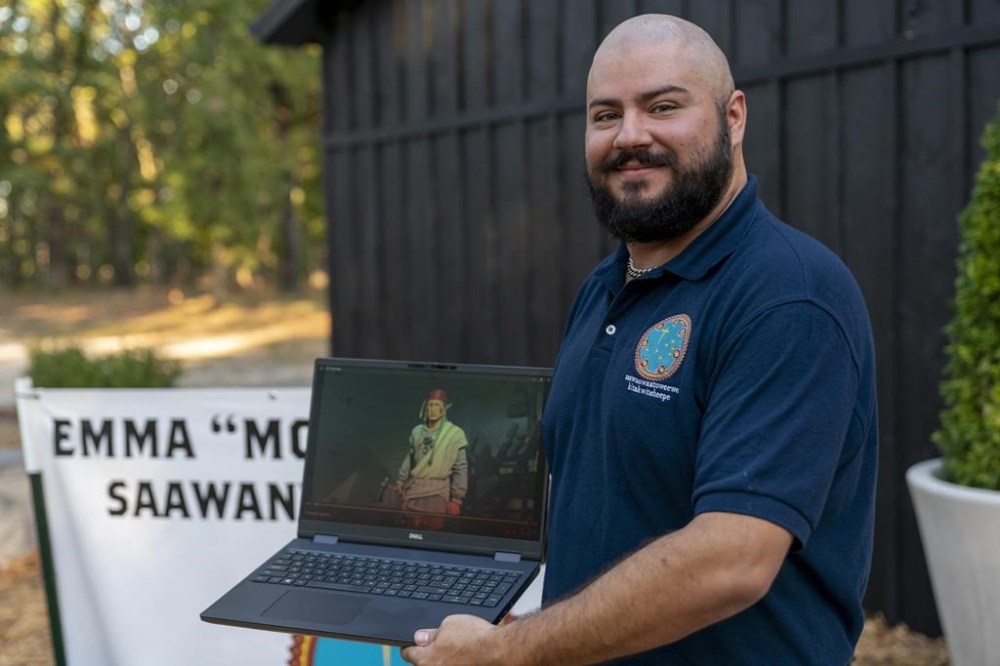

The game studio and the tribal nation decided on a partnership that would help the Shawnee people preserve and expand some of that culture, particularly language. Chief Barnes said the tribe was in dire need of resources for language education, and creating dialogue for a Shawnee civilization of the future was another way to help revitalize their language.
“Firaxis was asking questions about language we never would have thought to ask,” Barnes said in September at the opening of a new language education center in northeastern Oklahoma.
Barnes hasn’t had a chance to play the new version of the game yet, but he is already imaging the future he can build virtually, as well as how doing so will inspire other Shawnee gamers. “What I do know is that with the efforts we’re making here today, I expect Shawnee to be spoken in 2500.”
—————-
O’Brien reported from Providence, Rhode Island.