Google says it will stop linking to New Zealand news if a law passes forcing it to pay for content

Advertisement

Advertise with us

WELLINGTON, New Zealand (AP) — Google said Friday it will stop linking to New Zealand news content and will reverse its support of local media outlets if the government passes a law forcing tech companies to pay for articles displayed on their platforms.

Read this article for free:


or

Already have an account? Log in here »

To continue reading, please subscribe:

Subscribe and receive a limited-edition Free Press branded hat or tote.

Digital Subscription

One year of digital access for only $205*

  • Enjoy unlimited reading on winnipegfreepress.com
  • Read the E-Edition, our digital replica newspaper
  • Access News Break, our award-winning app
  • Play interactive puzzles

*First annual payment billed as $205.00 + GST for one year. This annual subscription will automatically renew at $233.00 + GST every 52 weeks (10% off the regular annual price of $259.35). Offer available to new and qualified returning subscribers only. Cancel any time.

To continue reading, please subscribe:

Add Free Press access to your Brandon Sun subscription for only an additional

$1 for the first 4 weeks*

  • Enjoy unlimited reading on winnipegfreepress.com
  • Read the E-Edition, our digital replica newspaper
  • Access News Break, our award-winning app
  • Play interactive puzzles
Start now

*Your next Brandon Sun subscription payment will increase by $1.00 and you will be charged $17.95 plus GST for four weeks. After four weeks, your payment will increase to $24.95 plus GST every four weeks.

Hey there, time traveller!
This article was published 04/10/2024 (730 days ago), so information in it may no longer be current.

WELLINGTON, New Zealand (AP) — Google said Friday it will stop linking to New Zealand news content and will reverse its support of local media outlets if the government passes a law forcing tech companies to pay for articles displayed on their platforms.

The vow to sever Google traffic to New Zealand news sites — made in a blog post by the search giant on Friday — echoes strategies the firm deployed as Australia and Canada prepared to enact similar laws in recent years.

It followed a surprise announcement by New Zealand’s government in July that lawmakers would advance a bill forcing tech platforms to strike deals for sharing revenue generated from news content with the media outlets producing it.
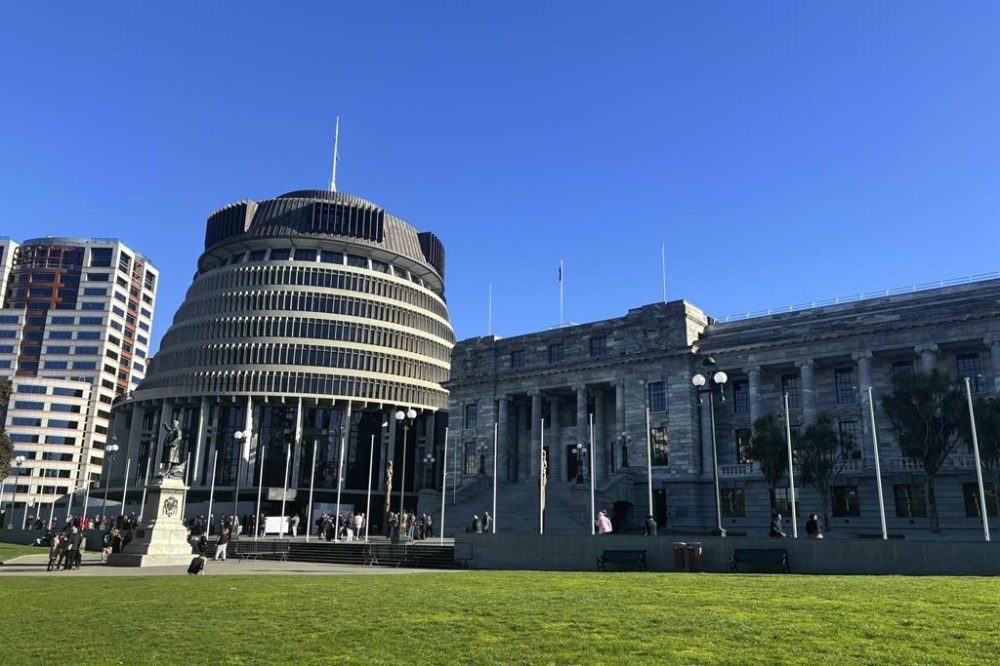
FILE - People arrive at Parliament in Wellington, New Zealand, Wednesday, July 24, 2024. (AP Photo/Charlotte Graham-McLay, File)

The government, led by center-right National, had opposed the law in 2023 when introduced by the previous administration.

But the loss of more than 200 newsroom jobs earlier this year — in a national media industry that totaled 1,600 reporters at the 2018 census and has likely shrunk since — prompted the current government to reconsider forcing tech companies to pay publishers for displaying content.

The law aims to stanch the flow offshore of advertising revenue derived from New Zealand news products.

Google New Zealand Country Director Caroline Rainsford wrote Friday that the firm would change its involvement in the country’s media landscape if it passed.

“Specifically, we’d be forced to stop linking to news content on Google Search, Google News, or Discover surfaces in New Zealand and discontinue our current commercial agreements and ecosystem support with New Zealand news publishers,” she wrote.

Google’s licensing program in New Zealand contributed “millions of dollars per year to almost 50 local publications,” she added.

The News Publishers’ Association, a New Zealand sector group, said in a written statement Friday that Google’s pledge amounted to “threats” and reflected “the kind of pressure that it has been applying” to the government and news outlets, Public Affairs Director Andrew Holden said.

The government “should be able to make laws to strengthen democracy in this country without being subjected to this kind of corporate bullying,” he said.

Australia was the first country to attempt to force tech firms — including Google and Meta — to the bargaining table with news outlets through a law passed in 2021. At first, the tech giants imposed news blackouts for Australians on their platforms, but both eventually somewhat relented, striking deals reportedly worth 200 million Australian dollars ($137 million) a year, paid to Australian outlets for use of their content.

But Belinda Barnet, a media expert at Swinburne University in Melbourne, said Meta has refused to renew its contracts with Australian news media while Google is renegotiating its initial agreements.

As Canada prepared to pass similar digital news bargaining laws in 2023, Google and Meta again vowed to cease their support for the country’s media. Last November, however, Google promised to contribute 100 million Canadian dollars ($74 million) — indexed to inflation — in financial support annually for news businesses across the country.

Colin Peacock, an analyst who hosts the Mediawatch program on RNZ, New Zealand’s public radio broadcaster, said Google “doesn’t want headlines around the world that say another country has pushed back” by enacting such a law.

While Google pointed Friday to its support of local outlets, Peacock said one of its funding recipients – the publisher of a small newspaper – had told a parliamentary committee this year that the amount he received was “a pittance” and not enough to hire a single graduate reporter.

Minister for Media and Communications Paul Goldsmith told The Associated Press in a written statement on Friday that he was still consulting on the next version of the bill.

“My officials and I have met with Google on a number of occasions to discuss their concerns, and will continue to do so,” he said.

Goldsmith said in July that he planned to pass the law by the end of the year.

——

Associated Press writer Rod McGuirk contributed reporting from Melbourne, Australia.

Report Error Submit a Tip

More Stories

Letters, Oct. 3

7 minute read 2:01 AM CDT

A morning in the life …

My very first lesson does not start when I walk into that lecture hall, oh no — it starts long before. It begins when I walk to my car, check the estimated arrival time to the University of Manitoba and hope that Winnipeg traffic agrees with it.

A drive that appears completely manageable changes almost immediately when I’m greeted by a tsunami of orange pylons and a line of cars that appears to go on forever. Traffic moves by the inch, lanes magically disappear and the detour I took yesterday now has a detour of its own. These factors make me do a calculation that I have become all too familiar with. How late can I arrive and still find parking, run to my class across campus and get to class with enough time left to make it worth it?

I have grown used to people saying, “Why not just leave earlier?” I do. But when I’m already leaving for my 8:30 a.m. class at 7 a.m., there’s only so much I can do. This drive that some would think is relaxing is one that feels like an assignment that I didn’t know I had to complete and is due at 8:30 a.m.

Province looks to seize notorious drug den

Erik Pindera 5 minute read Preview

Province looks to seize notorious drug den

Erik Pindera 5 minute read 12:00 PM CDT

Provincial justice officials are trying to seize a Dominion Street drug den that has been the source of trouble in the West End for years.

The owner of 982 Dominion St., 45-year-old Robert Edward Johnson, was most recently arrested in June along with several others after a lengthy Winnipeg Police investigation into thefts and illicit drug sales connected to the house.

“The residence has a reputation within the neighbourhood as being a location where individuals habitually attend for the purpose of purchasing and/or consuming controlled substances,” reads a statement of claim filed by the province’s director of civil forfeiture in the Court of King’s Bench last week.

“For several years, the residence has been associated with criminal activity, violence, and disorder, resulting in numerous police attendances and complaints from members of the surrounding community.”

Read
12:00 PM CDT

Six high school hockey programs ceased operations following new Hockey Manitoba policy

Joshua Frey-Sam 7 minute read Preview

Six high school hockey programs ceased operations following new Hockey Manitoba policy

Joshua Frey-Sam 7 minute read Updated: Yesterday at 8:19 PM CDT

She lived the best of both worlds.

For the last three years, the 17-year-old wore a sweater for two different hockey programs — her high school team and AAA club in the Manitoba Female Hockey League — and was preparing to flourish in both colours again this winter.

Recently, however, the blue-liner was disappointed to learn she is no longer eligible to play her Grade 12 season with her school owing to a new policy imposed by Hockey Manitoba that bans players from participating in the Manitoba Women’s High School Hockey League if they are rostered on a U18 AAA team.

The rule applies to all athletes who play for both Winnipeg-based and rural AAA teams.

Read
Updated: Yesterday at 8:19 PM CDT

Retired guidance counsellor defends explicit 2025 sex-ed presentation to high school football team in disciplinary hearing

Maggie Macintosh 7 minute read Preview

Retired guidance counsellor defends explicit 2025 sex-ed presentation to high school football team in disciplinary hearing

Maggie Macintosh 7 minute read Updated: Yesterday at 12:26 PM CDT

Gus Watanabe, a former employee of Oak Park High School in Winnipeg, was the subject of a public disciplinary hearing on Thursday.

Read
Updated: Yesterday at 12:26 PM CDT

’Disgusting’ posters being investigated by police

Morgan Modjeski 4 minute read 2:22 PM CDT

The Winnipeg Police Service major crimes unit is investigating what some have labelled offensive and hateful posters on full-display at a Winnipeg home.

One of the people irked by the display is Gracie Garrett. She’s has lived on Ashburn Street in Winnipeg’s Minto neighbourhood for almost ten years. She’s never felt unsafe in the neighbourhood before, but now, a set of posters plastered on a nearby house are making her feel uneasy.

The five signs, posted facing the street prominently on a front window, contain a slur, refer to Nazis as “heroes” and call Muslims, Christians and other groups “evil.”

Learning of the signs Friday, Garrett said she’ll be reporting the posters to police, as she worries they incite and promote violence.

Moving drama at MTYP gives voice to boy who changed law

Holly Harris 5 minute read Preview

Moving drama at MTYP gives voice to boy who changed law

Holly Harris 5 minute read 2:37 PM CDT

The heroic true tale of Norway House Cree Nation-born Jordan River Anderson came home Friday night, as Manitoba Theatre for Young People presented Yvette Nolan’s Jordan.

The touring production, a collaboration with Geordie Theatre, runs weekends through Oct. 11, with additional stops in Toronto, Vancouver and Ottawa’s National Arts Centre.

Having several of Anderson’s family members witness the local première underscored the evening with poignancy. Elder and Pine Creek First Nation member Barbara Nepinak added her own dignified presence and prayers following MTYP artistic director Pablo Felices-Luna’s welcoming remarks.

The season-opener also marks the Winnipeg-raised playwright’s homecoming; the Algonquin playwright, director, dramaturg, actor and educator was a fixture in our local theatre community for many years before going on to serve as artistic director for Native Earth Performing Arts from 2003 to ‘11, among other contributions.

Read
2:37 PM CDT