US ahead in AI innovation, easily surpassing China in Stanford’s new ranking

Advertisement

Advertise with us

The U.S. leads the world in developing artificial intelligence technology, surpassing China in research and other important measures of AI innovation, according to a newly released Stanford University index.

Read this article for free:


or

Already have an account? Log in here »

To continue reading, please subscribe:

Subscribe and receive a limited-edition Free Press branded hat or tote.

Digital Subscription

One year of digital access for only $205*

  • Enjoy unlimited reading on winnipegfreepress.com
  • Read the E-Edition, our digital replica newspaper
  • Access News Break, our award-winning app
  • Play interactive puzzles

*First annual payment billed as $205.00 + GST for one year. This annual subscription will automatically renew at $233.00 + GST every 52 weeks (10% off the regular annual price of $259.35). Offer available to new and qualified returning subscribers only. Cancel any time.

To continue reading, please subscribe:

Add Free Press access to your Brandon Sun subscription for only an additional

$1 for the first 4 weeks*

  • Enjoy unlimited reading on winnipegfreepress.com
  • Read the E-Edition, our digital replica newspaper
  • Access News Break, our award-winning app
  • Play interactive puzzles
Start now

*Your next Brandon Sun subscription payment will increase by $1.00 and you will be charged $17.95 plus GST for four weeks. After four weeks, your payment will increase to $24.95 plus GST every four weeks.

Hey there, time traveller!
This article was published 21/11/2024 (657 days ago), so information in it may no longer be current.

The U.S. leads the world in developing artificial intelligence technology, surpassing China in research and other important measures of AI innovation, according to a newly released Stanford University index.

There’s no surefire way to rank global AI leadership but Stanford researchers have made an attempt by measuring the “vibrancy” of the AI industry across various dimensions, from how much research and investment is happening to how responsibly the technology is being pursued to prevent harm.

“The gap is actually widening” between the U.S. and China, said computer scientist Ray Perrault, director of the steering committee that runs Stanford’s AI Index. “The U.S. is investing a lot more, at least at the level of firm creation and firm funding.”

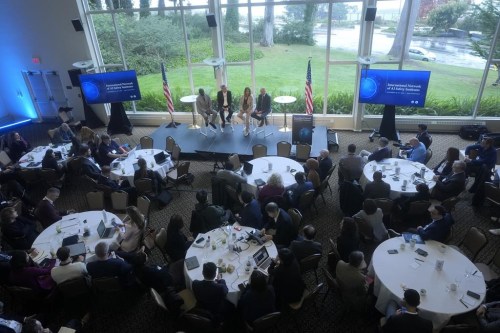
Attendees listen during a panel discussion with Ambassador Philip Thigo, Special Envoy on Technology for the Office of the President of Kenya, from top left, Hong Yuen Poon, Deputy Secretary of Singapore's Ministry of Digital Development and Information, Lucilla Sioli, Director of the Artificial Intelligence Office for the European Commission, and Dr. Seth Center, Acting Special Envoy Office of the Special Envoy for Critical and Emerging Technology, at the convening of the International Network of AI Safety Institutes at the Golden Gate Club at the Presidio in San Francisco, Wednesday, Nov. 20, 2024. (AP Photo/Jeff Chiu)

The California-based university’s Institute for Human-Centered AI — which has ties to Silicon Valley’s tech industry — released the report Thursday as government AI officials from the U.S. and several allies met in San Francisco this week to compare notes on AI safety measures.

Here’s which countries made the top 10:

United States

The U.S. ranks No. 1 on Stanford’s list and has consistently held that position since 2018 when it overtook China. It has far outpaced China in private AI investment, which hit $67.2 billion in the U.S. last year compared to $7.8 billion in China, according to the report. It also leads in publishing responsible AI research. It’s no surprise that the home of commercial AI powerhouses such as Google and Meta, along with relative newcomers like OpenAI and Anthropic, has produced many notable AI models that have influenced how the technology is being developed and applied. The U.S. also gets some points for having a number of AI-related laws on the books, though Congress has yet to pass any broad AI regulations.

China

China has requested far more patents than any other country regarding generative AI, the U.N. intellectual property agency said earlier this year. Stanford researchers counted that as one measure of China’s strong growth in AI innovation but not enough to lead the pack. Still, the report says that “China’s focus on developing cutting-edge AI technologies and increasing its R&D investments has positioned it as a major AI powerhouse.” China’s universities have produced a large number of AI-related research publications and it has commercial leaders developing notable AI models, such as Baidu and its chatbot Ernie.

United Kingdom

Coming in at No. 3 is the UK, which also ranked high in research and development, and educational infrastructure due to top computer science universities churning out a skilled AI workforce. It’s also home to Google’s AI subsidiary DeepMind, whose co-founder recently won a Nobel Prize; and “had more mentions of AI in parliamentary proceedings” than any other country. Last year, the UK hosted the world’s first international AI safety summit.

India

Close behind the UK was India, thanks to a “strong AI research community,” improvements in economic investments tied to AI and a robust public discourse about AI on social media, according to the report.

United Arab Emirates

The UAE’s deliberate focus on AI appears to have paid off in the Middle Eastern nation’s fifth-place score. It was one of the top locations for AI investments. Microsoft earlier this year said it was investing $1.5 billion in UAE-based tech firm G42, which is overseen by the country’s powerful national security adviser. Based in Abu Dhabi, G42 runs data centers and has built what’s considered the world’s leading Arabic-language AI model, known as Jais.

The rest of the top 10

Rounding out the top 10 are France at No. 6, followed by South Korea, Germany, Japan and Singapore. France, home to the buzzy AI startup Mistral, ranked high in AI policy and governance. Both it and Germany are part of the European Union’s sweeping new AI Act that places safeguards on a range of AI applications based on how risky they are. The EU also follows the U.S. in developing a plan to expand semiconductor production within the bloc.

Report Error Submit a Tip

More Stories

Double climate whammy hits home

Editorial 4 minute read Preview

Double climate whammy hits home

Editorial 4 minute read 2:00 AM CDT

It’s a bit of a one-two punch. First, the show-and-tell of what global warming could be bringing us. Then, the fact we’ve already failed our best chance of halting climate change.

Read
2:00 AM CDT

Time to ditch role as ex’s emotional crutch

Maureen Scurfield 5 minute read Yesterday at 2:00 AM CDT

DEAR MISS LONELYHEARTS: I mourn the end of summer every fall, but this year it’s far worse. My partner (a man, like me) broke up with me and my menagerie of animals.

The hardest part is that he still calls me before he goes to sleep at night — to see if I’m OK, and to tell me essentially, to buck up! Nothing like losing somebody and being told to be happy about it by the exact person you’ve lost.

He goes on about his new life and the people he’s meeting, and sometimes I just have to hang up on him.

Why does he bother calling? It seems like he maybe doesn’t know if he’s completely through with me yet, so he’s using me as a crutch. (Do I sound bitter?) What can I do?

Weekender festivities to take over downtown

Sheldon Birnie 3 minute read Preview

Weekender festivities to take over downtown

Sheldon Birnie 3 minute read 6:00 AM CDT

Come one, come all, to Graham Avenue this weekend.

Organizers of the Weekender hope to welcome thousands of Winnipeggers to the streets and parking lots in and around the Graham Avenue pedestrian mall in what they are billing as “Downtown’s Biggest Street Party.”

Starting Friday evening and running through Sunday, the free festival boasts a plethora of ways by which visitors can enjoy themselves. From food trucks to markets, games to live music, classic cars and free bike repairs, the festival aims to provide a little something for everyone.

“The Weekender is truly about bringing people together, to have fun, to experience all that downtown has to offer,” says Olivia Billson, director of communications and public relations for Downtown Winnipeg BIZ, which is putting on the festival in conjunction with Smith Events and Arch Events.

Read
6:00 AM CDT

Bumps in the road as students collect free bus passes

Maggie Macintosh 5 minute read Preview

Bumps in the road as students collect free bus passes

Maggie Macintosh 5 minute read Yesterday at 9:17 PM CDT

Alexis Enns left her guidance counsellor’s office empty-handed, but no less excited about starting Grade 12 — even though she still didn’t know how she would get there or her timetable — on Tuesday.

Read
Yesterday at 9:17 PM CDT

Letters, Sept. 9

7 minute read Preview

Letters, Sept. 9

7 minute read 3:00 AM CDT

As River Heights residents caught in a swath of rain and wind on Sunday evening, we survived 10 hours with no power after a big boom and an electric arc favoured us with a strike in our back lane. So far, we have had two brief additional outages (Monday) and in the early hours of (Tuesday) morning. This doesn’t begin to compare with the damage on Mathers Avenue, which is still under repair.

Read
3:00 AM CDT

Trump ramps up retaliation against Canada, banning imports of booze, other products

Kelly Geraldine Malone, The Canadian Press 6 minute read Preview

Trump ramps up retaliation against Canada, banning imports of booze, other products

Kelly Geraldine Malone, The Canadian Press 6 minute read Updated: Yesterday at 10:13 PM CDT

WASHINGTON - U.S. President Donald Trump signed new executive orders on Tuesday, ramping up retaliation after Canada imposed its latest set of duties on the United States. 

The five orders, which will take effect later this month, will completely bar imports of certain Canadian goods, including motorcycles, some dairy products and alcoholic beverages.

U.S. Trade Representative Jamieson Greer, in a statement later Tuesday, said the decision was a "natural consequence" of Canada's "discriminatory" treatment of American exports.

"After weeks of good faith and intensive efforts between U.S. and Canadian negotiators, Canada walked away from a near-final trade deal that offered better treatment than any other trading partner, and instead Canada chose to embark on senseless retaliation against the United States," Greer said in the statement.

Read
Updated: Yesterday at 10:13 PM CDT