European satellites launched to create artificial solar eclipses in a tech demo

Advertisement

Advertise with us

CAPE CANAVERAL, Fla. (AP) — A pair of European satellites rocketed into orbit Thursday on the first mission to create artificial solar eclipses through fancy formation flying in space.

Read this article for free:

or

Already have an account? Log in here »

To continue reading, please subscribe:

Subscribe and receive a limited-edition Free Press branded hat or tote.

Digital Subscription

One year of digital access for only $205*

  • Enjoy unlimited reading on winnipegfreepress.com
  • Read the E-Edition, our digital replica newspaper
  • Access News Break, our award-winning app
  • Play interactive puzzles

*First annual payment billed as $205.00 + GST for one year. This annual subscription will automatically renew at $233.00 + GST every 52 weeks (10% off the regular annual price of $259.35). Offer available to new and qualified returning subscribers only. Cancel any time.

To continue reading, please subscribe:

Add Free Press access to your Brandon Sun subscription for only an additional

$1 for the first 4 weeks*

  • Enjoy unlimited reading on winnipegfreepress.com
  • Read the E-Edition, our digital replica newspaper
  • Access News Break, our award-winning app
  • Play interactive puzzles
Start now

*Your next Brandon Sun subscription payment will increase by $1.00 and you will be charged $17.95 plus GST for four weeks. After four weeks, your payment will increase to $24.95 plus GST every four weeks.

Hey there, time traveller!
This article was published 05/12/2024 (608 days ago), so information in it may no longer be current.

CAPE CANAVERAL, Fla. (AP) — A pair of European satellites rocketed into orbit Thursday on the first mission to create artificial solar eclipses through fancy formation flying in space.

Each fake eclipse should last six hours once operations begin next year. That’s considerably longer than the few minutes of totality offered by a natural eclipse here on Earth, allowing for prolonged study of the sun’s corona, or outer atmosphere.

The launch took place from India.

This image provided by the European Space Agency shows a pair of probes creating an artificial total solar eclipse through formation flying. (European Space Agency via AP)

“We are a very happy science team here” in India, the European Space Agency’s mission scientist Joe Zender said via email.

Billed as a tech demo, the two satellites will separate in a month or so and fly 492 feet (150 meters) apart once reaching their destination high above Earth, lining up with the sun so that one spacecraft casts a shadow on the other.

This will require extreme precision, within just one millimeter, equivalent to a fingernail’s thickness, according to the European Space Agency. To maintain their position, the satellites will rely on GPS, star trackers, lasers and radio links, flying autonomously.

Each cube-shaped spacecraft is less than 5 feet (1.5 meters) across. The shadow-casting satellite holds a disk to block the sun from the telescope on the other satellite. This disk will mimic the moon in a natural total solar eclipse, with the darkened satellite posing as Earth.

“This has a huge scientific relevance” in addition to testing high-precision formation flying,” said the European Space Agency’s technology and engineering director Dietmar Pilz.

Scientists need the glaring face of the sun completely blocked in order to scrutinize the wispy crown-like corona encircling it, getting an especially good look close to the solar rim on this mission. They’re particularly interested to learn why the corona is hotter than the surface of the sun, and also want to better understand coronal mass ejections, eruptions of billions of tons of plasma with magnetic fields out into space.

The resulting geomagnetic storms can disrupt power and communication on Earth and in orbit. Such outbursts can also produce stunning auroras in unexpected places.

With a lopsided orbit stretching from 370 miles (600 kilometers) to 37,000 miles (60,000 kilometers) away, the satellites will take nearly 20 hours to circle the world. Six of those hours — at the farther end of certain orbits — will be spent generating an eclipse. Other orbits will be strictly for formation flying experiments, according to the European Space Agency.

The first eclipse results should be available in March, following checkout of both craft.
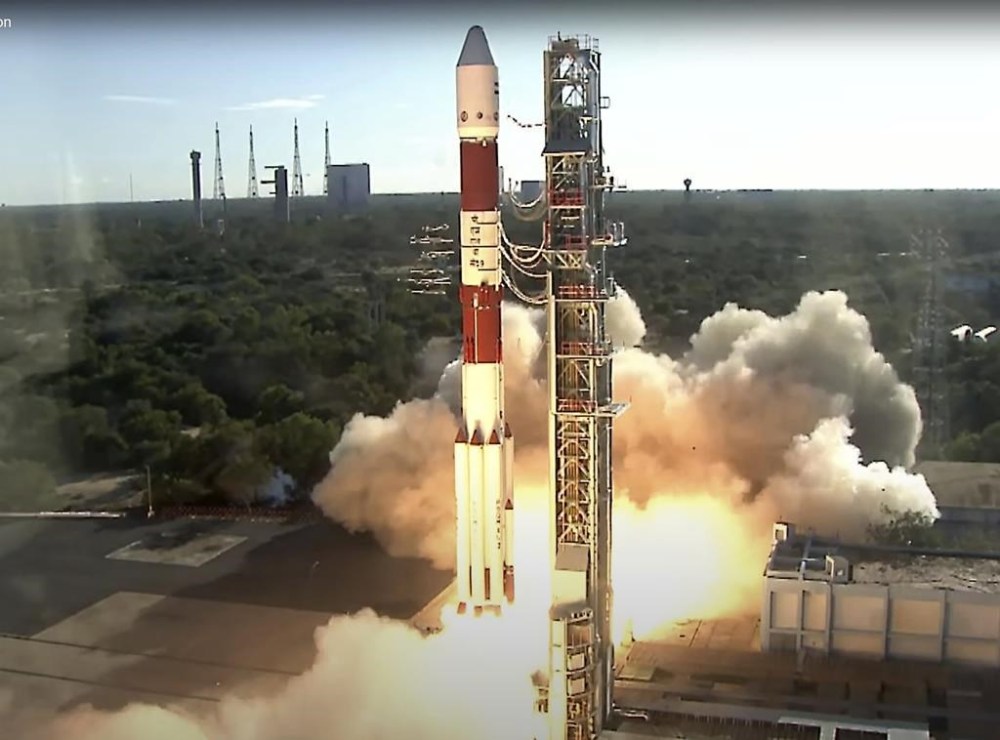
This image taken from video provided by the European Space Agency shows the launching of a rocket from the Satish Dhawan Space Centre in Sriharikota, India on Thursday, Dec. 5, 2024. A pair of European satellites rocketed into orbit Thursday on the first mission to create artificial solar eclipses through fancy formation flying in space. (European Space Agency via AP)

Zender said eclipses will be created at least twice a week, with six hours of totality each time for corona observations. The frequency will depend on solar activity, he noted, and prove a boon for scientists who now must travel across the world for a mere three to five minutes of totality during the occasional eclipse.

The $210 million mission, dubbed Proba-3, is aiming for at least 1,000 hours of “on demand” totality during its two-year operation. Once their job is done, both satellites will gradually drop lower until they burn up in the atmosphere, likely within five years.

Liftoff was delayed a day by a last-minute issue with the backup propulsion system of one of the satellites, crucial for precision formation flying. The European Space Agency said engineers relied on a computer software fix.

___

The Associated Press Health and Science Department receives support from the Howard Hughes Medical Institute’s Science and Educational Media Group. The AP is solely responsible for all content.

Report Error Submit a Tip

More Stories

Building bridges for the next generation

Zoe Pierce 8 minute read Preview

Building bridges for the next generation

Zoe Pierce 8 minute read Yesterday at 6:00 AM CDT

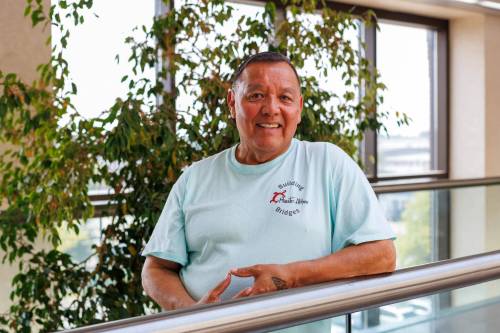
Change has been the motivation behind Clayton Sandy’s work for decades.

A member of Sioux Valley Dakota First Nation, Sandy is an Indigenous knowledge keeper, cultural advisor and community advocate. His work has taken him into newcomer organizations, schools, hospitals and workplaces across Manitoba, where he teaches Indigenous history, mentors youth and helps build relationships between communities.

Sitting down for an interview with the Free Press, Sandy arrived with a busy calendar in hand, a reflection of the many projects and initiatives that continue to fill his days as he works to create change for future generations.

“I have two boys and I have five grandchildren. The racism I put up with was really bad,” Sandy said. “And I don’t want my grandchildren to put up with that garbage.”

Read
Yesterday at 6:00 AM CDT

Even AI has to watch its diet

Editorial 4 minute read Preview

Even AI has to watch its diet

Editorial 4 minute read 2:01 AM CDT

Imagine going to your doctor and have that doctor tell you how much they like a new health app — but when you ask them whether their family likes it, the doctor says “Oh, I don’t trust it enough to let them use it.” Or having your general contractor extol the benefits of robotic construction workers — while bluntly saying he’d never use them to work on his home.

Well, enter AI.

For the last nine months or so, there have been recurring stories about AI companies buying up huge stockpiles of rare and out-of-print books, and “harvesting” — and destroying — the physical books to train their AI models.

Plenty of people questioned the stories, and went to Snopes to see if there was any truth to the claim.

Read
2:01 AM CDT

Drunk driver who killed cycling couple, orphaned their infant daughter, sentenced to eight years

Dean Pritchard 4 minute read Preview

Drunk driver who killed cycling couple, orphaned their infant daughter, sentenced to eight years

Dean Pritchard 4 minute read Yesterday at 5:47 PM CDT

A Winnipeg man responsible for a drunk-driving crash that killed two cyclists last summer and left their infant child an orphan has been sentenced to eight years in prison.

Kuldeep Singh Gill was arrested Sept. 13 after fleeing from a high-speed collision on Kenaston Boulevard that killed 31-year-old Egor Popov and his 25-year-old common-law partner Kerry Ashley Bonner.

Gill, 46, pleaded guilty earlier this year to two counts of impaired driving causing death and two counts of failing to stop at the scene of a collision.

Gill, who has a prior conviction for impaired driving, made a conscious decision to drive drunk, knowing it made him a danger on the road, provincial court Judge David Ireland said at a sentencing hearing Tuesday.

Read
Yesterday at 5:47 PM CDT

Letters, Aug. 5

6 minute read 2:01 AM CDT

An opportunity for corporate good

Re: Giant Tiger to close downtown store (July 31); Giant Tiger decision creates giant void for desperate population downtown (Aug. 1)

The recently announced November closing of the Giant Tiger store at Donald Street and Ellice Avenue is cause for some alarm. As a self-described community-focused, family discount store, the grocery and clothing chain has become an important part of Winnipeg’s downtown fabric, catering to, in Niigaan Sinclair’s words, “… people living less-privileged lives: people working low-paying jobs; those with no fixed address and the homeless population…”

Other existing downtown shopping options have anecdotally been described as too expensive and unaffordable.

Today’s horoscope

Georgia Nicols 4 minute read Preview

Today’s horoscope

Georgia Nicols 4 minute read 2:00 AM CDT

MOON ALERT: There are no restrictions to shopping or important decisions. The moon is in Taurus.

ARIES (March 21-April 19)

Resist the urge to get tangled up in financial disagreements with your kids, a friend, a group or a romantic partner. (Actually, anyone who wants to get in a fight with you.) You don’t need this. Focus on social outings. Keep things light.

TAURUS (April 20-May 20)

Read
2:00 AM CDT

Book gives patients tools for navigating the Canadian health-care system and getting treatment they need

Janine LeGal 8 minute read Preview

Book gives patients tools for navigating the Canadian health-care system and getting treatment they need

Janine LeGal 8 minute read Yesterday at 6:00 AM CDT

More than a few of us have been known to complain about the Canadian health-care system: the lack of staffing, the long ER waits, the challenge of finding a family physician, the lengthy waiting lists for specialized tests and surgeries. There’s been an outcry for answers for a long time.

The publication of The Canadian Health Care Guerrilla Handbook: How to Fight for What You Need is welcome news for anyone seeking those answers.

Written by Michael Decter, who served as cabinet secretary in Manitoba before his move to Ontario — and Mike McCarthy, patient advocate and consultant who brings a personal story of living with hemophilia, the book is a must-have, packed with answers to commonly asked questions that will help the reader navigate a complex and fractured system.

The book, written in plain language, talks about how to get what you want and need: a family doctor, diagnostic tests, appropriate medications, a second opinion, long-term care, home care, mental-health care — all of that and more is easily accessible in its 217 pages.

Read
Yesterday at 6:00 AM CDT