AI pioneer Geoffrey Hinton receives Nobel Prize in physics in proud moment for U of T
Advertisement
Read this article for free:
or
Already have an account? Log in here »
To continue reading, please subscribe:

Digital Subscription
One year of digital access for only $205*
- Enjoy unlimited reading on winnipegfreepress.com
- Read the E-Edition, our digital replica newspaper
- Access News Break, our award-winning app
- Play interactive puzzles
*First annual payment billed as $205.00 + GST for one year. This annual subscription will automatically renew at $233.00 + GST every 52 weeks (10% off the regular annual price of $259.35). Offer available to new and qualified returning subscribers only. Cancel any time.
To continue reading, please subscribe:
Add Free Press access to your Brandon Sun subscription for only an additional
$1 for the first 4 weeks*
- Enjoy unlimited reading on winnipegfreepress.com
- Read the E-Edition, our digital replica newspaper
- Access News Break, our award-winning app
- Play interactive puzzles
*Your next Brandon Sun subscription payment will increase by $1.00 and you will be charged $17.95 plus GST for four weeks. After four weeks, your payment will increase to $24.95 plus GST every four weeks.
Read unlimited articles for free today:
or
Already have an account? Log in here »
Hey there, time traveller!
This article was published 10/12/2024 (675 days ago), so information in it may no longer be current.
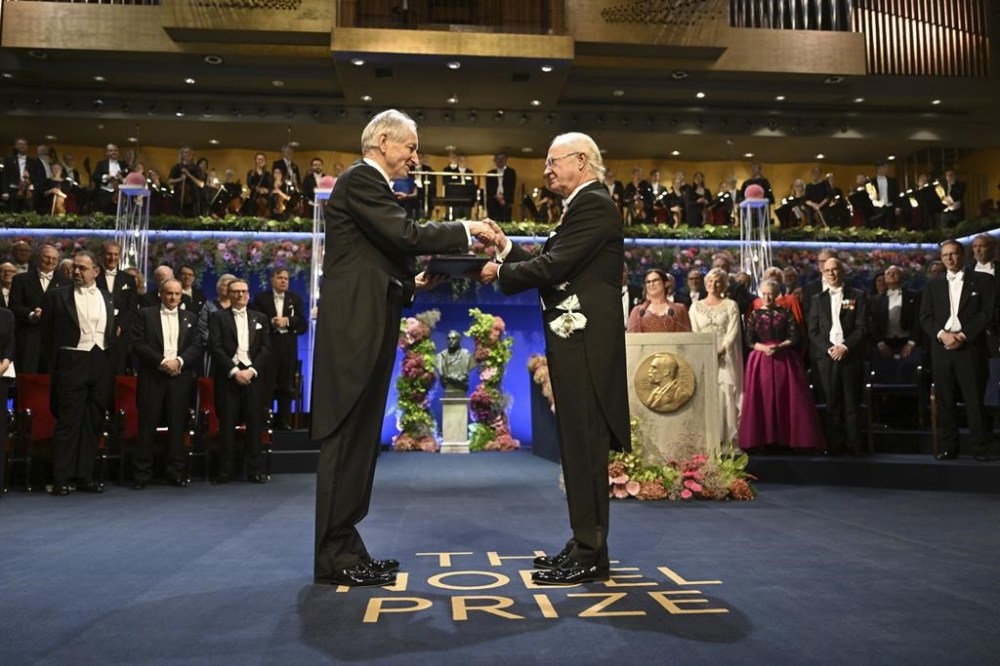
TORONTO – When Geoffrey Hinton strode across the Stockholm Concert Hall stage Tuesday to receive his Nobel Prize for physics from King Carl XVI Gustaf of Sweden, he was beaming.
It has taken decades for many beyond the science community to realize the British Canadian computer scientist’s life’s work was so significant it eventually formed the foundation of artificial intelligence.
But on Tuesday, as he accepted the Nobel diploma and its accompanying gold medal with co-laureate John Hopfield, there was no question about the importance of Hinton’s discoveries nor how he has shaped history.
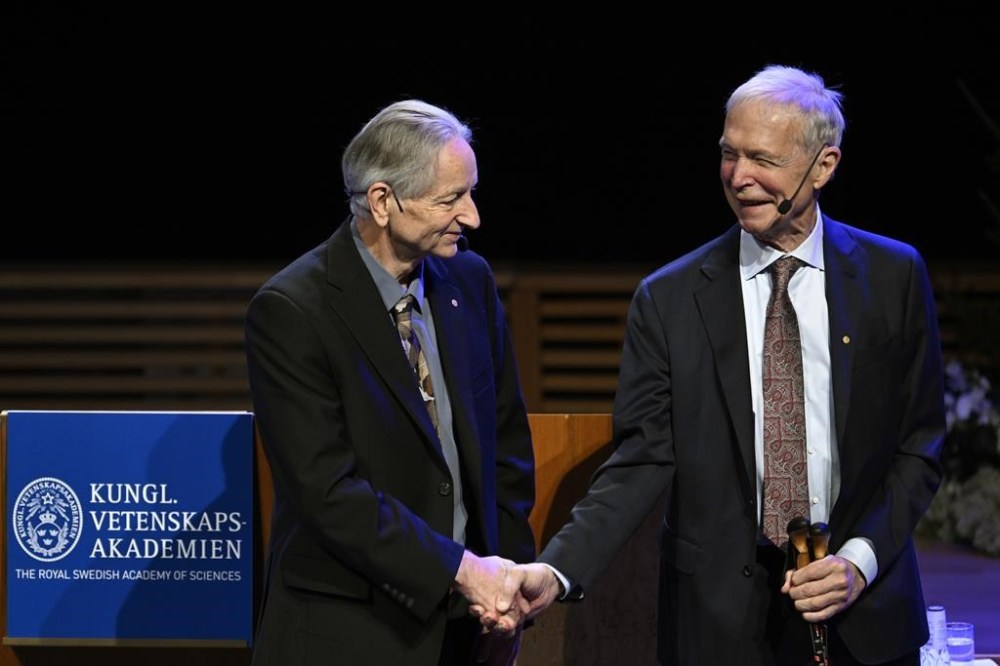
Instead, there was only pride for the affable 77-year-old, often called the godfather of AI — and that pride stretched from Stockholm to Toronto.
A crowd of about 100 students and colleagues at the University of Toronto, where Hinton is a professor emeritus, gathered at the school’s downtown campus to watch the Nobel ceremony. Two other watch parties took over the school’s Mississauga and Scarborough campuses.
Any mention of physics or a sighting of Hinton, clad in a dark suit and white bow tie, generated rousing applause at the Toronto gathering. When the man of the hour headed to retrieve his accolade from the King, a few former students and colleagues wiped tears from their eyes.
“There is, at least for me, this sense that Prof. Hinton created the whole ecosystem here, where there are thousands of people who are working on his ideas,” Michael Guerzhoy, one of Hinton’s former students who went on to teach a course Hinton had once led at the university, said before the ceremony began.
The idea that earned Hinton the Nobel dates back to the 1980s, when he was working at Carnegie Mellon University in Pittsburgh and AI was far from the buzzy technology it is today.
It was then that Hinton developed the Boltzmann machine, which learns from examples, rather than instructions, and when trained, can recognize familiar characteristics in information, even if it has not seen that data before.
“It was a lot of fun doing the research but it was slightly annoying that many people — in fact, most people in the field of AI — said that neural networks would never work,” Hinton recalled during a press conference on the October day he was named as a Nobel laureate.
“They were very confident that these things were just a waste of time and we would never be able to learn complicated things like, for example, understanding natural language using neural networks — and they were wrong.”
Neural networks are computational models that resemble the human brain’s structure and functions.
When Nobel physics committee chair Ellen Moons presented Hinton to receive his award, she said these networks are good at sorting and interpreting large amounts of data and self-improve based on the accuracy of the results they generate.
“Today, artificial neural networks are powerful tools in research fields spanning physics, chemistry and medicine, as well as in daily life,” she said.
John DiMarco wasn’t surprised that Hinton’s work paved the way for such possibilities, but the IT director for U of T’s computer science department was taken aback that Hinton’s Nobel came in the unlikely physics category.
DiMarco met Hinton roughly 35 years ago in a job interview and quickly took note of his proclivity for humour and the quirks in how his mind works.
“He is quite insightful and he goes straight to the core of things,” DiMarco said.
“He would sometimes come out of his office and share some new idea. We didn’t always understand what he was sharing, but he was very excited about it.”
Many of those ideas required lots of computing power the school’s systems didn’t have, so DiMarco’s team patched together a solution with graphics processing units from video game consoles.
DiMarco brought one of Hinton’s GPUs to the watch party, which was also attended by Joseph Jay Williams, the director of U of T’s Intelligent Adaptive Interventions Lab.
Williams took one of Hinton’s classes and said the Nobel winner “changed the course of my life” by encouraging him to go to grad school, which then led him to win the XPRIZE Digital Learning Challenge, a global competition aimed at rewarding people who modernize learning tools and processes.
Other notable mentees and alumni of Hinton’s classes include OpenAI co-founder Ilya Sutskever and Cohere co-founders Nick Frosst and Aidan Gomez.
With his Nobel win and so many esteemed protege, Williams said Hinton has become a “reluctant celebrity” who is hounded for photos every time he’s on campus.
Hinton, however, has taken a much more humble approach to his recent win, which he learned of on a trip to California.
He initially thought the call from the academy that gives out the Nobel was “a spoof,” but later realized it had to be real because it was placed from Sweden and the speaker had a “strong Swedish accent.”
The award the academy gave him comes with 11 million Swedish kronor (about $1.4 million) from a bequest arranged by Swedish inventor Alfred Nobel.
Hinton and Hopfield will split the money, with some of Hinton’s share going to Water First, an Ontario organization working to boost Indigenous access to water, and another unnamed charity supporting neurodiverse young adults.
Hinton has said he doesn’t plan to do much more “frontier research.”
“I believe I’m going to spend my time advocating for people to work on safety,” he said in October.
Last year, Hinton left a role he held at Google to more freely speak about the dangers of AI, which he has said include bias and discrimination, fake news, joblessness, lethal autonomous weapons and even the end of humanity.

“We have no idea whether we can stay in control,” Hinton said at a Nobel banquet held after the award ceremony.
“But we now have evidence that if (digital beings) are created by companies motivated by short-term profits, our safety will not be the top priority. We urgently need research on how to prevent these new beings from wanting to take control. They are no longer science fiction.”
At a Stockholm press conference over the weekend, he said he doesn’t regret the work he did to lay the foundations of artificial intelligence, but wishes he thought of safety sooner.
“In the same circumstances, I would do the same again,” he said.
This report by The Canadian Press was first published Dec. 10, 2024.