US hikes tariffs on imports of Chinese solar wafers, polysilicon and tungsten products

Advertisement

Advertise with us

BANGKOK (AP) — The Biden administration plans to raise tariffs on solar wafers, polysilicon and some tungsten products from China to protect U.S. clean energy businesses.

Read this article for free:


or

Already have an account? Log in here »

To continue reading, please subscribe:

Subscribe and receive a limited-edition Free Press branded hat or tote.

Digital Subscription

One year of digital access for only $205*

  • Enjoy unlimited reading on winnipegfreepress.com
  • Read the E-Edition, our digital replica newspaper
  • Access News Break, our award-winning app
  • Play interactive puzzles

*First annual payment billed as $205.00 + GST for one year. This annual subscription will automatically renew at $233.00 + GST every 52 weeks (10% off the regular annual price of $259.35). Offer available to new and qualified returning subscribers only. Cancel any time.

To continue reading, please subscribe:

Add Free Press access to your Brandon Sun subscription for only an additional

$1 for the first 4 weeks*

  • Enjoy unlimited reading on winnipegfreepress.com
  • Read the E-Edition, our digital replica newspaper
  • Access News Break, our award-winning app
  • Play interactive puzzles
Start now

*Your next Brandon Sun subscription payment will increase by $1.00 and you will be charged $17.95 plus GST for four weeks. After four weeks, your payment will increase to $24.95 plus GST every four weeks.

Hey there, time traveller!
This article was published 11/12/2024 (669 days ago), so information in it may no longer be current.

BANGKOK (AP) — The Biden administration plans to raise tariffs on solar wafers, polysilicon and some tungsten products from China to protect U.S. clean energy businesses.

The notice from the U.S. Trade Representative’s office said tariffs on Chinese-made solar wafers and polysilicon will rise to 50% from 25% and duties on certain tungsten products will increase from zero to 25%, effective on Jan. 1, following a review of Chinese trade practices under Section 301 of the 1974 Trade Act.

The decision followed a public comment period after the USTR said in September that it was considering such actions.
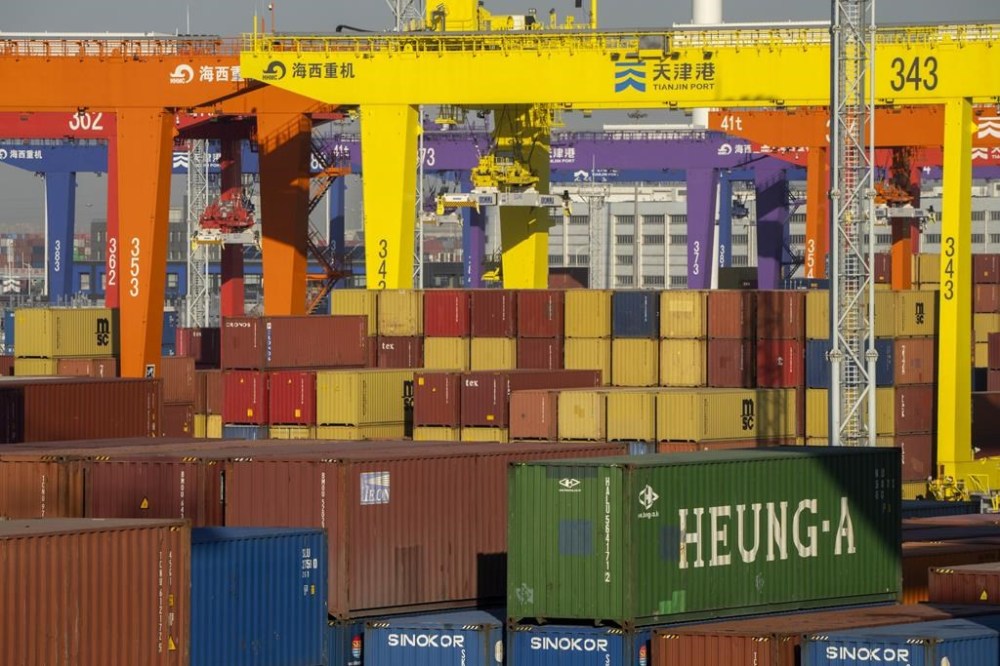
FILE - Shipping containers are stacked at a port in Tianjin, China, Jan. 16, 2023. (AP Photo/Mark Schiefelbein, File)

“The tariff increases announced today will further blunt the harmful policies and practices by the People’s Republic of China,” USTR Katharine Tai said in a statement. “These actions will complement the domestic investments made under the Biden-Harris Administration to promote a clean energy economy, while increasing the resilience of critical supply chains.”

Reports Thursday said U.S. and Chinese officials were meeting this week and next for trade talks ahead of the year’s end.

Last week, Washington tightened restrictions on Chinese access to advanced semiconductor technology. Beijing responded by banning exports to the U.S. of certain critical minerals needed to make computer chips, such as gallium, germanium and antimony. It also stepped up its controls on graphite exports to the U.S.

China provides a very large share of most of those materials and the United States has been working to secure alternative sources in Africa and other parts of the world.

Tungsten is another strategically vital metal whose production is dominated by China. The U.S. does not produce it, but South Korea is a potential big supplier. It’s used to make armaments and is also used in x-ray tubes and light bulb filaments, among other industrial applications. U.S. imports of the metal from China fell to $10.9 million in 2023 from $19.5 million the year before.

After Beijing announced its ban on exporting gallium and the other materials to the United States, analysts said tungsten was another likely area where China might strike back.

The sun sets over electric pylons along a solar farm near Weifang in eastern China's Shandong province on March 22, 2024. (AP Photo/Ng Han Guan)

Trade frictions have been escalating ahead of the inauguration of President-elect Donald Trump, who has vowed to impose 60% tariffs on Chinese goods, among other threats. President Joe Biden has said Trump’s promise of broad tariffs on foreign imports would be a mistake.

His administration has kept in place tariffs that Trump imposed during his first term in office, but says it has a more targeted approach.

China has sharply ramped up production of cheap electric vehicles, solar panels, and batteries at a time when the Biden administration has championed moves to support those industries in the U.S.

The U.S. and other trading partners say China improperly subsidizes exports, giving exporters of solar panels and other products an unfair advantage in overseas markets, where its manufacturers charge lower prices thanks to government support. Washington also says China improperly pressures foreign companies to hand over technology.

China accounts for more than 80% of the market for solar panels at all stages of production, according to the International Energy Agency, more than double domestic demand for those products. Its huge economies of scale have made solar power more affordable, but also concentrated the supply chain inside China. The IEA has urged other countries to assess their solar panel supply chains and develop strategies to address any risks.

In early 2018, the Trump administration imposed 30% tariffs on imports of Chinese solar panels. Beijing filed a complaint with the World Trade Organization charging that the U.S. was unfairly supporting electric vehicle purchases.

FILE - Workers check solar panels at a solar power station on a factory roof in Changxing, eastern China's Zhejiang province on Feb. 7, 2012. (AP Photo/File)

The investigation that led the USTR to raise the tariffs on solar panels concluded with a report in May that has prompted increases in tariffs on a range of products including electric vehicles, syringes and needles, medical gloves and facemasks, semiconductors and steel and aluminum products, among others.

It has pushed tariffs on Chinese-made electric vehicles up to 100% from 25%, raised tariffs on Chinese-made lithium batteries to 25% from 7.5%.

Report Error Submit a Tip

More Stories

Jets encouraged by play through first five games

Mike McIntyre 6 minute read Preview

Jets encouraged by play through first five games

Mike McIntyre 6 minute read Yesterday at 4:21 PM CDT

Turkey. Stuffing. And a heaping helping of rest and recovery.

The Winnipeg Jets have plenty to be thankful for this holiday weekend, including a solid 3-1-1 start to the NHL campaign. Players and coaches are also counting their blessings at finally getting a breather after a busy stretch of five games in eight days.

“We don’t have another (break like this) until a week before Christmas. So we’re going to take advantage of it,” head coach Scott Arniel said following the club’s first regulation loss, a 5-1 stinker on Friday night against the visiting Anaheim Ducks.

To borrow a funny old Thanksgiving-related phrase from former defenceman Nate Schmidt, the hockey club was “leaking gravy.” They looked like a group that could use a timeout — which they’ll get since they don’t play again until hosting the Minnesota Wild on Tuesday night.

Read
Yesterday at 4:21 PM CDT

Police looking into robbery of children captured on video

Morgan Modjeski 3 minute read Preview

Police looking into robbery of children captured on video

Morgan Modjeski 3 minute read Friday, Oct. 9, 2026

The Winnipeg Police Service said it is aware of a video circulating online that appears to show two children robbed while walking home from the library.

The mother of the siblings said the Sept. 26 incident, which happened in the area of Andrews Street and Magnus Avenue at around 7:30 p.m., has left her children afraid and her feeling guilty.

“I should have been there with them. I felt horrible,” said Brittany Beaudet. “I would have been out the door if I knew any sooner to help them out.”

In the 40-second video, the two children, 14-year-old Mason and nine-year-old Kenzie, are approached by a man wearing a black shirt, black pants and white shoes.

Read
Friday, Oct. 9, 2026

Puppies, stocks — ‘zoomies’ abound

Andrew Froese 4 minute read Yesterday at 2:01 AM CDT

This spring, I adopted a three-month-old rescued German Shepherd mix. To say she is easily excitable is an understatement.

It is not really her fault. A puppy’s frontal cortex, the part of the brain that helps with decision-making and impulse control, is still developing. When an older dog, or a human, gets tired, we generally understand we should rest. Puppies have not quite figured that out. They often interpret tiredness as a signal something is wrong, which makes them more alert, more reactive and harder to settle.

That creates a feedback loop. The puppy gets tired, which makes her frantic, which makes her more tired, which makes her even more frantic. Eventually, this becomes what people call the “zoomies”: frantic sprinting, biting, jumping and general chaos.

From the outside, it looks like the puppy has too much energy. In reality, the opposite is true. The zoomies are not a sign of excess energy. They are a sign the puppy is overtired and does not know it yet.

A Rocky day on the mayoral campaign trail for Kevin Klein

Malak Abas 12 minute read Preview

A Rocky day on the mayoral campaign trail for Kevin Klein

Malak Abas 12 minute read Friday, Oct. 9, 2026

Kevin Klein acknowledges it’s hard to foresee what he’ll wake up to each morning in the final weeks of a mayoral campaign.

But the seasoned politician, who has served as both a city councillor and a provincial cabinet minister, couldn’t have predicted the events — what he describes as “drama” — that unfolded last Sunday.

Fellow mayoral candidate Mike Vogiatzakis accused Klein’s campaign team of offering him a job to drop out of the race, while a guest writer’s column in the Winnipeg Sun that questioned the deaths of Indigenous children at residential schools, just days after the National Day for Truth and Reconciliation, sparked condemnation from a prominent Indigenous organization. (Klein is the CEO of the Klein Group, the company that owns the Sun. He has maintained he is not involved in its operations while running for mayor.)

The Free Press had already been scheduled to join Klein on the campaign trail Monday, intending to document a day in the life of the front-running candidate to unseat incumbent Scott Gillingham, before the controversies hit.

Read
Friday, Oct. 9, 2026

Is this the season of secession?

David McLaughlin 5 minute read Preview

Is this the season of secession?

David McLaughlin 5 minute read Yesterday at 2:01 AM CDT

Canada has entered its season of secession. Like El Nino, the currents of grievance can blow hot and cold. Today, they are hot. But how hot for how long? The odds of Alberta and now Quebec separating from Canada are not high, but they are never zero.

After a year of waving the flag in a surge of national patriotism to confront Donald Trump’s attacks on Canada — economic and verbal — it is both jarring and frustrating for most Canadians to be reminded of the pervasive and persistent tensions that come with governing our federation.

When we need new national purpose to confront big economic sovereignty and security challenges from outside, that purpose is undermined and diminished by having to confront homegrown grievances.

We’ve seen and seen off two separation referendums in Quebec. Now we have a newly elected separatist party coming to power. In Alberta, voters will soon decide whether the independence road is one they want to travel.

Read
Yesterday at 2:01 AM CDT

Phoneless concert a beautiful chance to bask in moment

Jen Zoratti 5 minute read Preview

Phoneless concert a beautiful chance to bask in moment

Jen Zoratti 5 minute read Yesterday at 2:01 AM CDT

Outside the Scotiabank Arena in Toronto, digital billboards flashed fans their singular photo op for the night: “I took this photo before I saw Phoebe Bridgers: The Lost Tour 2026.”

It is, as it is for so many other people, my only documentation of a concert by one of my favourite artists. The American singer-songwriter — who I discovered at the Winnipeg Folk Festival in 2018 — has had a meteoric rise in the past few years, winning three Grammys in 2024 as one third of Boygenius, the indie-rock supergroup rounded out by Lucy Dacus and Julien Baker, and opening for Taylor Swift on select dates of her titanic Eras Tour.

Now, Bridgers is touring in support of Lost Weekend, her third album and first since 2020’s Punisher. It’s a feat of a record, a richly textured meditation on loss and grief, written in the aftermath of the death of her dad, with whom she had a complicated relationship.

So she is in a position to not only play multiple sold-out arena shows, but also insist that those shows be phone-free.

Read
Yesterday at 2:01 AM CDT