WEATHER ALERT

Scientists drill nearly 2 miles down to pull 1.2 million-year-old ice core from Antarctic

Advertisement

Advertise with us

An international team of scientists announced Thursday they’ve successfully drilled one of the oldest ice cores yet, penetrating nearly 2 miles (2.8 kilometers) to Antarctic bedrock to reach ice they say is at least 1.2 million years old.

Read this article for free:

or

Already have an account? Log in here »

To continue reading, please subscribe:

Subscribe and receive a limited-edition Free Press branded hat or tote.

Digital Subscription

One year of digital access for only $205*

  • Enjoy unlimited reading on winnipegfreepress.com
  • Read the E-Edition, our digital replica newspaper
  • Access News Break, our award-winning app
  • Play interactive puzzles

*First annual payment billed as $205.00 + GST for one year. This annual subscription will automatically renew at $233.00 + GST every 52 weeks (10% off the regular annual price of $259.35). Offer available to new and qualified returning subscribers only. Cancel any time.

To continue reading, please subscribe:

Add Free Press access to your Brandon Sun subscription for only an additional

$1 for the first 4 weeks*

  • Enjoy unlimited reading on winnipegfreepress.com
  • Read the E-Edition, our digital replica newspaper
  • Access News Break, our award-winning app
  • Play interactive puzzles
Start now

*Your next Brandon Sun subscription payment will increase by $1.00 and you will be charged $17.95 plus GST for four weeks. After four weeks, your payment will increase to $24.95 plus GST every four weeks.

Hey there, time traveller!
This article was published 09/01/2025 (567 days ago), so information in it may no longer be current.

An international team of scientists announced Thursday they’ve successfully drilled one of the oldest ice cores yet, penetrating nearly 2 miles (2.8 kilometers) to Antarctic bedrock to reach ice they say is at least 1.2 million years old.

Analysis of the ancient ice is expected to show how Earth’s atmosphere and climate have evolved. That should provide insight into how Ice Age cycles have changed, and may help in understanding how atmospheric carbon changed climate, they said.

“Thanks to the ice core we will understand what has changed in terms of greenhouse gases, chemicals and dusts in the atmosphere,” said Carlo Barbante, an Italian glaciologist and coordinator of Beyond EPICA, the project to obtain the core. Barbante also directs the Polar Science Institute at Italy’s National Research Council.

The same team previously drilled a core about 800,000 years old. The latest drilling went 2.8 kilometers (about 1.7 miles) deep, with a team of 16 scientists and support personnel drilling each summer over four years in average temperatures of about minus-35 Celsius (minus-25.6 Fahrenheit).

Italian researcher Federico Scoto was among the glaciologists and technicians who completed the drilling at the beginning of January at a location called Little Dome C, near Concordia Research Station.

“It was a great a moment for us when we reached the bedrock,” Scoto said. Isotope analysis gave the ice’s age as at least 1.2 million years old, he said.

Both Barbante and Scoto said that thanks to the analysis of the ice core of the previous Epica campaign they have assessed that concentrations of greenhouse gases, such as carbon dioxide and methane, even during the warmest periods of the last 800,000 years, have never exceeded the levels seen since the Industrial Revolution began.

“Today we are seeing carbon dioxide levels that are 50% above the highest levels we’ve had over the last 800,000 years,” Barbante said.

The European Union funded Beyond EPICA (European Project for Ice Coring in Antarctica) with support from nations across the continent. Italy is coordinating the project.

The announcement was exciting to Richard Alley, a climate scientist at Penn State who was not involved with the project and who was recently awarded the National Medal of Science for his career studying ice sheets.

Alley said advancements in studying ice cores are important because they help scientists better understand the climate conditions of the past and inform their understanding of humans’ contributions to climate change in the present. He added that reaching the bedrock holds added promise because scientists may learn more about Earth’s history not directly related to the ice record itself.
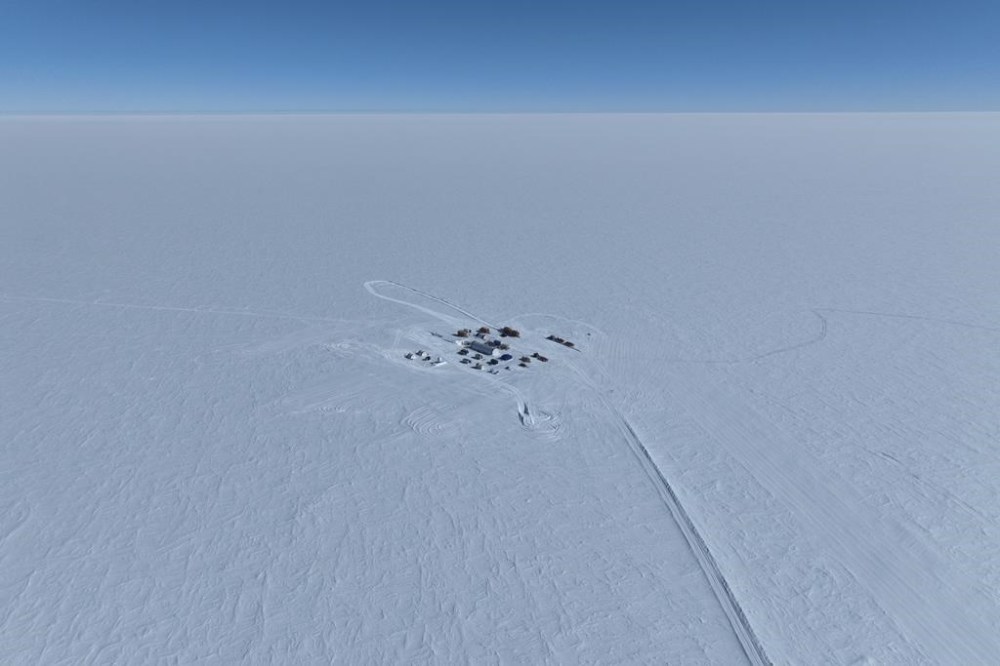
Little Dome C field base and drilling station sits in eastern Antarctica on Tuesday, Jan. 7, 2025. (PNRA/IPEV Beyond Epica via AP)

“This is truly, truly, amazingly fantastic,” Alley said. “They will learn wonderful things.”

___

Associated Press writer Melina Walling contributed from Chicago. Santalucia reported from Rome.

___

The Associated Press’ climate and environmental coverage receives financial support from multiple private foundations. AP is solely responsible for all content. Find AP’s standards for working with philanthropies, a list of supporters and funded coverage areas at AP.org.

Report Error Submit a Tip

More Stories

Decision on corridor for Trans-Canada twinning near Ontario border expected this fall, province says

Chris Kitching 4 minute read Preview

Decision on corridor for Trans-Canada twinning near Ontario border expected this fall, province says

Chris Kitching 4 minute read Updated: 5:24 PM CDT

The Manitoba government is taking more time to evaluate and select a preferred corridor for the twinning of a 16-kilometre section of the Trans-Canada Highway near the Ontario boundary.

An earlier timeline indicated Manitoba Transportation and Infrastructure expected to choose an alignment by the fall of 2025. A provincial spokesperson told the Free Press on Monday a decision is expected this winter, but a different spokesperson said Wednesday a decision is expected this fall.

“The department continues to evaluate corridor alternatives and will undertake additional geotechnical, environmental and design work as part of the (functional design study) to support the selection of a preferred corridor,” the spokesperson said in a statement.

The study, which will include Crown-Indigenous and public consultation, is expected to be completed in late 2027, with a detailed design to follow.

Read
Updated: 5:24 PM CDT

Gaps in homecare leave Winnipeg man in perilous situation

Nicole Buffie 4 minute read Preview

Gaps in homecare leave Winnipeg man in perilous situation

Nicole Buffie 4 minute read 6:00 AM CDT

Tom Landy fears he won’t live long enough to receive adequate homecare.

The 49-year-old Winnipegger has spinal muscular atrophy, a degenerative disease, and requires 24-7 homecare, but gaps in his care leave him sitting in one spot for hours and lately he’s developed bed sores.

Landy was approved for around-the-clock care in June 2025, but staffing issues and an investigation into a homecare worker’s workplace injury have left him without help for periods of time throughout the day and forced his 76-year-old father to fill in.

“This is what they’re here for, to take care of me, and now it feels like I’m a burden,” he said from his home in the Maples.

Read
6:00 AM CDT

Puzzles Palace

1 minute read Monday, Jul. 27, 2026

To solve our puzzles, please subscribe with this special offer: |

Sottobraccio brings Harth’s Italian flavours to new location in Osborne Village

Eva Wasney 4 minute read Preview

Sottobraccio brings Harth’s Italian flavours to new location in Osborne Village

Eva Wasney 4 minute read Yesterday at 5:21 PM CDT

Sottobraccio is the answer to a common refrain at Harth Mozza & Wine Bar.

“The No. 1 thing we always hear from guests at Harth is, ‘We love coming here, but it’s such a drive,’” chef Brent Genyk says of his popular fine-dining restaurant in South St. Vital.

Harth’s new sister restaurant opened in the heart of Osborne Village in June, joining a raft of other eateries that have moved into the central Winnipeg neighbourhood in recent years.

Sottobraccio is located at 160 Osborne St. in the main floor of the Zü, a new retail and residential complex built on the former site of the Osborne Village Motor Inn and its well-known music venue, the Zoo.

Read
Yesterday at 5:21 PM CDT

Rare white buffalo gets dignified sendoff

By Tiago Resko 4 minute read Preview

Rare white buffalo gets dignified sendoff

By Tiago Resko 4 minute read 6:02 PM CDT

Indigenous elders and others came together in the blistering heat Wednesday morning to perform a sacred pipe ceremony in honour of a rare white buffalo at the Assiniboine Park Zoo.

Blizzard died July 24 after spending nearly 20 of the 21 years of his life at the zoo.

Charlene Moore, 33, was visibly emotional during the ceremony, saying she came to watch in honour of the animal she felt had guided her throughout her life.

“I feel oddly connected to them, even though we didn’t spend that much time together, but I always thought about them every time I came to this part of the city,” she said of Blizzard.

Read
6:02 PM CDT

WAG wraps exhibition showcasing fine art of a sweet bike

Tiago Resko 4 minute read Preview

WAG wraps exhibition showcasing fine art of a sweet bike

Tiago Resko 4 minute read 7:49 PM CDT

Growing up in rural Manitoba, Allen Hildebrand was always tinkering with something. While on a flight to Mexico in 2016, it felt like an act of fate when he picked up a magazine and opened it to the ultimate project.

“It had this dirty old bike on it and I was like, ‘I want one of these in my life,’” Hildebrand says.

After 10 years, he is running out of space in his garage after filling it with four bikes, two of which are featured in a pop-up motorcycle exhibition at the WAG-Qaumajuq that ends Thursday.

The art gallery is broadening the perspective of what fine art can be with Art Moto: Where Design Meets the Road, featuring 25 motorbikes hand-built by local enthusiasts and set up in the gallery’s main hall and skylight.

Read
7:49 PM CDT