Spacecraft buzzes Mercury’s north pole and beams back stunning photos
Advertisement
Read this article for free:
or
Already have an account? Log in here »
To continue reading, please subscribe:

Digital Subscription
One year of digital access for only $205*
- Enjoy unlimited reading on winnipegfreepress.com
- Read the E-Edition, our digital replica newspaper
- Access News Break, our award-winning app
- Play interactive puzzles
*First annual payment billed as $205.00 + GST for one year. This annual subscription will automatically renew at $233.00 + GST every 52 weeks (10% off the regular annual price of $259.35). Offer available to new and qualified returning subscribers only. Cancel any time.
To continue reading, please subscribe:
Add Free Press access to your Brandon Sun subscription for only an additional
$1 for the first 4 weeks*
- Enjoy unlimited reading on winnipegfreepress.com
- Read the E-Edition, our digital replica newspaper
- Access News Break, our award-winning app
- Play interactive puzzles
*Your next Brandon Sun subscription payment will increase by $1.00 and you will be charged $17.95 plus GST for four weeks. After four weeks, your payment will increase to $24.95 plus GST every four weeks.
Read unlimited articles for free today:
or
Already have an account? Log in here »
Hey there, time traveller!
This article was published 09/01/2025 (600 days ago), so information in it may no longer be current.
CAPE CANAVERAL, Fla. (AP) — A spacecraft has beamed back some of the best close-up photos yet of Mercury’s north pole.
The European and Japanese robotic explorer swooped as close as 183 miles (295 kilometers) above Mercury’s night side before passing directly over the planet’s north pole. The European Space Agency released the stunning snapshots Thursday, showing the permanently shadowed craters at the top of of our solar system’s smallest, innermost planet.
Cameras also captured views of neighboring volcanic plains and Mercury’s largest impact crater, which spans more than 930 miles (1,500 kilometers).
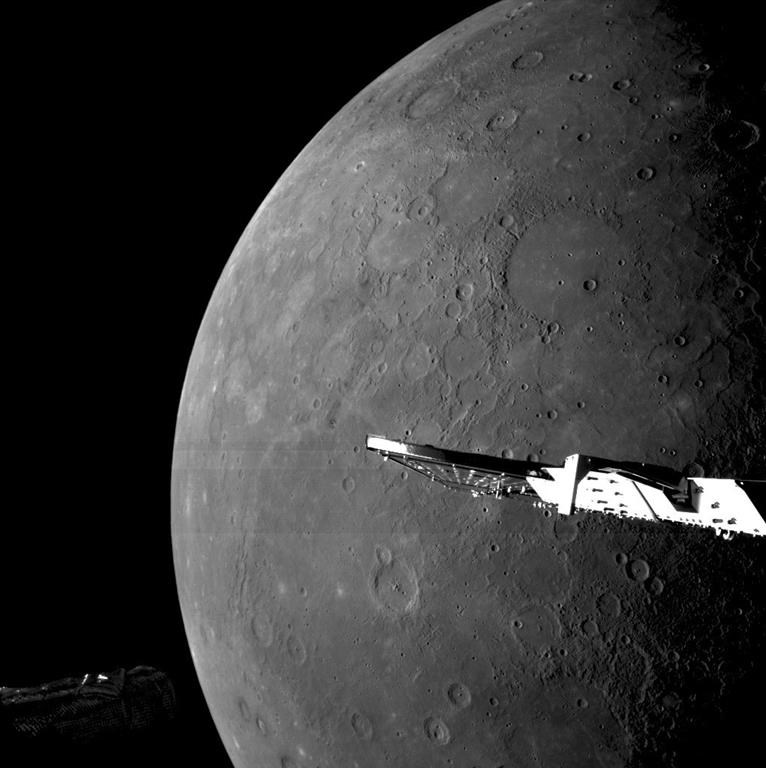
This was the sixth and final flyby of Mercury for the BepiColombo spacecraft since its launch in 2018. The maneuver put the spacecraft on course to enter orbit around Mercury late next year. The spacecraft holds two orbiters, one for Europe and the other for Japan, that will circle the planet’s poles.
The spacecraft is named for the late Giuseppe (Bepi) Colombo, a 20th-century Italian mathematician who contributed to NASA’s Mariner 10 mission to Mercury in the 1970s and, two decades later, to the Italian Space Agency’s tethered satellite project that flew on the U.S. space shuttles.
___
The Associated Press Health and Science Department receives support from the Howard Hughes Medical Institute’s Science and Educational Media Group and the Robert Wood Johnson Foundation. The AP is solely responsible for all content.
Advertisement Advertise With Us