Biden’s administration proposes new rules on exporting AI chips, provoking an industry pushback
Advertisement
Read this article for free:
or
Already have an account? Log in here »
To continue reading, please subscribe:

Digital Subscription
One year of digital access for only $205*
- Enjoy unlimited reading on winnipegfreepress.com
- Read the E-Edition, our digital replica newspaper
- Access News Break, our award-winning app
- Play interactive puzzles
*First annual payment billed as $205.00 + GST for one year. This annual subscription will automatically renew at $233.00 + GST every 52 weeks (10% off the regular annual price of $259.35). Offer available to new and qualified returning subscribers only. Cancel any time.
To continue reading, please subscribe:
Add Free Press access to your Brandon Sun subscription for only an additional
$1 for the first 4 weeks*
- Enjoy unlimited reading on winnipegfreepress.com
- Read the E-Edition, our digital replica newspaper
- Access News Break, our award-winning app
- Play interactive puzzles
*Your next Brandon Sun subscription payment will increase by $1.00 and you will be charged $17.95 plus GST for four weeks. After four weeks, your payment will increase to $24.95 plus GST every four weeks.
Read unlimited articles for free today:
or
Already have an account? Log in here »
Hey there, time traveller!
This article was published 13/01/2025 (630 days ago), so information in it may no longer be current.
WASHINGTON (AP) — The Biden administration is proposing a new framework for the exporting of the advanced computer chips used to develop artificial intelligence, an attempt to balance national security concerns about the technology with the economic interests of producers and other countries.
But the framework proposed Monday also raised concerns of chip industry executives who say the rules would limit access to existing chips used for video games and restrict in 120 countries the chips used for data centers and AI products. Mexico, Portugal, Israel and Switzerland are among the nations that could have limited access, though much of the underlying focus is aimed at China.
“If it’s China and not the United States determining the future of AI on the planet, I think that the stakes of that are just profound,” said White House national security adviser Jake Sullivan on Monday.
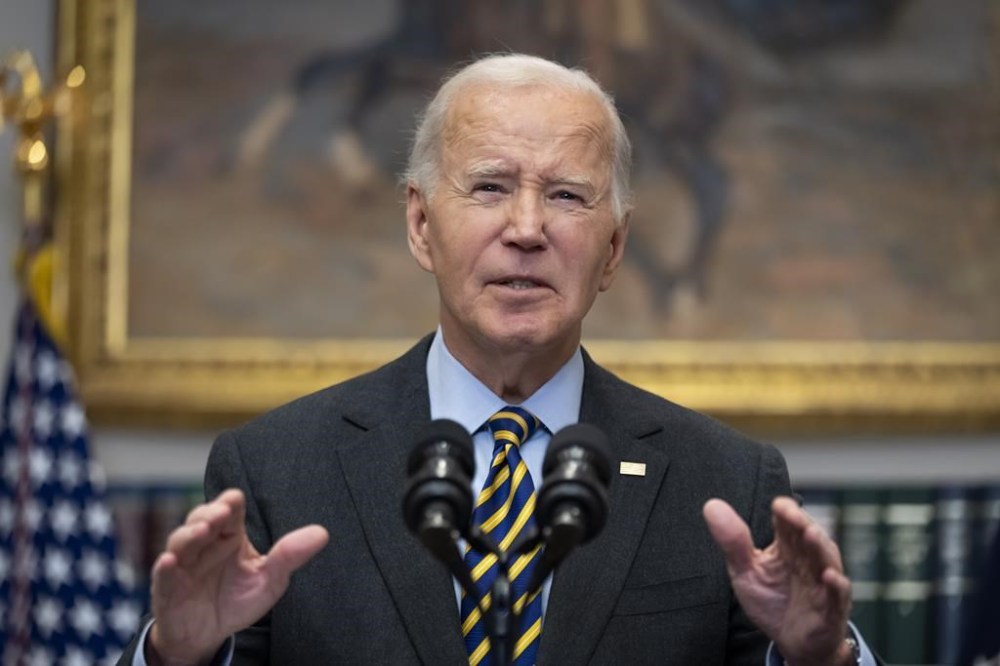
With just a week before President-elect Donald Trump takes office, Biden officials made clear it would be up to Trump to follow through with or drop an approach that Sullivan said “shouldn’t be a partisan issue at all.”
Commerce Secretary Gina Raimondo said that it’s “critical” to preserve America’s leadership in AI and the development of AI-related computer chips. Fast-evolving AI technology enables computers to produce novels, make scientific research breakthroughs, automate driving and foster a range of other transformations that could reshape economies and warfare.
Raimondo said the framework “is designed to safeguard the most advanced AI technology and ensure that it stays out of the hands of our foreign adversaries but also enabling the broad diffusion and sharing of the benefits with partner countries.”
While the Biden administration had already restricted exports to adversaries such as China and Russia, some of those controls had loopholes and the new rule would set limits on a much broader group of countries. Data centers built in the Middle East and Southeast Asia are of particular concern to U.S. officials, said Ed Mills, an analyst at Raymond James.
“Chinese companies have used those data centers to build AI models with technology that they would not be able to import to China itself,” Mills said.
A tech industry group, the Information Technology Industry Council, warned Raimondo in a letter last week that a hastily implemented new rule from the Democratic administration could fragment global supply chains and put U.S. companies at a disadvantage. Another group, the Semiconductor Industry Association, said Monday it was disappointed that the policy was being “rushed out the door” before a presidential transition.
“The new rule risks causing unintended and lasting damage to America’s economy and global competitiveness in semiconductors and AI by ceding strategic markets to our competitors,” said SIA President and CEO John Neuffer.
One industry executive, who is familiar with the framework and insisted on anonymity to discuss it, said the proposed restrictions would limit access to chips already used for video games, despite claims made otherwise by the government. The executive said it would also limit which companies could build data centers abroad.
Among those expected to be affected was the China-based data center developer GDS Holdings. Its stock dropped more than 18% Monday.
Because the framework includes a 120-day comment period, the incoming Republican administration could ultimately determine the rules for the sales abroad of advanced computer chips designed mostly by California companies like Nvidia and AMD.
Government officials said they felt the need to act quickly in hopes of preserving what is perceived to be America’s six- to 18-month advantage on AI over rivals such as China, a head start that could easily erode if competitors were able to stockpile the chips and make further gains.
Ned Finkle, vice president of external affairs at Nvidia, said in a statement that the prior Trump administration had helped create the foundation for AI’s development and that the proposed framework would hurt innovation without achieving the stated national security goals.
“While cloaked in the guise of an ‘anti-China’ measure, these rules would do nothing to enhance U.S. security,” he said. “The new rules would control technology worldwide, including technology that is already widely available in mainstream gaming PCs and consumer hardware.”
Under the framework, roughly 20 key allies and partners would face no restrictions on accessing chips, but other countries would face caps on the chips they could import, according to a fact sheet provided by the White House.
The allies without restrictions include Australia, Belgium, Canada, Denmark, Finland, France, Germany, Ireland, Italy, Japan, the Netherlands, New Zealand, Norway, South Korea, Spain, Sweden, Taiwan and the United Kingdom.
Sullivan stressed that the framework would ensure that the most cutting-edge aspects of AI would be developed within the United States and with its closest allies, instead of possibly getting offshored such as the battery and renewable energy sectors.
Users outside of these close allies could purchase up to 50,000 graphics processing units per country. There would also be government-to-government deals which could bump up the cap to 100,000 if their renewable energy and technological security goals are aligned with the United States.
Institutions in certain countries could also apply for a legal status that would let them purchase up to 320,000 advanced graphics processing units over two years. Still, there would be limits as to how much AI computational capacity could be placed abroad by companies and other institutions.
Also, computer chip orders equivalent to 1,700 advanced graphics processing units would not need a license to import or count against the national chip cap, among the other standards set by the framework. The exception for the 1,700 graphics processing units would likely help to meet the orders for universities and medical institutions, as opposed to data centers.
The new rules are not expected to hinder the AI-driven data center expansion plans of leading cloud computing providers such as Amazon, Google and Microsoft because of exemptions for trusted companies seeking large clusters of advanced AI chips.
“We’re confident we can comply fully with this rule’s high security standards and meet the technology needs of countries and customers around the world that rely on us,” said Brad Smith, Microsoft’s president, in a statement Monday.
Microsoft drew bipartisan scrutiny last year after it announced a $1.5 billion investment in a technology firm based in the United Arab Emirates and overseen by the country’s powerful national security adviser.

Biden leaving the ultimate decision to Trump will force the incoming administration to clarify how tough it will be in countering China’s AI ambitions.
While some Trump allies such as U.S. Sen Ted Cruz have already criticized the Biden approach as heavy-handed, Mills said it fits into a broader U.S.-China trade policy that Trump himself began eight years ago.
“This really started under Trump, continued under Biden, and the Biden team advanced a lot of things, but they weren’t quite done with some stuff,” Mills said. “It seems as if they’ve dropped a hot potato into the Trump administration’s lap and almost dared them to walk it back.”
——
O’Brien reported from Providence, Rhode Island.