The oldest evidence for lead pollution comes from ancient Greece
Advertisement
Read this article for free:
or
Already have an account? Log in here »
To continue reading, please subscribe:

Digital Subscription
One year of digital access for only $205*
- Enjoy unlimited reading on winnipegfreepress.com
- Read the E-Edition, our digital replica newspaper
- Access News Break, our award-winning app
- Play interactive puzzles
*First annual payment billed as $205.00 + GST for one year. This annual subscription will automatically renew at $233.00 + GST every 52 weeks (10% off the regular annual price of $259.35). Offer available to new and qualified returning subscribers only. Cancel any time.
To continue reading, please subscribe:
Add Free Press access to your Brandon Sun subscription for only an additional
$1 for the first 4 weeks*
- Enjoy unlimited reading on winnipegfreepress.com
- Read the E-Edition, our digital replica newspaper
- Access News Break, our award-winning app
- Play interactive puzzles
*Your next Brandon Sun subscription payment will increase by $1.00 and you will be charged $17.95 plus GST for four weeks. After four weeks, your payment will increase to $24.95 plus GST every four weeks.
Read unlimited articles for free today:
or
Already have an account? Log in here »
Hey there, time traveller!
This article was published 30/01/2025 (568 days ago), so information in it may no longer be current.
WASHINGTON (AP) — Ancient Greece produced the earliest records of democracy, western philosophy — and, it turns out, lead pollution.
Researchers studying sediment cores recovered from mainland Greece and the Aegean Sea have found the oldest known evidence of lead pollution in the environment dating to around 5,200 years ago.
That’s 1,200 years older than the previous earliest recorded lead pollution, which was found in a peatbog in Serbia.
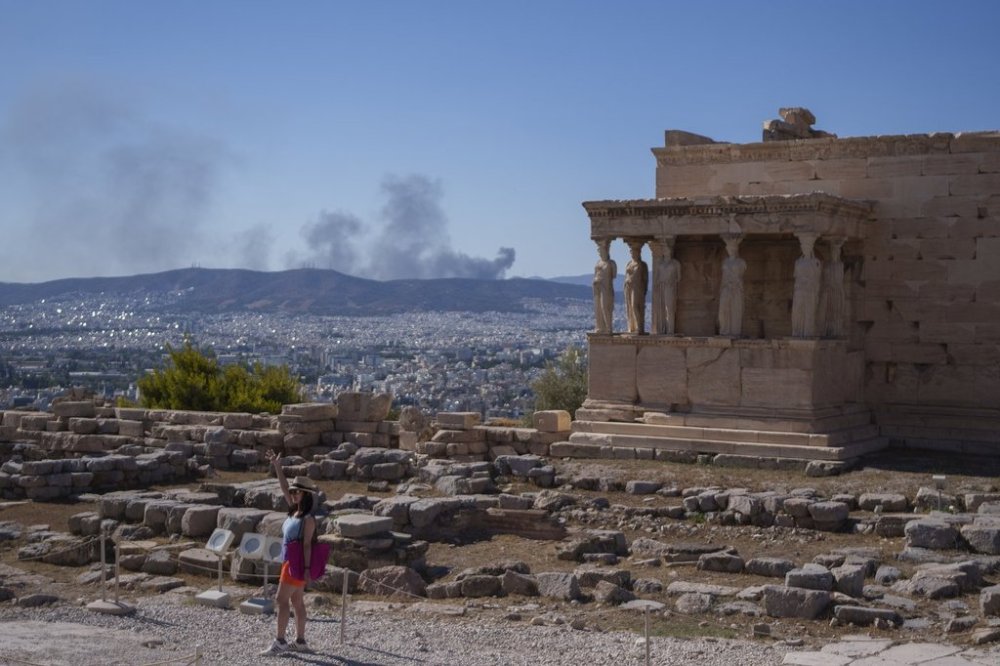
In antiquity, lead was released into the atmosphere as a byproduct of smelting ore for copper and silver. The toxic metal later condensed as dust and settled onto the soil.
“Silver was used for jewelry, for special objects — but it wasn’t found in a pure state,” but mined in ore combined with lead, said Heidelberg University archaeologist Joseph Maran, co-author of a new study published Thursday in Communications Earth and Environment.
The site with the earliest signs of lead contamination is located in northeastern Greece, near the island of Thasos. Prior archaeological evidence suggests Thasos was one of the region’s most significant sites for silver mining and metalwork, said Maran.
“Lead released from smelting is the world’s first form of toxic or industrial pollution,” said Yale historian Joseph Manning, who was not involved in the study.
The researchers found that levels of lead contamination remained fairly low and localized in ancient Greece, considered the cradle of European civilization, throughout the Bronze Age, the Classical period and the Hellenistic period. The Classical period is famous for Athenian democracy, Socrates and Plato, and the Hellenistic period saw Greek cultural influence peak across the Mediterranean region.
But around 2,150 years ago, the researchers detected “a very strong and abrupt increase” in lead emissions caused by human activities across Greece, said co-author Andreas Koutsodendris at Heidelberg University.
Around that time, in 146 B.C., the Roman army conquered the Greek peninsula, transforming the region’s society and economy. As Roman trade, colonies and shipping expanded across the Mediterranean Sea and Black Sea, demand for silver coins grew rapidly, requiring smelting that released lead, said Koutsodendris.
Later the Roman Empire used lead for tableware and for construction, including pipes.
Previous research – including an analysis of ice cores from Greenland – had detected high levels of lead across much of the Northern Hemisphere during Roman times.
But the new study adds a more “specific and local picture to how lead levels changed,” said Nathan Chellman, an environmental scientist at the University of Nevada, Reno, who was not involved in the research.
___
The Associated Press Health and Science Department receives support from the Howard Hughes Medical Institute’s Science and Educational Media Group and the Robert Wood Johnson Foundation. The AP is solely responsible for all content.