JD Vance rails against ‘excessive’ AI regulation in a rebuke to Europe at the Paris AI summit
Advertisement
Read this article for free:
or
Already have an account? Log in here »
To continue reading, please subscribe:

Digital Subscription
One year of digital access for only $205*
- Enjoy unlimited reading on winnipegfreepress.com
- Read the E-Edition, our digital replica newspaper
- Access News Break, our award-winning app
- Play interactive puzzles
*First annual payment billed as $205.00 + GST for one year. This annual subscription will automatically renew at $233.00 + GST every 52 weeks (10% off the regular annual price of $259.35). Offer available to new and qualified returning subscribers only. Cancel any time.
To continue reading, please subscribe:
Add Free Press access to your Brandon Sun subscription for only an additional
$1 for the first 4 weeks*
- Enjoy unlimited reading on winnipegfreepress.com
- Read the E-Edition, our digital replica newspaper
- Access News Break, our award-winning app
- Play interactive puzzles
*Your next Brandon Sun subscription payment will increase by $1.00 and you will be charged $17.95 plus GST for four weeks. After four weeks, your payment will increase to $24.95 plus GST every four weeks.
Read unlimited articles for free today:
or
Already have an account? Log in here »
Hey there, time traveller!
This article was published 11/02/2025 (590 days ago), so information in it may no longer be current.
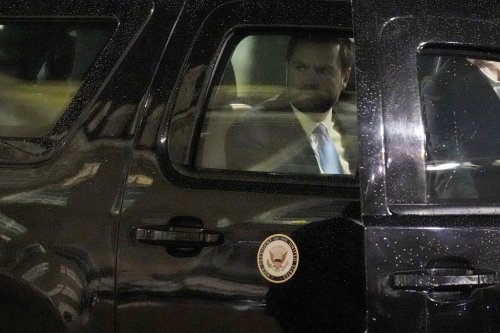
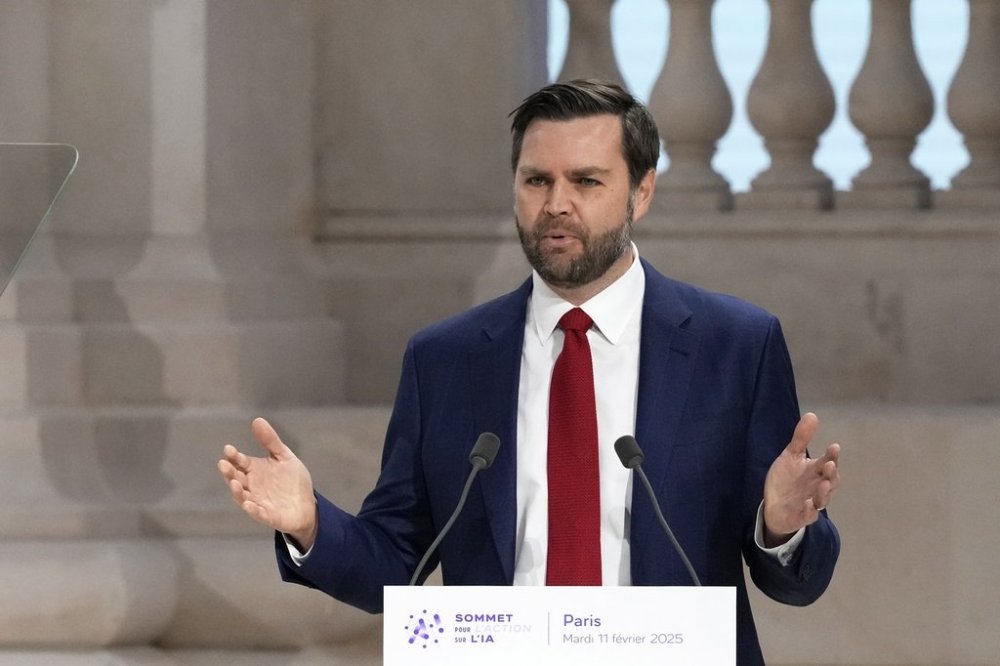
PARIS (AP) — U.S. Vice President JD Vance on Tuesday warned global leaders and tech industry executives that “excessive regulation” could cripple the rapidly growing artificial intelligence industry in a rebuke to European efforts to curb AI’s risks.
The speech underscored a widening, three-way rift over the future of the technology — one that critics warn could either cement human progress for generations or set the stage for its downfall.
The United States, under President Donald Trump, champions a hands-off approach to fuel innovation, while Europe is tightening the reins with strict regulations to ensure safety and accountability. Meanwhile, China is rapidly expanding AI through state-backed tech giants, vying for dominance in the global race.
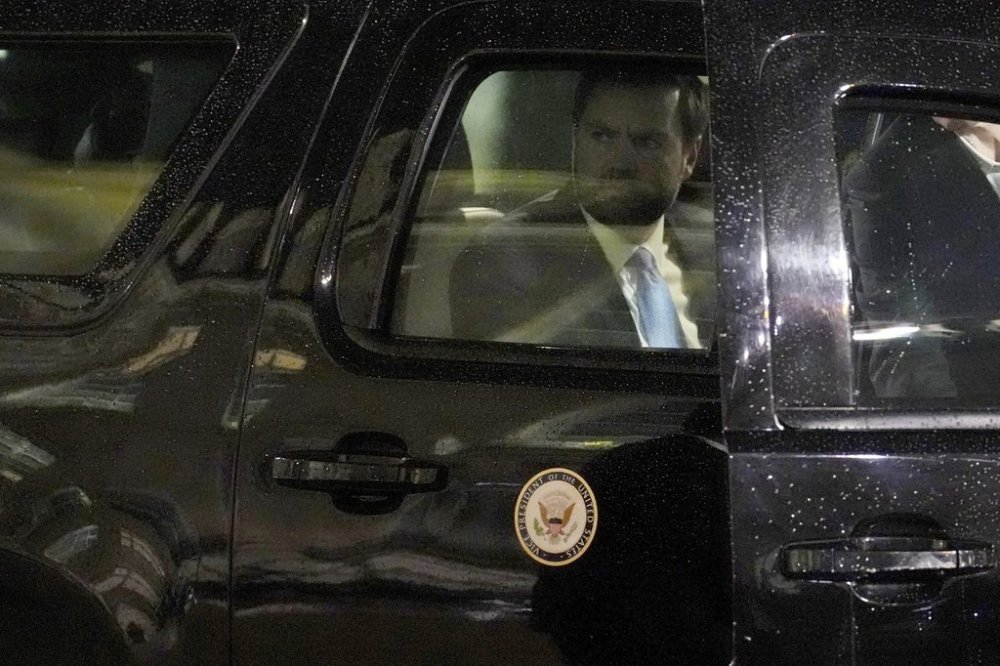
The U.S. was noticeably absent from an international document signed by more than 60 nations, including China, making the Trump administration an outlier in a global pledge to promote responsible AI development. The United Kingdom also declined to sign the pledge.
Vance’s debut
At the summit, Vance made his first major policy speech since becoming vice president last month, framing AI as an economic turning point but cautioning that “at this moment, we face the extraordinary prospect of a new industrial revolution, one on par with the invention of the steam engine.”
“But it will never come to pass if overregulation deters innovators from taking the risks necessary to advance the ball,” Vance added.
The 40-year-old vice president, leveraging the AI summit and a security conference in Munich later this week, is seeking to project Trump’s forceful new style of diplomacy.
The Trump administration will “ensure that AI systems developed in America are free from ideological bias,” Vance said and pledged the U.S. would “never restrict our citizens’ right to free speech.”
A global AI pledge—and the U.S. absence
The international document, signed by scores of countries, including European nations, pledged to “promote AI accessibility to reduce digital divides” and “ensure AI is open, inclusive, transparent, ethical, safe, secure, and trustworthy.” It also called for “making AI sustainable for people and the planet” and protecting “human rights, gender equality, linguistic diversity, consumer rights, and intellectual property.”
In a surprise move, China — long criticized for its human rights record — signed the declaration, further widening the distance between America and the rest in the tussle for AI supremacy.
The UK also declined to sign despite agreeing with much of the declaration because it “didn’t provide enough practical clarity on global governance,” said Tom Wells, a spokesman for Prime Minister Keir Starmer.
“We didn’t feel it sufficiently addressed broader questions around national security and the challenge that AI poses to it,” Wells said.
He insisted: “This is not about the U.S. This is about our own national interest, ensuring the balance between opportunity and security.”
A growing divide
Vance also took aim at foreign governments for “tightening the screws” on U.S. tech firms, saying such moves were troubling. His remarks underscored the growing divide between Washington and its European allies on AI governance.
The agreement comes as the EU enforces its AI Act, the world’s first comprehensive AI law, which took effect in August 2024.
European Commission President Ursula von der Leyen stressed that, “AI needs the confidence of the people and has to be safe″ and detailed EU guidelines intended to standardize the bloc’s AI Act but acknowledged concerns over regulatory burden.
“At the same time, I know that we have to make it easier and we have to cut red tape and we will,” she added.
She also announced that the “InvestAI” initiative had reached a total of €200 billion in AI investments across Europe, including €20 billion dedicated to AI gigafactories.
A race for AI dominance
The summit laid bare a global power struggle over AI—Europe wants strict rules and public funding, China is expanding state-backed AI, and the U.S. is going all-in on a free-market approach.
French President Emmanuel Macron pitched Europe as a “third way”—a middle ground that regulates AI without smothering innovation or relying too much on the U.S. or China.
“We want fair and open access to these innovations for the whole planet,” he said, calling for global AI rules. He also announced fresh investments across Europe to boost the region’s AI standing. “We’re in the race,” he declared.
China, meanwhile, is playing both sides: pushing for control at home while promoting open-source AI abroad.
Chinese Vice Premier Zhang Guoqing, speaking for President Xi Jinping, said Beijing wants to help set global AI rules. At the same time, Chinese officials slammed Western limits on AI access, and China’s DeepSeek chatbot has already triggered security concerns in the U.S. China argues open-source AI will benefit everyone, but critics see it as a way to spread Beijing’s influence.
With China and the U.S. in an AI arms race, Washington is also clashing with Europe.
Vance, a vocal critic of European tech rules, has floated the idea of the U.S. rethinking NATO commitments if Europe cracks down on Elon Musk’s social media platform, X. His Paris visit also included talks on Ukraine, AI’s growing role in global power shifts, and U.S.-China tensions.
How to regulate AI?
Concerns over AI’s potential dangers have loomed over the summit, particularly as nations grapple with how to regulate a technology that is increasingly entwined with defense and warfare.
“I think one day we will have to find ways to control AI or else we will lose control of everything,” said Admiral Pierre Vandier, NATO’s commander who oversees the alliance’s modernization efforts.
Beyond diplomatic tensions, a global public-private partnership is being launched called “Current AI,” aimed at supporting large-scale AI initiatives for the public good.
Analysts see this as an opportunity to counterbalance the dominance of private companies in AI development. However, it remains unclear whether the U.S. will support such efforts.
Separately, a high-stakes battle over AI power is escalating in the private sector.
A group of investors led by Musk — who now heads Trump’s Department of Government Efficiency — has made a $97.4 billion bid to acquire the nonprofit behind OpenAI. OpenAI CEO Sam Altman, attending the Paris summit, said it is “not for sale.”
Pressed on AI regulation, Altman also dismissed the need for further restrictions in Europe. But the head of San Francisco-based Anthropic, an OpenAI competitor, described the summit as a “missed opportunity” to more fully address the urgent global challenges posed by the technology.
“The need for democracies to keep the lead, the risks of AI, and the economic transitions that are fast approaching — these should all be central features of the next summit,” said Anthropic CEO Dario Amodei in a written statement.
___
Associated Press writers Sylvie Corbet and Kelvin Chan in Paris contributed to this report.