Ancient humans made tools from animal bones 1.5 million years ago

Advertisement

Advertise with us

WASHINGTON (AP) — Early humans were regularly using animal bones to make cutting tools 1.5 million years ago.

Read this article for free:


or

Already have an account? Log in here »

To continue reading, please subscribe:

Subscribe and receive a limited-edition Free Press branded hat or tote.

Digital Subscription

One year of digital access for only $205*

  • Enjoy unlimited reading on winnipegfreepress.com
  • Read the E-Edition, our digital replica newspaper
  • Access News Break, our award-winning app
  • Play interactive puzzles

*First annual payment billed as $205.00 + GST for one year. This annual subscription will automatically renew at $233.00 + GST every 52 weeks (10% off the regular annual price of $259.35). Offer available to new and qualified returning subscribers only. Cancel any time.

To continue reading, please subscribe:

Add Free Press access to your Brandon Sun subscription for only an additional

$1 for the first 4 weeks*

  • Enjoy unlimited reading on winnipegfreepress.com
  • Read the E-Edition, our digital replica newspaper
  • Access News Break, our award-winning app
  • Play interactive puzzles
Start now

*Your next Brandon Sun subscription payment will increase by $1.00 and you will be charged $17.95 plus GST for four weeks. After four weeks, your payment will increase to $24.95 plus GST every four weeks.

Hey there, time traveller!
This article was published 05/03/2025 (528 days ago), so information in it may no longer be current.

WASHINGTON (AP) — Early humans were regularly using animal bones to make cutting tools 1.5 million years ago.

A newly discovered cache of 27 carved and sharpened bones from elephants and hippos found in Tanzania’s Olduvai Gorge site pushes back the date for ancient bone tool use by around 1 million years. Researchers know that early people made simple tools from stones as early as 3.3 million years ago.

The new discovery, published Wednesday in Nature, reveals that ancient humans “had rather more complex tool kits than previously we thought,” incorporating a variety of materials, said William Harcourt-Smith, a paleoanthropologist at the American Museum of Natural History, who was not involved in the research.
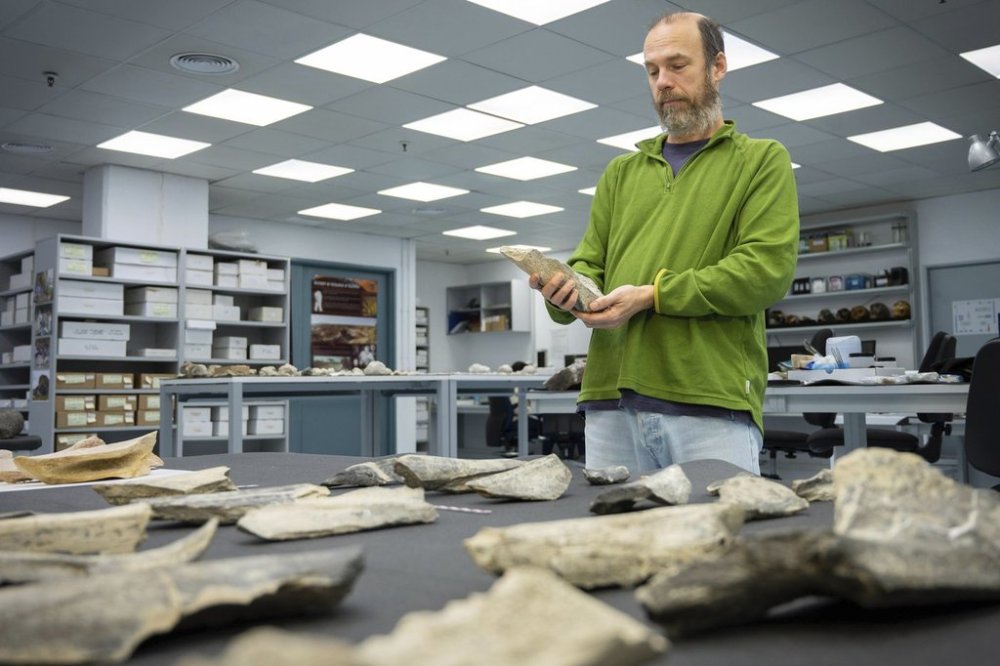
In this photo provided by the Spanish National Research Council (CSIC), researcher Ignacio de la Torre holds a bone tool found in Tanzania's Olduvai Gorge, at the CSIC-Pleistocene Archaeology Lab in Madrid in 2023. (Angeliki Theodoropoulou/CSIC via AP)

The well-preserved bone tools, measuring up to around 16 inches (40 centimeters), were likely made by breaking off the thick ends of leg bones and using a stone to knock off flakes from the remaining bone shaft. This technique was used to create one sharpened edge and one pointed tip, said study co-author Ignacio de la Torre, a researcher at the Spanish National Research Council.

The bone tools were “probably used as a hand axe” – a handheld blade that’s not mounted on a stick – for butchering dead animals, he said.

Such a blade would be handy for removing meat from elephant and hippo carcasses, but not used as a spear or projectile point. “We don’t believe they were hunting these animals. They were probably scavenging,” he said.

Some of the artifacts show signs of having been struck to remove flakes more than a dozen times, revealing persistent craftsmanship.

The uniform selection of the bones – large and heavy leg bones from specific animals – and the consistent pattern of alteration makes it clear that early humans deliberately chose and carved these bones, said Mírian Pacheco, a paleobiologist at the Federal University of Sao Carlos in Brazil, who was not involved in the study.

The bones show minimal signs of erosion, trampling or gnawing by other animals — ruling out the possibility that natural causes resulted in the tool shapes, she added.

The bone tools date from more than a million years before our species, Homo sapiens, arose around 300,000 years ago.

At the time the tools were made, three different species of human ancestors lived in the same region of East Africa, said Briana Pobiner, a paleoanthropologist at the Smithsonian’s Human Origins Program, who was not involved in the study.

The tools may have been made and used by Homo erectus, Homo habilis or Paranthropus boisei. “It could have been any of these three, but it’s almost impossible to know which one,” said Pobiner.

___

The Associated Press Health and Science Department receives support from the Howard Hughes Medical Institute’s Science and Educational Media Group and the Robert Wood Johnson Foundation. The AP is solely responsible for all content.

Report Error Submit a Tip

More Stories

Icy relationship with U.S. beginning to thaw at border, data shows; American visits to Manitoba hit five-year high

Nicole Buffie 5 minute read Preview

Icy relationship with U.S. beginning to thaw at border, data shows; American visits to Manitoba hit five-year high

Nicole Buffie 5 minute read Yesterday at 5:32 PM CDT

As Canadians begin to lower their elbows and start to cross the U.S. border again, Americans are coming to Manitoba in numbers not seen in years.

Read
Yesterday at 5:32 PM CDT

Ancient humans made tools from animal bones 1.5 million years ago

Christina Larson, The Associated Press 3 minute read Preview

Ancient humans made tools from animal bones 1.5 million years ago

Christina Larson, The Associated Press 3 minute read Wednesday, Mar. 5, 2025

WASHINGTON (AP) — Early humans were regularly using animal bones to make cutting tools 1.5 million years ago.

A newly discovered cache of 27 carved and sharpened bones from elephants and hippos found in Tanzania's Olduvai Gorge site pushes back the date for ancient bone tool use by around 1 million years. Researchers know that early people made simple tools from stones as early as 3.3 million years ago.

The new discovery, published Wednesday in Nature, reveals that ancient humans “had rather more complex tool kits than previously we thought,” incorporating a variety of materials, said William Harcourt-Smith, a paleoanthropologist at the American Museum of Natural History, who was not involved in the research.

The well-preserved bone tools, measuring up to around 16 inches (40 centimeters), were likely made by breaking off the thick ends of leg bones and using a stone to knock off flakes from the remaining bone shaft. This technique was used to create one sharpened edge and one pointed tip, said study co-author Ignacio de la Torre, a researcher at the Spanish National Research Council.

Read
Wednesday, Mar. 5, 2025

Safety upgrades at Whiteshell park to begin soon

Free Press staff 2 minute read Preview

Safety upgrades at Whiteshell park to begin soon

Free Press staff 2 minute read 7:06 PM CDT

Construction on safety improvements at a site where two boys drowned in Whiteshell Provincial Park will soon get underway.

The improvements, which include new barriers and fenced lookouts, signage and a new portage for kayakers and canoeists at Sturgeon Falls, was promised by the province after the deaths of brothers Maximo Au Ramirez, 10, and Aaron Au Ramirez, 13, who went missing in Nutimik Lake on July 18.

The province said in a news release Friday the upgrades would begin shortly.

“We have a responsibility to do everything we can to make this site safer and to prevent another family from going through this kind of heartbreak,” said Environment Minister Mike Moyes in the release. “These measures will make the Sturgeon Falls area safer and ensure that Manitobans and visitors are protected when the area reopens.”

Read
7:06 PM CDT

Foster mom pleads guilty to assault that left six-year-old-girl paralyzed

Dean Pritchard 4 minute read Preview

Foster mom pleads guilty to assault that left six-year-old-girl paralyzed

Dean Pritchard 4 minute read Updated: 6:27 PM CDT

A Winnipeg foster mother has admitted to violently assaulting her ill foster daughter and leaving her paralyzed after the girl resisted the woman’s efforts to provide her with medication, a court has heard.

Marilyn Keno, 26, pleaded guilty Friday to one count of aggravated assault.

Keno remains in custody and will be sentenced at a later date following the completion of a court-ordered pre-sentence report.

The maximum sentence for aggravated assault is 14 years in prison. Crown attorney Alanna Littman and defence lawyer Jeremy Kostiuk did not disclose what sentences they will be recommending.

Read
Updated: 6:27 PM CDT

Three security guards charged with assault after Sea Bears star injured outside nightclub

Nicole Buffie 3 minute read Preview

Three security guards charged with assault after Sea Bears star injured outside nightclub

Nicole Buffie 3 minute read Updated: Yesterday at 12:50 PM CDT

Three security guards are facing assault charges, accused of injuring a Winnipeg Sea Bears player at a nightclub earlier this month.

Read
Updated: Yesterday at 12:50 PM CDT

Around the NSL: Quarterfinal upset; Wild win; Rapid still human

Grace Anne Paizen 5 minute read Preview

Around the NSL: Quarterfinal upset; Wild win; Rapid still human

Grace Anne Paizen 5 minute read 7:50 PM CDT

Oh, the drama in the week that was.

The quarterfinals of the inaugural W Canadian Championship have been a wild ride since the Calgary Wild shut out CS Mont-Royal Outremont 4-0 on Aug. 5. The development this week? The NSL’s second-best team dropped a 1-0 decision to semi-pro Simcoe County Rovers FC on Wednesday in front of a hometown crowd at Stade Boréale.

Club backlash over the loss has been swift as the Montreal Roses promptly fired manager Robert Rositoui on Thursday. First assistant coach Maryse Bard-Martel has been placed as the interim bench boss until a new head coach is hired.

Rositoui was the club’s inaugural head coach, who led the Roses to a semifinal berth in Montreal’s inaugural season. It’s a shock that after a loss in a knockout tournament would amount to his firing — but the club claims a “new spark” is needed.

Read
7:50 PM CDT