Newfoundland history has lessons for ‘imperialist’ Trump regime: Furey
Advertisement
Read this article for free:
or
Already have an account? Log in here »
To continue reading, please subscribe:

Digital Subscription
One year of digital access for only $205*
- Enjoy unlimited reading on winnipegfreepress.com
- Read the E-Edition, our digital replica newspaper
- Access News Break, our award-winning app
- Play interactive puzzles
*First annual payment billed as $205.00 + GST for one year. This annual subscription will automatically renew at $233.00 + GST every 52 weeks (10% off the regular annual price of $259.35). Offer available to new and qualified returning subscribers only. Cancel any time.
To continue reading, please subscribe:
Add Free Press access to your Brandon Sun subscription for only an additional
$1 for the first 4 weeks*
- Enjoy unlimited reading on winnipegfreepress.com
- Read the E-Edition, our digital replica newspaper
- Access News Break, our award-winning app
- Play interactive puzzles
*Your next Brandon Sun subscription payment will increase by $1.00 and you will be charged $17.95 plus GST for four weeks. After four weeks, your payment will increase to $24.95 plus GST every four weeks.
Read unlimited articles for free today:
or
Already have an account? Log in here »
Hey there, time traveller!
This article was published 06/03/2025 (581 days ago), so information in it may no longer be current.
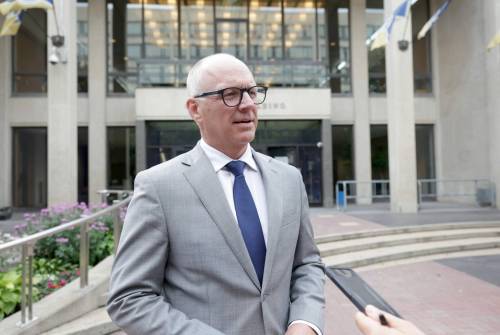
ST. JOHN’S, N.L. – The outgoing premier of Newfoundland and Labrador says he’s drawing on the province’s history as he urges Canadians not to underestimate U.S. President Donald Trump’s “imperialist” ambitions.
In a recent interview, Andrew Furey was clear: he says Trump is launching an attack on Canada by sowing economic chaos to create instability. And he warned that economic pressure can be just as effective as tanks and gunfire at eroding a nation’s independence and sovereignty.
“In Newfoundland and Labrador, we know that all too well,” the premier said. “It was the economic forces, not the military forces, that caused us to lose our independence and choose to join Canada.”

Trump has kept Canadians frustrated and bewildered for months, threatening punishing tariffs on Canadian goods and then changing his plan at the last minute. As of Thursday evening, he had imposed 25 per cent tariffs on most Canadian goods, but paused duties on some imports linked to the auto industry and lowered levies on potash to 10 per cent. Energy flowing from Canada to the U.S. was subject to 10 per cent duties.
Meanwhile, Trump regularly calls the Canadian prime minister “Governor Justin Trudeau,” and has threatened to use “economic force” to make Canada the 51st state.
“He has shown by his threats that he has an expansive agenda, a territorial agenda, and that feeds an imperialist approach,” Furey said.
Jeff Webb, a history professor at Memorial University, agrees that dire economic circumstances influenced Newfoundlanders when they voted to become a Canadian province in 1949. But they didn’t do it under force, he said in a recent interview.
Newfoundland was a self-governing dominion of the British Empire until 1933, when Canada and Britain stepped in to help bail the region out of financial hardship. The Great Depression hit Newfoundland hard, and the dominion had accrued a large debt sending soldiers to fight in the First World War.
As a condition of the bailout, Newfoundland gave up self-governance, and instead agreed to be ruled by a commission appointed by the British government, according to Memorial University’s Newfoundland and Labrador Heritage website.
By the 1940s, Britain and Canada thought it would be best for Newfoundland to join Canada, but they didn’t force it, Webb said. When 52 per cent of Newfoundlanders voted in 1949 to join Canada rather than return to self-government, many hoped Confederation would bring financial stability and help them avoid the destitution that plagued the region under its own government, he said.
“We didn’t get arm-twisted into this,” Webb said about Newfoundland’s Confederation with Canada. “It’s incredibly different from what we’re getting now. And what we’re getting now is crazy, nonsensical bullying.”
“Part of the craziness of this is that there are no sensible parallels,” he said of Trump’s behaviour toward his northern neighbour.
Historian Sean Cadigan noted that some of Newfoundland’s hardship before it joined Canada were a result of the Trump-like tariffs it imposed on foreign manufacturers. It was already costly to make things in Newfoundland — an island in the North Atlantic Ocean — and the taxes just made everything expensive, he said. The cost of living became unbearable, particularly in rural Newfoundland.
“The lessons that I’ve learned from protectionism, is that it just hurts a lot of people, especially rural people,” the Memorial University professor said. “Tariffs create tremendous social and economic divisions. They create winners and losers, and the stress among the losers can be terrible.”
The United States under Trump is absolutely “acting in an imperial manner,” said Blayne Haggart, an associate political science professor at Brock University. And he agrees with Furey: Canada needs to take it seriously.
“I think we’re taking the threat of the tariffs seriously,” Haggart said in an interview. “But what comes next? … I don’t know yet if Canadians, and particularly our political leaders, fully understand what it means to chart a separate course from the United States.”

That will involve costly measures such as strengthening the Canadian military, relying less on the United States for regulatory approvals for drugs and manufacturing, and even strengthening weather forecasting systems as Elon Musk’s Department of Government Efficiency fires workers at the National Oceanic and Atmospheric Administration.
But instead of having a government digging into those discussions, Canada has an outgoing prime minister and an upcoming federal election, Haggart said.
“I’m 52 years old. This is the worst crisis that Canada has faced in my lifetime,” he said. “It’s been disappointing to me that the federal leadership vacuum was allowed to persist for so long … I understand the reasons for it but it’s still incredibly concerning.”
This report by The Canadian Press was first published March 6, 2025.
— With files from The Associated Press