Universities are facing big cuts to research funding. At Duke, it’s a time for ‘damage control’
Advertisement
Read this article for free:
or
Already have an account? Log in here »
To continue reading, please subscribe:

Digital Subscription
One year of digital access for only $205*
- Enjoy unlimited reading on winnipegfreepress.com
- Read the E-Edition, our digital replica newspaper
- Access News Break, our award-winning app
- Play interactive puzzles
*First annual payment billed as $205.00 + GST for one year. This annual subscription will automatically renew at $233.00 + GST every 52 weeks (10% off the regular annual price of $259.35). Offer available to new and qualified returning subscribers only. Cancel any time.
To continue reading, please subscribe:
Add Free Press access to your Brandon Sun subscription for only an additional
$1 for the first 4 weeks*
- Enjoy unlimited reading on winnipegfreepress.com
- Read the E-Edition, our digital replica newspaper
- Access News Break, our award-winning app
- Play interactive puzzles
*Your next Brandon Sun subscription payment will increase by $1.00 and you will be charged $17.95 plus GST for four weeks. After four weeks, your payment will increase to $24.95 plus GST every four weeks.
Read unlimited articles for free today:
or
Already have an account? Log in here »
Hey there, time traveller!
This article was published 07/03/2025 (572 days ago), so information in it may no longer be current.
DURHAM, N.C. (AP) — Facing the potential loss of hundreds of millions of dollars in federal funding, Duke University is preparing for the worst.
Like research universities around the United States, the private school in North Carolina’s Research Triangle would see a massive loss from Trump administration cuts to grants from the National Institutes of Health.
Duke would be among the hardest hit. In its previous fiscal year, Duke took in $580 million in NIH grants and contracts, 11th most among the country’s research institutions. The cuts are delayed temporarily by a court challenge, but universities nationwide have implemented hiring freezes, scaled back research and drawn up contingency plans in case the loss in funding takes effect.
Historically, the federal government has negotiated with colleges and universities on its contribution toward their operating costs. If a scientist wins a federal grant to fund their research, the government pays the school an additional amount as a percentage of the grant money.
At Duke, the current rate for these “indirect costs” — expenses such as utilities and laboratory maintenance — is about 61%. Last month, President Donald Trump’s administration set the rate cap at 15%, significantly less than most universities receive.
The cut in indirect costs is far from the only concern. Funding for new grants also slowed to a trickle after the NIH halted grant application review meetings in January. At Duke, NIH grant and contract award notices plummeted, dropping from 166 in January and February of 2024 to 64 so far in 2025, according to the university.
Already, the uncertainty is causing reverberations at Duke’s School of Medicine, which receives over three-quarters of the university’s NIH funding. Expansion projects are being shelved. Fewer Ph.D. students are being admitted. And researchers are assessing whether their projects can continue.
Payments maintain freezers and machines to grow cancer cells
The Trump administration has described indirect costs as “administrative bloat” and said the cuts would save more than $4 billion annually. The change would also free up more money for scientific research, officials said.
“The Trump administration is committed to slashing the cottage industry built off of the waste, fraud, and abuse within our mammoth government while prioritizing the needs of everyday Americans,” White House spokesperson Kush Desai said.
Through NIH funding, universities for decades have partnered with the federal government to support scientists’ academic pursuits.
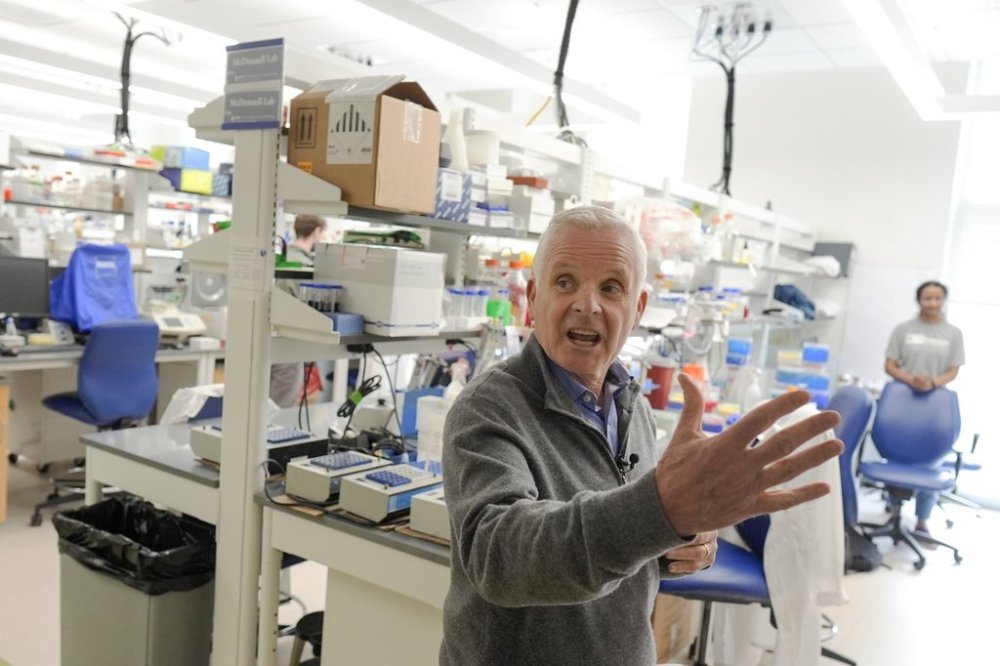
Duke pharmacology and cancer biology professor Donald McDonnell estimates his laboratory has received up to $40 million in NIH funding over 30 years. His lab developed a drug approved in 2023 by the U.S. Food and Drug Administration to treat metastatic breast cancer.
Upkeep for lab equipment, including machines to grow cancer cells and massive freezers for enzymes and chemicals, would be difficult to afford if indirect cost rates dropped to 15%, McDonnell said. His laboratory also likely will be in the red due to the uncertainty around NIH grants, which would lead to staff layoffs.
“The bottom line is, I can’t live, I can’t think in this chaos,” McDonnell said.
Duke’s total research budget last fiscal year was $1.33 billion, with $863 million coming from the federal government. Without NIH funding, many scientists would have to turn to private organizations and philanthropies, which typically offer substantially less money, researchers said.
“We have long-standing relationships with private funders and industry partners, and value the contributions they make, but federal funds by far provide the largest single source of research dollars,” said Geeta Swamy, executive vice dean of the School of Medicine.
The cap on indirect costs also would hinder research for incoming neurosurgery and biomedical engineering professor Nanthia Suthana, who is relocating from the University of California, Los Angeles.
To study brain activity and treat conditions like post-traumatic stress disorder and Parkinson’s disease, Suthana requires a lab large enough for patients to walk around while headsets and monitors capture heart rate, eye tracking, perspiration and brainwaves. Along the walls, 40 to 50 cameras — each costing about $5,000 — record their movements.
Her new lab is under construction, but Suthana said she is worried she will have to downsize within a year if funding uncertainties persist.
Ph.D. students are in limbo
Duke’s medical school has scaled back the number of Ph.D. students it will admit for the upcoming fall semester. Last year, the school brought in about 130 students, said Beth Sullivan, who oversees the school’s 17 biomedical Ph.D. programs. Now, the target is 100 students or less.
That means smaller class sizes over time and, in turn, a shrinking pipeline into medical research careers, she said.
“Our next generation of researchers are now poised on the edge of this cliff, not knowing if there’s going to be a bridge that’s going to get them to the other side, or if this is it,” Sullivan said.
Of the more than 630 Ph.D. students in the medical school, nearly all the students in their second year and beyond receive federal support from either NIH or the National Science Foundation.
Third-year doctoral student Caleb McIver was applying for an NIH diversity supplement — a funding opportunity to encourage professors to train minority students — when information about the initiative was removed from the agency’s website. McIver, who is Black, is now looking into other NIH grants without ties to diversity, equity and inclusion initiatives, which the Trump administration has been wiping out of the federal government.
“I’m pretty stressed,” McIver said. “I mean, I need funding, so we need to find it.”
Duke reconsiders plans for new research building
The university had been planning to build a new research building on the site of an old, recently vacated building. Now those plans are on hold, School of Medicine Vice Dean Colin Duckett said.

Even smaller projects like renovating a building floor can’t start because of the budget uncertainty. Hundreds of people working in shuttered labs will consolidate in other buildings. If the indirect costs rate drops to 15%, there also would be widespread layoffs, Duckett said.
Duckett’s job previously focused on recruiting the brightest scientists and providing them with resources at Duke, he said. Now, he has taken on a much different role.
“It’s damage control,” he said. “It’s how to survive as an institution.”
___
The Associated Press’ education coverage receives financial support from multiple private foundations. AP is solely responsible for all content. Find AP’s standards for working with philanthropies, a list of supporters and funded coverage areas at AP.org.