A 10% drop for stocks is scary, but isn’t that rare
Advertisement
Read this article for free:
or
Already have an account? Log in here »
To continue reading, please subscribe:

Digital Subscription
One year of digital access for only $205*
- Enjoy unlimited reading on winnipegfreepress.com
- Read the E-Edition, our digital replica newspaper
- Access News Break, our award-winning app
- Play interactive puzzles
*First annual payment billed as $205.00 + GST for one year. This annual subscription will automatically renew at $233.00 + GST every 52 weeks (10% off the regular annual price of $259.35). Offer available to new and qualified returning subscribers only. Cancel any time.
To continue reading, please subscribe:
Add Free Press access to your Brandon Sun subscription for only an additional
$1 for the first 4 weeks*
- Enjoy unlimited reading on winnipegfreepress.com
- Read the E-Edition, our digital replica newspaper
- Access News Break, our award-winning app
- Play interactive puzzles
*Your next Brandon Sun subscription payment will increase by $1.00 and you will be charged $17.95 plus GST for four weeks. After four weeks, your payment will increase to $24.95 plus GST every four weeks.
Read unlimited articles for free today:
or
Already have an account? Log in here »
Hey there, time traveller!
This article was published 13/03/2025 (542 days ago), so information in it may no longer be current.
NEW YORK (AP) — The U.S. stock market has just dropped 10% from its high set last month, hurt by worries about the economy and a global trade war.
T he fall for the S&P 500 is steep enough that Wall Street has a name for it: a “correction.” Such drops have happened regularly for more than a century, and market pros often view them as potentially healthy wipeouts of overdone euphoria, which could send stock prices too high if unchecked.
But corrections are frightening in the moment, particularly for every new generation of investors that gets into the market at a time when it seems like stocks only go up.
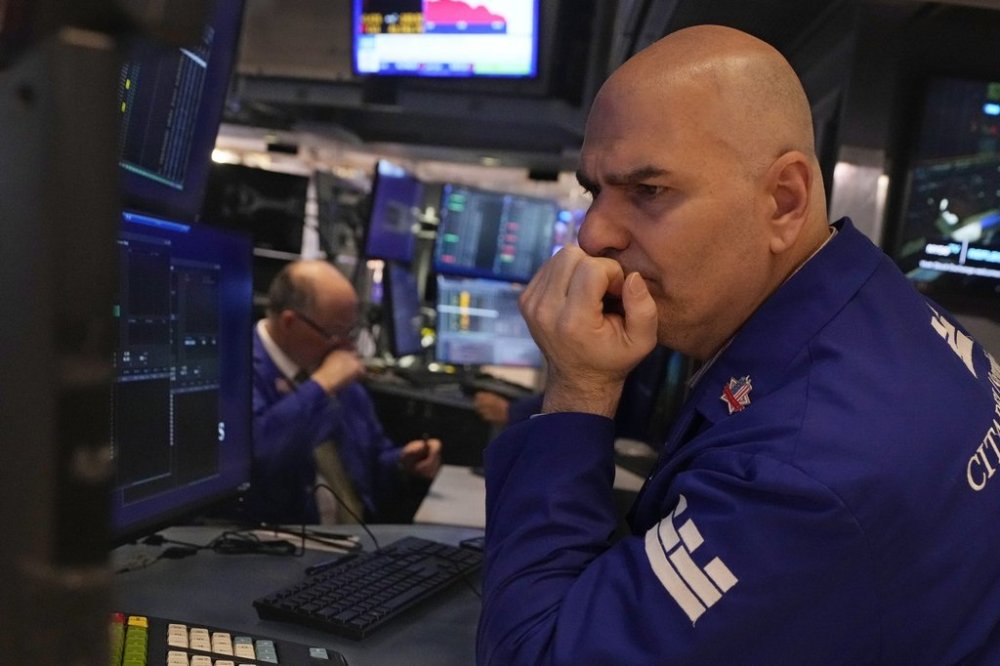
The S&P 500 is coming off two straight years with gains of more than 20%. Such stellar gains left the market looking too expensive to critics, who pointed to how prices rose faster than corporate profits.
Culling too-high enthusiasm among day traders is one thing. The larger fear always accompanying a correction is that it could be a warning sign of a coming “bear market,” which is what Wall Street calls a drop of at least 20%.
Here’s a look at what history shows about past corrections, and what market watchers are expecting going forward.
What’s behind this correction?
The U.S. stock market initially jumped after President Donald Trump’s election in November on hopes he’d bring lower taxes, less regulation for businesses and other policies that would drive corporate profits higher. All those gains have since disappeared, as Wall Street faces the potential downsides of Trump’s White House for the economy.
The president has been making announcements on tariffs at a dizzying pace, first placing them on trading partners, then exempting some and then doing it all over again. The tariffs could hit every country that trades with the United States, which would raise prices for U.S. households and businesses when high inflation has already proven stubborn to fully subdue.
The fear is that tariffs could slow or even halt the solid growth the U.S. economy was showing when it ended 2024. Even if Trump ultimately goes forward with less painful tariffs, all the uncertainty around the will-he-or-won’t-he rollout could prove damaging by freezing economic activity. Such concerns have shown up in the latest readings on consumer confidence, as well as companies’ forecasts for future profits.
Trump himself has acknowledged his plans could affect the U.S. economy’s growth.
All the uncertainty is also making things more complicated for the Federal Reserve, which had been cutting interest rates after getting inflation nearly all the way down to its 2% target. Cutting rates further would help the economy, but it could also put upward pressure on inflation.
The brunt of this sell-off has also hit stocks that critics were saying looked the most expensive after running wild through the frenzy around artificial intelligence. Nvidia, for example, has already dropped roughly 14% in 2025 so far after surging more than 800% through 2023 and 2024.
Most of the other big stocks in the “Magnificent Seven” that have dominated the market recently have also been lagging the rest of the S&P 500. Those seven stocks alone had accounted for more than half the S&P 500’s total return last year.
How often do corrections occur?
Every couple years, on average. Even during the historic, nearly 11-year-long bull run for U.S. stocks from March 2009 to February 2020, the S&P 500 stumbled to five corrections, according to CFRA. Worries about everything from interest rates to trade wars to a European debt crisis caused the pullbacks.
The U.S. market’s last correction was in 2023, when the S&P 500 dropped 10.3% from the end of July into October. At the time, high Treasury yields were undercutting stock prices as traders accepted a new normal where the Fed would keep rates high for a while. But stocks would quickly turn higher as optimism revived that cuts to rates were on the horizon.
The last correction that did graduate into a bear market was in 2022. That’s when the Fed first began cranking up interest rates to combat the worst inflation in generations. Worries rose that high rates would slow the economy enough to create a recession, one that ultimately never came.
Through the 2022 bear market, the S&P 500 fell 25.4% from Jan. 3 to Oct. 12.
What typically happens after a drop like this?
Looking only at corrections since 1946 that managed to right themselves before turning into a bear market, the S&P 500 has taken an average of 133 days to hit bottom and lost an average of nearly 14% along the way, according to CFRA. The index has taken an average of 113 days to recoup its losses.
For declines that become bear markets, the damage is much worse. Going back to 1929, the average bear market has taken an average of nearly 19 months to hit bottom and caused a loss of 38.5% for the S&P 500, according to S&P Dow Jones Indices.
How bad can a bear market be?
On paper, an investor can lose most of their money. From late 1929 into the middle of 1932, the stock market fell a little more than 86%, for example.
A bear market can also feel interminable: One lasted more than five years, from 1937 into 1942, where U.S. stocks lost 60%, according to S&P Dow Jones Indices.

In Japan, after the Nikkei 225 index set a record at the end of 1989, it sank and then took decades to fully recover. It wasn’t until 2024 that it got back to that peak.
The Japanese example is an outlier, though. In almost every case, investors would have made back all their losses from a downturn for U.S. stocks if they simply held on and didn’t sell. That includes the 2000 dot-com bust, the 2008 financial crisis and the 2020 coronavirus collapse.
What should we expect this time?
No one knows. Some investors on Wall Street say they expect Trump to pull back on some policies if they prove to be too damaging, while others say the uncertainty alone is creating enough pain.
The economy has given signals that it’s still relatively solid at the moment, including last month’s jobs report, but the outlook looks cloudier than usual given all the unknowns.
Related Articles
Wall Street tumbles 10% below its record for first 'correction' since 2023 on Trump's trade war
Advertisement Advertise With Us
Advertisement Advertise With Us