Young scientists see career pathways vanish as schools adapt to federal funding cuts
Advertisement
Read this article for free:
or
Already have an account? Log in here »
To continue reading, please subscribe:
Digital Subscription
One year of digital access for only $1.44 a week*
- Enjoy unlimited reading on winnipegfreepress.com
- Read the E-Edition, our digital replica newspaper
- Access News Break, our award-winning app
- Play interactive puzzles
*Billed as $5.77 plus GST every four weeks. After 52 weeks, price increases to the regular rate of $19.95 plus GST every four weeks. Offer available to new and qualified returning subscribers only. Cancel any time.
To continue reading, please subscribe:
Add Free Press access to your Brandon Sun subscription for only an additional
$1 for the first 4 weeks*
- Enjoy unlimited reading on winnipegfreepress.com
- Read the E-Edition, our digital replica newspaper
- Access News Break, our award-winning app
- Play interactive puzzles
*Your next Brandon Sun subscription payment will increase by $1.00 and you will be charged $17.95 plus GST for four weeks. After four weeks, your payment will increase to $24.95 plus GST every four weeks.
Read unlimited articles for free today:
or
Already have an account? Log in here »
Hey there, time traveller!
This article was published 15/03/2025 (584 days ago), so information in it may no longer be current.
As an infant, Connor Phillips was born three months premature with cerebral palsy. The science that saved his life was the inspiration that led to his role studying brain processes as a research fellow at the National Institutes of Health.
He had hopes of continuing his work at NIH through a partnership with Brown University, where he was invited to interview for a program that would lead to a doctorate in neuroscience. But training programs at the NIH have been suspended, a casualty of funding cuts by the Trump administration.
He is applying to other programs — and hoping policies putting strains on science might be reversed.

“You don’t take these jobs that pay worse and have insane hours and are really stressful unless you care about helping others and taking our love for science and translating that into something that can improve people’s lives,” Phillips said.
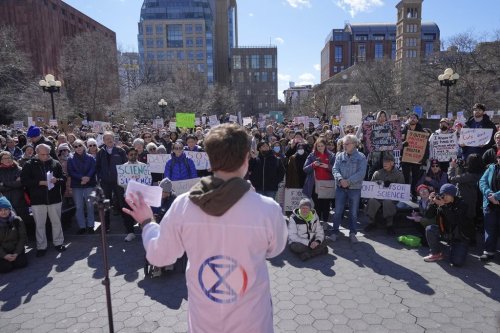
Reductions to federal support for research at universities and other institutions under President Donald Trump are dimming young scientists’ prospects, cutting off pathways to career-building projects and graduate programs.
Universities are cutting back offers of admission for graduate students due to the uncertainty. Many also are freezing hiring as the Trump administration threatens to take away federal money over their handling of a wide range of issues from antisemitism complaints to diversity, equity and inclusion initiatives.
Students are pivoting from carefully laid plans
Mira Polishook, a Duke University research technician, recently heard from one of the programs she applied to that “government decisions” had left it unable to offer her admission. She applied to the National Science Foundation’s Graduate Research Fellowship which would guarantee three years of graduate school funding, but lately NSF has been silent on timing for awards. She’s uncertain the agency will have funding at all.
“It’s beyond frustrating,” she said. “It’s made me feel like I am in limbo.”
Cuts to NIH funding have been delayed by a legal challenge from a group of 22 states plus organizations representing universities, hospitals and research institutions. But the uncertainty already has put some projects on hold as universities deal also with delays or cuts in grants from other agencies including USAID and NSF.
Admissions in some graduate programs have have been cut in half or paused altogether, said Emilya Ventriglia, president of UAW 2750, the union representing around 5,000 early career researchers at NIH facilities in Bethesda, Maryland, and elsewhere.
“At this rate, with the hiring freeze, there may be no Ph.D. students next year if it’s not lifted soon, because usually people make their decisions by April,” Ventriglia said.
Ventriglia’s research focuses on how the brain responds to anti-depressants. But now she is unable to continue recruiting another researcher she planned to mentor this spring. She said she also is worried that new purchasing restrictions, and firings of employees who processed those purchases, mean she will be unable to acquire reagents she needs for experiments.
“We’re expecting this to play out for generations,” said Levin Kim, the president of a union that represents 8,000 academic workers at the University of Washington.
The financial and emotional toll on those navigating the uncertainty is mounting.
“I love the work that I do. It’s all I want to do,” said Natalie Antenucci, a first-year graduate student at the University of North Carolina. Her work at a lab researching the ways social experiences can impact health is funded by an NIH grant. “I’m not in a financial position where I could continue to do it if there wasn’t funding available for this sort of work.”
Scholars see impact for the U.S. as a destination for researchers
Some American students are looking to institutions overseas.
Marleigh Hutchinson, who will graduate from Kansas State University in May with an undergraduate degree in environmental engineering, said getting hired in the U.S. as a graduate teaching assistant or researcher seems unlikely because of the uncertainty.
“I’ve always told people I do want to work in the international development space. I want to work on food security and water security issues,” she said, “and if that’s something that the United States is no longer going to value, then I would like to go somewhere else.”
Hutchinson was notified last month that funding was slashed to a USAID-funded lab where she was working. Its focus was making crops more resistant to drought in places like Africa as the world grows warmer.
At the University of Nebraska, an institute that works to improve water management for agriculture offered to host a doctoral candidate in hydrology from Ghana and was talking to three other international students. But it had to rescind the offer after it lost USAID funding, said Nicole Lefore, associate director of the school’s Daugherty Water for Food Global Institute.
She now worries about the diplomatic fallout, noting she has met with agriculture ministers in other countries who were educated at land grant universities in the U.S. through USAID programs.
“The university you go to, people have a loyalty to it. And so bringing in generations of students for education and agriculture in the U.S. helped to create those personal connections and then later scientific and diplomatic connections. That’s really important to the soft diplomacy side of what the innovation labs were doing.”
She said she is barraged with emails asking what this will mean.
“The only winner out of this is China, she said. ”Because the countries that are being cut off there, I think they will turn to someone.”
___
The Associated Press’ education coverage receives financial support from multiple private foundations. AP is solely responsible for all content. Find AP’s standards for working with philanthropies, a list of supporters and funded coverage areas at AP.org.