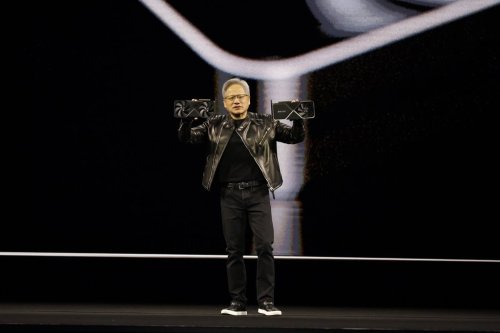
Nvidia CEO Jensen Huang unveils new Rubin AI chips at GTC 2025

Advertisement

Advertise with us

Nvidia founder Jensen Huang kicked off the company’s artificial intelligence developer conference on Tuesday by telling a crowd of thousands that AI is going through “an inflection point.”

Read this article for free:


or

Already have an account? Log in here »

To continue reading, please subscribe:

Subscribe and receive a limited-edition Free Press branded hat or tote.

Digital Subscription

One year of digital access for only $205*

  • Enjoy unlimited reading on winnipegfreepress.com
  • Read the E-Edition, our digital replica newspaper
  • Access News Break, our award-winning app
  • Play interactive puzzles

*First annual payment billed as $205.00 + GST for one year. This annual subscription will automatically renew at $233.00 + GST every 52 weeks (10% off the regular annual price of $259.35). Offer available to new and qualified returning subscribers only. Cancel any time.

To continue reading, please subscribe:

Add Free Press access to your Brandon Sun subscription for only an additional

$1 for the first 4 weeks*

  • Enjoy unlimited reading on winnipegfreepress.com
  • Read the E-Edition, our digital replica newspaper
  • Access News Break, our award-winning app
  • Play interactive puzzles
Start now

*Your next Brandon Sun subscription payment will increase by $1.00 and you will be charged $17.95 plus GST for four weeks. After four weeks, your payment will increase to $24.95 plus GST every four weeks.

Hey there, time traveller!
This article was published 18/03/2025 (539 days ago), so information in it may no longer be current.

Nvidia founder Jensen Huang kicked off the company’s artificial intelligence developer conference on Tuesday by telling a crowd of thousands that AI is going through “an inflection point.”

At GTC 2025 — dubbed the “Super Bowl of AI” — Huang focused his keynote on the company’s advancements in AI and his predictions for how the industry will move over the next few years. Demand for GPUs from the top four cloud service providers is surging, he said, adding that he expects Nvidia’s data center infrastructure revenue to hit $1 trillion by 2028.

Huang’s highly anticipated announcement revealed more details around Nvidia’s next-generation graphics architectures: Blackwell Ultra and Vera Rubin — named for the famous astronomer. Blackwell Ultra is slated for the second half of 2025, while its successor, the Rubin AI chip, is expected to launch in late 2026. Rubin Ultra will take the stage in 2027.
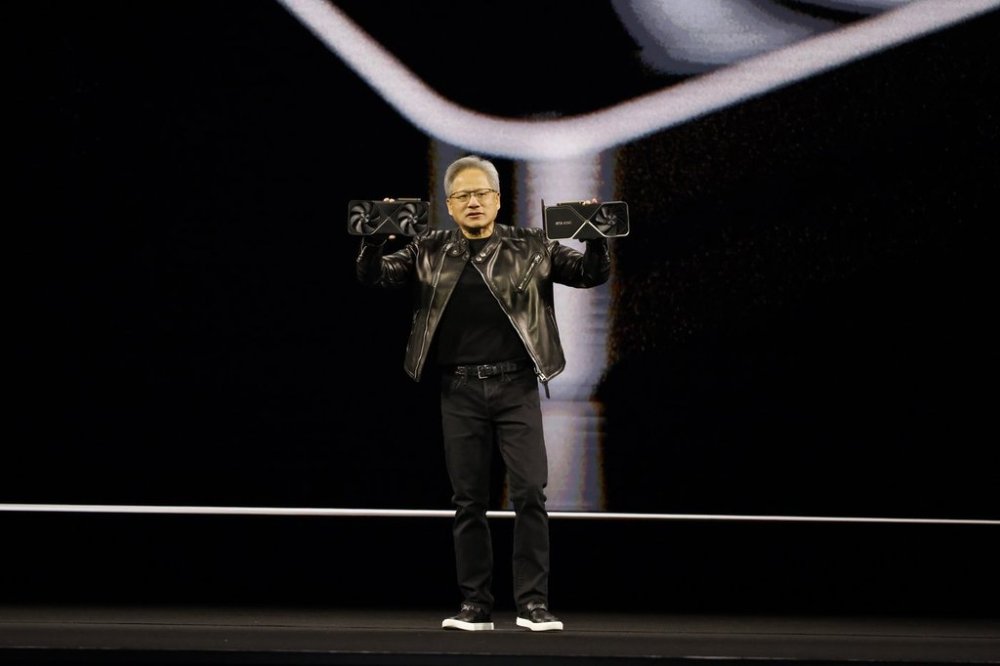
Nvidia CEO Jensen Huang speaks on stage during a keynote at the Nvidia GPU Technology Conference (GTC) in San Jose, Calif., Tuesday, March 18, 2025. (Stephen Lam /San Francisco Chronicle via AP)

In a talk that lasted at over two hours, Huang outlined the “extraordinary progress” that AI has made. In 10 years, he said, AI graduated from perception and “computer vision” to generative AI, and now to agentic AI — or AI that has the ability to reason.

“AI understands the context, understands what we’re asking. Understands the meaning of our request,” he said. “It now generates answers. Fundamentally changed how computing is done.”

The next wave of AI, he said, is already happening: robotics.

Robotics fueled by so-called “physical AI” can understand concepts like friction and inertia, cause and effect, and object permanence, he said.

“Each one of these phases, each one of these waves, opens up new market opportunities for all of us,” Huang said.

The key to that physical AI, and many of Huang’s other announcements, was the concept of using synthetic data generation — AI or computer-created data — for model training. AI needs digital experiences to learn from, he said, and it learns at speeds that make using humans in the training loops obsolete.

“There’s only so much data and so much human demonstration we can perform,” he said. “This is the big breakthrough in the last couple of years: reinforcement learning.”

Nvidia’s tech, he said, can help with that type of learning for AI as it attacks or tries to engage in solving a problem, step by step.

To that end, Huang announced Isaac GR00T N1, an open-source foundation model designed to assist in developing humanoid robots. Isaac GR00T N1 would be paired with an updated Cosmos AI model to help develop simulated training data for robots.

Benjamin Lee, a professor of electrical and systems engineering at the University of Pennsylvania, said that the challenge in training robotics lies in data collection because training in the real world is time-consuming and expensive.

A simulated environment has long been a standard for reinforcement learning, Lee said, so researchers can test the effectiveness of their models.

“I think it’s really exciting. Providing a platform, and an open-source one, will allow more people to learn on reinforcement learning,” Lee said. “More researchers could start playing with this synthetic data — not just big players in the industry but also academic researchers.”

CEO Jensen Huang talks during the keynote address of Nvidia GTC Tuesday, March 18, 2025, in San Jose, Calif. (AP Photo/Nic Coury)

Huang introduced the Cosmos series of AI models, which can generate cost-efficient photo-realistic video that can then be used to train robots and other automated services, at CES earlier this year.

The open-source model, which works with the Nvidia’s Omniverse — a physics simulation tool — to create more realistic video, promises to be much cheaper than traditional forms of gathering training, such as having cars record road experiences or having people teach robots repetitive tasks.

U.S. car maker General Motors plans to integrate Nvidia technology in its new fleet of self-driving cars, Huang said. The two two companies will work together to build custom AI systems using both Omniverse and Cosmos to train AI manufacturing models.

The Nvidia head also unveiled the company’s Halos system, an AI solution built around automotive — especially autonomous driving — safety.

“We’re the first company in the world, I believe, to have every line of code safety assessed,” Huang said.

At the end of his talk, Huang an open-source physics engine for robotics simulation called Newton, which is being developed with Google DeepMind and Disney Research.

A small, boxy robot named Blue joined him on stage, popping up from a hatch in the floor. It beeped at Huang and followed his commands, standing beside him as he wrapped up his thoughts.

“The age of generalist robotics is here,” Huang said.

Report Error Submit a Tip

More Stories

NDP minister needs lesson in political civility

Dan Lett 5 minute read Preview

NDP minister needs lesson in political civility

Dan Lett 5 minute read Friday, Sep. 4, 2026

Families Minister Nahanni Fontaine’s decision to intercede in Winnipeg’s mayoral election may be surprising to some political observers. To others, however, it is entirely on brand.

On Tuesday, Fontaine posted a video on social media in which she expressed concern that former city councillor and Progressive Conservative cabinet minister Kevin Klein was entering the race to challenge incumbent Mayor Scott Gillingham.

The caption on the video was blunt: “I mean, really, who chooses to work for Count Dracula?”

“Kevin Klein once worked for Peter Nygard. Peter Nygard is Canada’s equivalent to (American sex offender) Jeffrey Epstein — had his own little island, did unspeakable, disgusting things to women and girls … anyways, I just thought that Winnipeggers would want to know that Kevin Klein, at one point, worked for Peter Nygard,” she says in the video.

Read
Friday, Sep. 4, 2026

Nvidia CEO Jensen Huang unveils new Rubin AI chips at GTC 2025

Sarah Parvini, The Associated Press 5 minute read Preview

Nvidia CEO Jensen Huang unveils new Rubin AI chips at GTC 2025

Sarah Parvini, The Associated Press 5 minute read Tuesday, Mar. 18, 2025

Nvidia founder Jensen Huang kicked off the company’s artificial intelligence developer conference on Tuesday by telling a crowd of thousands that AI is going through “an inflection point.”

At GTC 2025 — dubbed the “Super Bowl of AI” — Huang focused his keynote on the company’s advancements in AI and his predictions for how the industry will move over the next few years. Demand for GPUs from the top four cloud service providers is surging, he said, adding that he expects Nvidia’s data center infrastructure revenue to hit $1 trillion by 2028.

Huang’s highly anticipated announcement revealed more details around Nvidia’s next-generation graphics architectures: Blackwell Ultra and Vera Rubin -- named for the famous astronomer. Blackwell Ultra is slated for the second half of 2025, while its successor, the Rubin AI chip, is expected to launch in late 2026. Rubin Ultra will take the stage in 2027.

In a talk that lasted at over two hours, Huang outlined the “extraordinary progress" that AI has made. In 10 years, he said, AI graduated from perception and “computer vision” to generative AI, and now to agentic AI — or AI that has the ability to reason.

Read
Tuesday, Mar. 18, 2025

Canadians do not want to sacrifice nature for development

Emily McMillan and Akaash Maharaj 4 minute read 2:00 AM CDT

Prime Minister Mark Carney’s pledge to build faster — “Build, baby, build” — helped propel the Liberals to victory, but his government’s push to fast-track major development projects by cutting environmental oversight is sharply out of step with Canadians’ priorities.

It is a political miscalculation that could come back to haunt the Liberals at the ballot box.

New polling, commissioned by Nature Canada and conducted by EKOS Research Associates, shows strong support among Canadians for protecting nature and endangered species while building the economy.

Canadians soundly reject the notion that they must sacrifice conservation protections for economic development.

Four teens dead in crash near Winnipeg Beach

1 minute read Yesterday at 4:52 PM CDT

Four teenagers have died in a highway crash near Winnipeg Beach.

Manitoba RCMP are investigating the two-vehicle collision, which happened at about 9:15 p.m. Sept. 6. A vehicle travelling west on Highway 229 was struck while crossing Highway 8, RCMP stated in a news release Monday.

Everyone inside the westbound vehicle died at the scene, including the driver, an 18-year-old female from Winnipeg, and three passengers: an 18-year-old male from Gimli, an 18-year-old female from Sandy Hook and a 17-year-old male from Ear Falls, Ont.

The intersection is controlled by stop signs for westbound and eastbound traffic. Both vehicles went into the southwest ditch, with one vehicle rolling and landing on its roof, RCMP stated.

For newcomer pizza purveyors, it’s all about crafting solid foundations

David Sanderson 7 minute read Preview

For newcomer pizza purveyors, it’s all about crafting solid foundations

David Sanderson 7 minute read Saturday, Sep. 5, 2026

A recent poll conducted by an Internet-based market-research firm determined that close to 20 per cent of people eschew their leftover pizza crust.

Some argued that the residual crust lacks flavour. Others submitted that it’s too hard or crunchy to enjoy sans toppings. Given that information, what are we to make of Crusty Craft Pizza, a five-month-old takeout spot whose owners are so confident in their European-style pizza crust that they’ve chosen to highlight it in their business moniker?

Whenever somebody informs them they don’t like pizza crust, their response is, well, they haven’t tried theirs, says Oleksii Samokvhal, who together with his wife, Iryna Mehedyn, opened Crusty Craft Pizza in early April, at 1311 Day St. in Transcona.

“It’s thin in the middle, with raised edges we hand-form ourselves,” says Mehedyn, a native of Ukraine who, like her Kyiv-born husband, relocated to Winnipeg to escape the conflict in their home country.

Read
Saturday, Sep. 5, 2026

Affordable housing development in Winnipeg, Swan River gets boost

Joyanne Pursaga 2 minute read 10:27 AM CDT

A new government partnership will aim to speed up home construction in Winnipeg and Swan River, with a goal to produce at least 740 affordable housing units.

The Build Canada Homes partnership between the governments of Canada, Manitoba and Winnipeg will support the delivery of at least 820 housing units in Winnipeg and the western Manitoba community, a news release from the federal government said Tuesday.

Governments officials will provide more details at a news conference at Portage Place Tuesday morning.

Many of the units will be targeted to low-income people, the homeless, newcomers, veterans and Indigenous communities.