Takeaways from Associated Press report on efforts to capture carbon in the ocean
Advertisement
Read this article for free:
or
Already have an account? Log in here »
To continue reading, please subscribe:

Digital Subscription
One year of digital access for only $205*
- Enjoy unlimited reading on winnipegfreepress.com
- Read the E-Edition, our digital replica newspaper
- Access News Break, our award-winning app
- Play interactive puzzles
*First annual payment billed as $205.00 + GST for one year. This annual subscription will automatically renew at $233.00 + GST every 52 weeks (10% off the regular annual price of $259.35). Offer available to new and qualified returning subscribers only. Cancel any time.
To continue reading, please subscribe:
Add Free Press access to your Brandon Sun subscription for only an additional
$1 for the first 4 weeks*
- Enjoy unlimited reading on winnipegfreepress.com
- Read the E-Edition, our digital replica newspaper
- Access News Break, our award-winning app
- Play interactive puzzles
*Your next Brandon Sun subscription payment will increase by $1.00 and you will be charged $17.95 plus GST for four weeks. After four weeks, your payment will increase to $24.95 plus GST every four weeks.
Read unlimited articles for free today:
or
Already have an account? Log in here »
Hey there, time traveller!
This article was published 21/03/2025 (543 days ago), so information in it may no longer be current.
HALIFAX, Nova Scotia (AP) — A growing industry is racing to engineer a solution to global warming using the absorbent power of the oceans.
Dozens of companies and academic groups are pitching the same theory: that sinking rocks, nutrients, crop waste or seaweed in the ocean could lock away climate-warming carbon dioxide for centuries or more. Nearly 50 field trials have taken place in the past four years, with startups raising hundreds of millions in early funds.
But the field remains rife with debate over the consequences for the oceans if the strategies are deployed at large scale, and over the exact benefits for the climate. Critics say the efforts are moving too quickly and with too few guardrails.
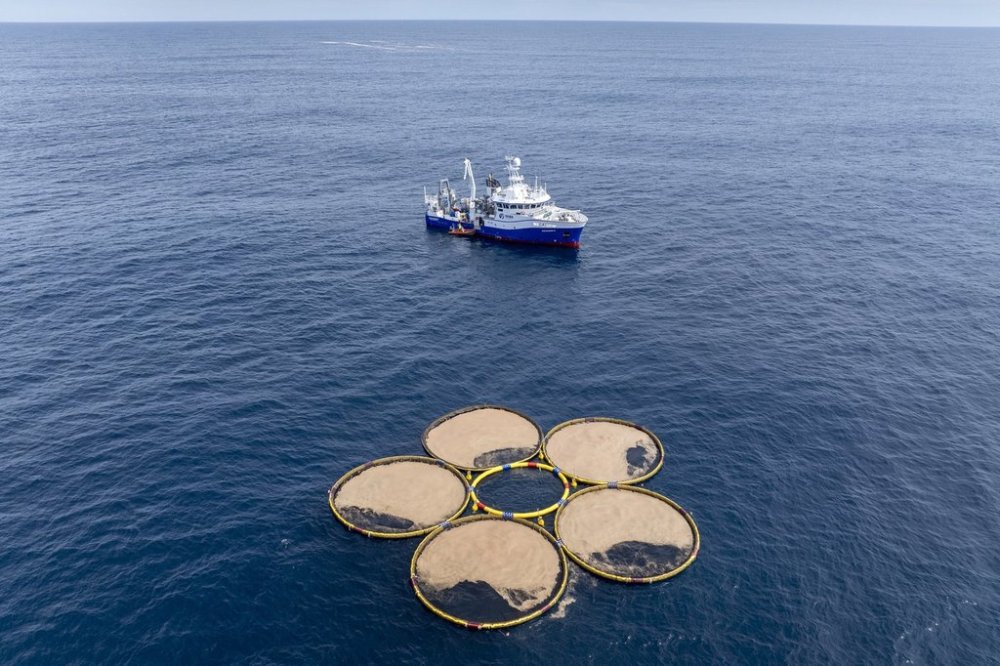
Here are takeaways from The Associated Press’ report on companies seeking to harness the world’s oceans to capture carbon.
What’s the problem?
Most climate models show that cutting emissions won’t be enough to curb global warming. The world needs to remove heat-trapping gases, too.
Money has poured into different strategies on land — among them, pumping carbon dioxide from the air, developing sites to store carbon underground and replanting forests, which naturally store CO2. But many of those projects are limited by space and could impact nearby communities.
How can oceans help?
The ocean already regulates Earth’s climate by absorbing heat and carbon, and by comparison, it seems limitless.
“Is that huge surface area an option to help us deal with and mitigate the worst effects of climate change?” asked Adam Subhas, who is leading an ocean carbon project with the Woods Hole Oceanographic Institution, based on Cape Cod, Massachusetts.
How does the science work?
Most companies looking offshore for climate solutions are trying to reduce or transform the carbon dioxide stored in the ocean. If they can achieve that, said Will Burt, chief ocean scientist for the company Planetary Technologies, the oceans will act “like a vacuum” to absorb more gases from the air.
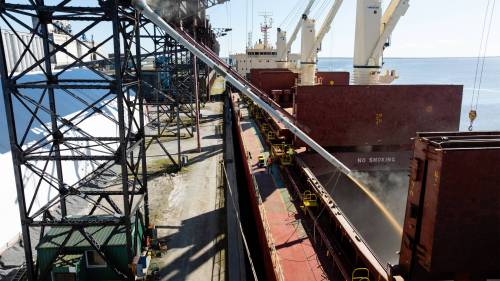
Planetary uses magnesium oxide to create that vacuum. When dissolved into seawater, it transforms carbon dioxide from a gas to stable molecules that won’t interact with the atmosphere for thousands of years. Limestone, olivine and other alkaline rocks have the same effect.
Other companies are focused on growing seaweed and algae. These marine organisms act like plants on land, absorbing carbon dioxide from the ocean just as trees do from the air.
Still others view the deepest parts of the ocean as a place to store organic material that would emit greenhouse gases if left on land.
How are the efforts being financed?
Most of the ocean startups are selling carbon credits — or tokens representing one metric ton of carbon dioxide removed from the air. Largely unregulated and widely debated, carbon credits have become popular this century as a way for companies to purchase offsets rather than reduce emissions themselves.
The industry sold more than 340,000 marine carbon credits last year, up from 2,000 credits four years ago, according to the tracking site CDR.fyi. But that amount of carbon removal is a tiny fraction of what scientists say will be required to keep the planet livable for centuries to come.
How have people reacted to the efforts?
Coastal communities aren’t always quick to jump on board.
In North Carolina, a request to dump shiploads of olivine near the beachside town of Duck received questions that downsized the project by more than half.
Fishing communities have opposed another project led by Subhas of the Woods Hole research center.
Sara Nawaz, research director at American University’s Institute for Responsible Carbon Removal, said she understood why scientists sometimes struggle to connect with communities and gain their support. Early research shows the public is reluctant to the idea of “engineering” the climate.
What are other challenges?
The ocean is a dynamic, challenging landscape to work in. Scientists are still uncovering new details about how it absorbs and recycles carbon, and any materials they add to seawater are liable to sink, become diluted or wash away to other locations, challenging efforts to track how the ocean responds.
“We can’t measure everywhere all the time,” said Katja Fennel, chair of the oceanography department at Dalhousie University, where she works on modeling how much carbon Planetary has captured at their project in Halifax Harbour.
Questions also linger about how long the carbon capture will last. It’s a point especially important to companies working with algae, wood chips, or other organic materials, because depending on where they decompose, they could release carbon dioxide back into the atmosphere.
Even if these solutions do work long term, most companies are operating on too small of a scale to influence the climate. Expanding to meet current climate goals will take massive amounts of resources, energy and money.
“The question is, what happens when you scale it up to billions of tons every year?” said David Ho, an oceanography professor at the University of Hawaii at Manoa and co-founder and chief science officer of the nonprofit (C)Worthy, which works on verifying the impact of ocean-based carbon removal.
Planetary’s Burt imagines a future in which minerals are pumped out through power plants and water treatment facilities on every major coastline in the world. But that would require a large, steady volume of magnesium oxide or similar minerals, along with the energy to mine and transport them.
Seaweed and algae growth would need to expand exponentially. The National Academies of Sciences, Engineering, and Medicine has estimated that nearly two-thirds of the world’s coastline would need to be encircled by kelp to even begin to make a dent in global warming. The company Seafields, which is running tests in the Caribbean, says it envisions building a Sargassum farm between Brazil and West Africa more than 200 miles wide.
There’s the risk that these expansions exacerbate environmental harm that isn’t detectable in small trials, and because of global water circulation, could be felt around the world.
But the alternative to never trying, Ho said, is unabated climate change.
—
This story was supported by funding from the Walton Family Foundation. The AP is solely responsible for all content.
__
Contact AP’s global investigative team at Investigative@ap.org or https://www.ap.org/tips/