Carney promises to revamp defence procurement, boost domestic research
Advertisement
Read this article for free:
or
Already have an account? Log in here »
To continue reading, please subscribe:

Digital Subscription
One year of digital access for only $205*
- Enjoy unlimited reading on winnipegfreepress.com
- Read the E-Edition, our digital replica newspaper
- Access News Break, our award-winning app
- Play interactive puzzles
*First annual payment billed as $205.00 + GST for one year. This annual subscription will automatically renew at $233.00 + GST every 52 weeks (10% off the regular annual price of $259.35). Offer available to new and qualified returning subscribers only. Cancel any time.
To continue reading, please subscribe:
Add Free Press access to your Brandon Sun subscription for only an additional
$1 for the first 4 weeks*
- Enjoy unlimited reading on winnipegfreepress.com
- Read the E-Edition, our digital replica newspaper
- Access News Break, our award-winning app
- Play interactive puzzles
*Your next Brandon Sun subscription payment will increase by $1.00 and you will be charged $17.95 plus GST for four weeks. After four weeks, your payment will increase to $24.95 plus GST every four weeks.
Read unlimited articles for free today:
or
Already have an account? Log in here »
Hey there, time traveller!
This article was published 14/04/2025 (532 days ago), so information in it may no longer be current.
DORVAL – Liberal Leader Mark Carney is promising his government would change the way the government purchases military equipment and build up domestic research on advanced military technology.
During a campaign stop Monday at Bombardier’s aerospace division headquarters in Dorval, Que., Carney said he would create a separate defence procurement agency tasked solely with streamlining military purchases that tend to get tangled in red tape.
He said the measures would be implemented in response to growing tensions with the United States.

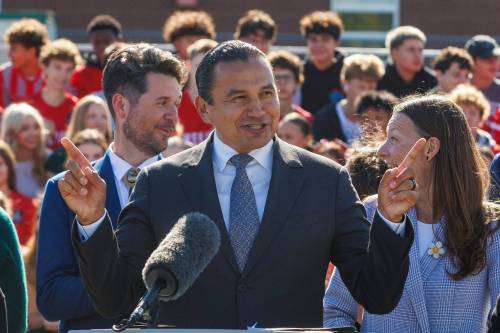
Liberal Leader Mark Carney makes a campaign stop in Hamilton, Ont., on Thursday, April 10, 2025. THE CANADIAN PRESS/Sean Kilpatrick
“These are challenging times. Our world is changing,” Carney said. “The threats to our sovereignty are multiple and in response, we have to give our armed forces the new resources that they need to defend our sovereignty with a made-in-Canada defence procurement approach that will help our defence businesses to grow here at home.”
Carney said he’s sure that his government’s plans would “broadly speaking” push Canada’s defence spending above the NATO membership target of two per cent of GDP within a few years. He said more details about the cost of the Liberal platform will be shared in the coming days.
The federal government has long been criticized for running a costly and slow military procurement system. Carney acknowledged Monday that Canada’s military has been underfunded and is “overly reliant” on the U.S.
Carney’s pledge to overhaul defence procurement with modernized rules and a new procurement agency may sound familiar to voters.
In 2019, the Liberals promised to establish an agency to be called Defence Procurement Canada. Then-defence minister Harjit Sajjan’s mandate letter in 2019 instructed him to “bring forward analyses and options” for the creation of such an agency but it never materialized.
Critics in the Canadian Armed Forces and outside the military have for years called on Ottawa to reform a procurement process infamous for delays and cost overruns.
The Harper government introduced a defence procurement strategy in 2014 to tackle some of the issues that arise from having multiple departments involved in procurement. The Trudeau government also promised to speed up procurement through its defence policy in 2017.
Carney is now pledging to make legislative changes as needed to “centralize expertise from across government and streamline the way we buy equipment for the military.”
Last month, Carney asked for a review of Canada’s plan to purchase a fleet of F-35 fighter jets in response to tensions with the United States. The deal with Lockheed Martin and the U.S. government is for 88 planes at a cost of about US$85 million each.
Bombardier has raised concerns about Carney’s decision to review the contract, warning of potential retaliation.
Mark Masluch, senior communications director for Bombardier, said the company plans to work collaboratively on defence efforts with the next federal government.
Carney also said Monday that he would create a new defence research bureau for domestic AI, quantum computing and cybersecurity technology.
“Today, defence is not only about manpower. It’s about brain power,” he said.
Carney said his plan would “build the tools needed” to ensure Canada’s sovereignty.
“We won’t only bring the Canadian Armed Forces up to today’s standards. We will also build a military that is ready to fight threats that Canada is facing, and we will protect Canadians now and into the future,” Carney said, adding that his approach also would help Canadian industries and businesses reach new markets around the world.
Carney’s new promises build on last month’s announcement that he would modernize the recruitment process for the Canadian Armed Forces and address a shortage of CAF members.
He said he would do that by increasing salaries an unspecified amount, building more on-base housing and improving health and child-care services.
James Bezan, the Conservative candidate for Selkirk-Interlake-Eastman, said in a news release that Carney’s defence procurement announcement is “just another hollow promise that seeks to once again fix all of the problems caused by Liberals’ bureaucracy and red tape.”
Christyn Cianfarani, president and CEO of the Canadian Association of Defence and Security Industries, said in an email that Carney is “saying a lot of the right things.”
She said favouring Canadian companies in procurement, building up Canada’s defence industrial base and supporting defence exports are all strategies the industry has called for repeatedly.
While the idea of a centralized procurement agency has been floated before, she said, “no previous government has been able to make it work.”
“The changes needed to the current machinery of government would be huge, and the growing pains during that transition could actually slow down procurement at a time when Canada needs to speed it up,” Cianfarani said.
Cianfarani added that getting Canadian firms integrated into European defence plans will take “sustained and high-level defence trade promotion.”
“We look forward to seeing the spending profile that would make it all happen,” she said.
Finance Minister François-Philippe Champagne, who attended Carney’s press conference, said Canada can offer technology, innovation and industrial capacity to European allies.
“Today, money doesn’t buy as much as you would think because the problem is industrial capacity,” he said. “We’re in a very strong position as part of this new investment.”
Carney’s swing through Quebec came just ahead of the French leaders’ debate on Wednesday.

In an interview with the popular Sunday night Radio-Canada show “Tout le monde en parle,” Carney said he is more focused on building up the country’s economy than his predecessor, former prime minister Justin Trudeau.
Carney said Monday he stands by his comments, noting that the pace of government spending — particularly operational expenditures — rose by about nine per cent a year under Trudeau.
“We are focused on a government that spends less so that Canada can invest more,” he said, adding that his government would provide greater support for industry, business investment and housing. “We’re also going to have the better tax system, better regulation, all those other factors.”
This report by The Canadian Press was first published April 14, 2025.
— With files from Kyle Duggan in Ottawa
Related Articles
Liberals win 4th mandate as NDP vote collapses and Singh announces he will resign












Advertisement Advertise With Us
Advertisement Advertise With Us