Proposed rule change on endangered species triggers alarm for environmentalists

Advertisement

Advertise with us

The Trump administration plans to eliminate habitat protections for endangered and threatened species in a move environmentalists say would lead to the extinction of critically endangered species because of logging, mining, development and other activities.

Read this article for free:


or

Already have an account? Log in here »

To continue reading, please subscribe:

Subscribe and receive a limited-edition Free Press branded hat or tote.

Digital Subscription

One year of digital access for only $205*

  • Enjoy unlimited reading on winnipegfreepress.com
  • Read the E-Edition, our digital replica newspaper
  • Access News Break, our award-winning app
  • Play interactive puzzles

*First annual payment billed as $205.00 + GST for one year. This annual subscription will automatically renew at $233.00 + GST every 52 weeks (10% off the regular annual price of $259.35). Offer available to new and qualified returning subscribers only. Cancel any time.

To continue reading, please subscribe:

Add Free Press access to your Brandon Sun subscription for only an additional

$1 for the first 4 weeks*

  • Enjoy unlimited reading on winnipegfreepress.com
  • Read the E-Edition, our digital replica newspaper
  • Access News Break, our award-winning app
  • Play interactive puzzles
Start now

*Your next Brandon Sun subscription payment will increase by $1.00 and you will be charged $17.95 plus GST for four weeks. After four weeks, your payment will increase to $24.95 plus GST every four weeks.

Hey there, time traveller!
This article was published 16/04/2025 (517 days ago), so information in it may no longer be current.

The Trump administration plans to eliminate habitat protections for endangered and threatened species in a move environmentalists say would lead to the extinction of critically endangered species because of logging, mining, development and other activities.

At issue is a long-standing definition of “harm” in the Endangered Species Act, which has included altering or destroying the places those species live. Habitat destruction is the biggest cause of extinction, said Noah Greenwald, endangered species director at the Center for Biological Diversity.

The U.S. Fish and Wildlife Service and National Marine Fisheries Service said in a proposed rule issued Wednesday that habitat modification should not be considered harm because it is not the same as intentionally targeting a species, called “take.” Environmentalists argue that the definition of “take,” though, has always included actions that harm species, and the definition of “harm” has been upheld by the U.S. Supreme Court.
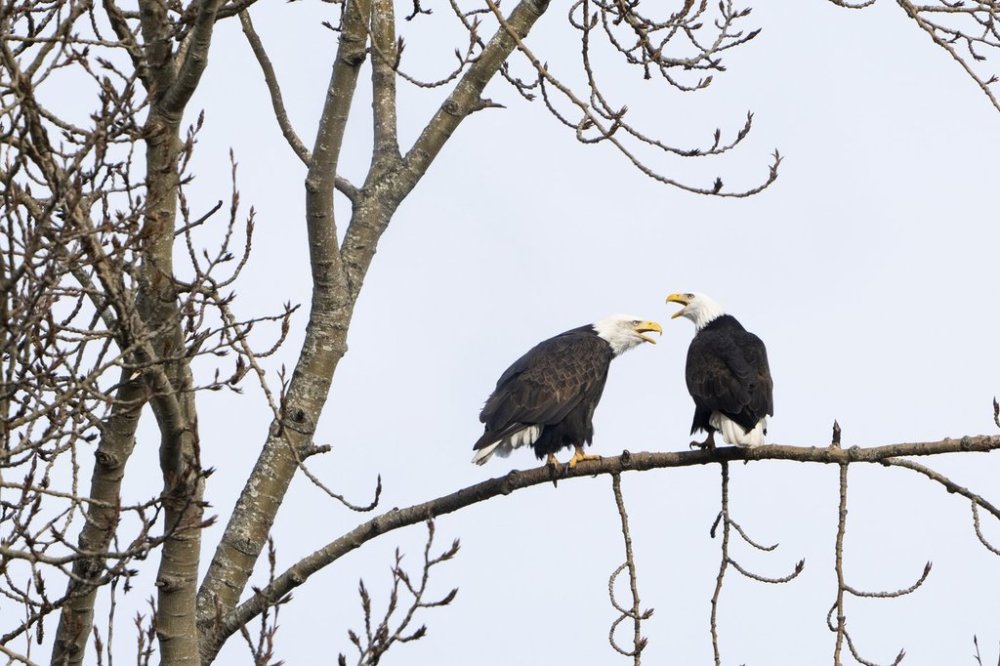
FILE - A pair of bald eagles call out while resting on a tree next to Union Bay, Jan. 16, 2024, in Seattle. (AP Photo/Lindsey Wasson, File)

The proposed rule “cuts the heart out of the Endangered Species Act,” Greenwald said. “If (you) say harm doesn’t mean significant habitat degradation or modification, then it really leaves endangered species out in the cold.”

For example, he said spotted owls and Florida panthers both are protected because the current rule forbids habitat destruction. But if the new rule is adopted, someone who logs in a forest or builds a development would be unimpeded as long as they could say they didn’t intend to harm an endangered species, he said.

The proposed rule was expected to be published in the Federal Register on Thursday, kicking off a 30-day public comment period.

A U.S. Fish and Wildlife Service spokeswoman referred The Associated Press to the Department of Interior, which declined to comment.

Environmental groups will challenge the rule in court if it is adopted, said Drew Caputo, an attorney at Earthjustice.

He said the proposal “threatens a half-century of progress in protecting and restoring endangered species,” including bald eagles, gray wolves, Florida manatees and humpback whales. He said that is because the current rule “recognizes the common-sense concept that destroying a forest, beach, river, or wetland that a species relies on for survival constitutes harm to that species.”

The question is whether the Trump administration is entitled to repeal a rule that was upheld specifically by the Supreme Court and therefore subject to precedent, said Patrick Parenteau, an emeritus professor at the Vermont Law and Graduate School who has handled endangered species cases.

Because of the current definition of harm, “many, many millions of acres of land has been conserved” to help keep species alive, he said.

The issue is of particular concern in Hawaii. The islands have more endangered species than any other state — 40% of the nation’s federally listed threatened and endangered species — even though Hawaii has less than 1% of the land area, according to the National Fish and Wildlife Foundation.

Maxx Philipps, Hawaii and Pacific Islands director for the Center for Biological Diversity, said removing these safeguards will accelerate Hawaii’s extinction crisis and erode the biological and cultural heritage of the islands.

She pointed to the example of tiny native bees that forage on and pollinate coastal dune plants. Very little oceanfront property remains undeveloped and what is left tends to be fragmented pockets. Other listed species living on the shoreline — like green sea turtles –- could also lose their homes if protections are removed.

“Habitat is life, right?” she said. “And without it, there is no recovery and without recovery, there is only extinction.”

___

Associated Press writer Audrey McAvoy in Hawaii contributed to this report.

___

The Associated Press’ climate and environmental coverage receives financial support from multiple private foundations. AP is solely responsible for all content. Find AP’s standards for working with philanthropies, a list of supporters and funded coverage areas at AP.org.

Report Error Submit a Tip

More Stories

Winnipeg venues saying no to AI-made advertisements

Sheldon Birnie 8 minute read Preview

Winnipeg venues saying no to AI-made advertisements

Sheldon Birnie 8 minute read Updated: Yesterday at 10:22 AM CDT

Although the days when telephone poles and notice boards across the city were thick with gig posters, either slopped up with wheat paste or wrapped tight with packing tape, are behind us, the art of making an appealing visual ad for live music events is still a vital part of the local creative scene.

However, a widespread backlash against a new kind of slop — the use of generative AI images — has been building, especially among creatives when it comes to promoting live music.

“Live music is and always has been a DIY type of scene, especially locally,” says Evan Simpson, who has been working as a graphic designer for nearly a decade.

“For years people have been making their own flyers, or if they have the budget, hiring a designer or artist to come up with some artwork for their flyers. It’s a whole ecosystem, a scene supporting itself. If you take away the visual side of it, the spark, individuality and uniqueness of each gig poster is lost. What a sad world it would be if all art were made by AI.”

Read
Updated: Yesterday at 10:22 AM CDT

Proposed rule change on endangered species triggers alarm for environmentalists

Tammy Webber, The Associated Press 4 minute read Preview

Proposed rule change on endangered species triggers alarm for environmentalists

Tammy Webber, The Associated Press 4 minute read Wednesday, Apr. 16, 2025

The Trump administration plans to eliminate habitat protections for endangered and threatened species in a move environmentalists say would lead to the extinction of critically endangered species because of logging, mining, development and other activities.

At issue is a long-standing definition of “harm” in the Endangered Species Act, which has included altering or destroying the places those species live. Habitat destruction is the biggest cause of extinction, said Noah Greenwald, endangered species director at the Center for Biological Diversity.

The U.S. Fish and Wildlife Service and National Marine Fisheries Service said in a proposed rule issued Wednesday that habitat modification should not be considered harm because it is not the same as intentionally targeting a species, called “take.” Environmentalists argue that the definition of “take,” though, has always included actions that harm species, and the definition of “harm” has been upheld by the U.S. Supreme Court.

The proposed rule “cuts the heart out of the Endangered Species Act,” Greenwald said. “If (you) say harm doesn’t mean significant habitat degradation or modification, then it really leaves endangered species out in the cold.”

Read
Wednesday, Apr. 16, 2025

Rogers, Telus deny blame for June twister alert barrage

Malak Abas 3 minute read Preview

Rogers, Telus deny blame for June twister alert barrage

Malak Abas 3 minute read Updated: 7:21 AM CDT

Telecom companies say they aren’t to blame for the barrage of tornado alerts Manitobans received during severe thunderstorms in early June.

The Canadian Radio-television and Telecommunications Commission announced in August it would investigate the unusually high number of alerts, and called on the Pelmorex Corp., which operates the national Alert Ready system, along with telecom companies Bell, Rogers and Telus to respond to a number of questions.

They were given until last Friday to describe their possible roles in the creation, receipt, processing or distribution of alerts issued from Environment and Climate Change Canada in the midst of the June 9 storm.

Telus said in its response that it received 133 alert requests targeted to Manitoba created by Environment Canada and forwarded by Pelmorex between 2:35 p.m. June 9 and 3:29 a.m. the following day. While the majority of those messages contained identical information and were automatically suppressed, 17 were ultimately sent out as alerts in Winnipeg.

Read
Updated: 7:21 AM CDT

MMF walks away from bid to buy Fort Garry Hotel

Carol Sanders 3 minute read Preview

MMF walks away from bid to buy Fort Garry Hotel

Carol Sanders 3 minute read Yesterday at 3:03 PM CDT

The Manitoba Métis Federation won’t buy the historic Fort Garry Hotel, President David Chartrand said Monday.

Read
Yesterday at 3:03 PM CDT

Police cracking down on gangs, organized crime in bars and lounges

Nicole Buffie 2 minute read Preview

Police cracking down on gangs, organized crime in bars and lounges

Nicole Buffie 2 minute read 12:16 PM CDT

Patrons can expect to see more police officers in and around bars and lounges in the coming months as the Winnipeg Police Service plans to crack down on gangs and organized crime.

Uniformed officers will be patrolling bars, lounges and other licensed establishments, targeting gang members and people associated with organized crime. Priority will be given to those who pose the greatest risk to public safety, WPS said in a news release Tuesday.

Under provincial liquor legislation, officers have the authority to remove people whose “presence creates a risk of violence or an increased possibility of violent conduct by or against that individual.”

Police will be working with bar and lounge operators to help them understand the requirements under the Liquor, Gaming and Cannabis Control Act. Manitoba’s liquor regulations say licensed establishments can ban gang identifiers and may refuse entry to, or remove, those who do not comply.

Read
12:16 PM CDT

A development infused with personal memory

Brent Bellamy 6 minute read Preview

A development infused with personal memory

Brent Bellamy 6 minute read 2:00 AM CDT

I haven’t written here in a while. Early this summer, my mom was unfairly taken from us — from me. Healing, as much as it’s possible, takes time.

Read
2:00 AM CDT